


5 Micron Filter Cartridges
In industrial filtration, the 5-micron threshold represents a critical balance between fine particulate removal and system throughput. Selecting the correct 5 micron filter cartridges is not merely a matter of choosing a pore size; it requires a deep understanding of fluid dynamics, material compatibility, and the specific mechanical requirements of the application. For engineers and procurement teams, the transition from coarse filtration to 5-micron precision often marks the difference between protected downstream equipment and costly system failures.
Industrial processes rely on these components to remove contaminants that are invisible to the naked eye but large enough to cause abrasive wear in hydraulic pumps, clog precision spray nozzles, or compromise the purity of chemical batches. This guide examines the technical specifications, engineering considerations, and selection criteria essential for implementing effective filtration solutions.
The Significance of 5-Micron Filtration in Industrial Systems
A micron, or micrometer, is one-millionth of a meter. To put a 5-micron rating in perspective, a human hair is approximately 50 to 70 microns in diameter, and the lower limit of human visibility is roughly 40 microns. Therefore, 5-micron filtration is designed to capture microscopic debris, including fine silt, precipitated metallic salts, and certain types of bacteria or cysts.
In B2B environments, the use of 5 micron filter cartridges is standard for "polishing" stages. While a 50-micron pre-filter might remove large scale and sand, the 5-micron stage ensures that the fluid meets the stringent cleanliness standards required for high-performance machinery or consumer-grade products. For manufacturers like Kaifil, providing these solutions involves balancing the fine mesh or sintered structures required for this accuracy with the structural integrity needed to withstand industrial pressures.
Absolute vs. Nominal: Decoding 5 Micron Filter Ratings
One of the most common points of confusion for purchasing departments is the distinction between nominal and absolute micron ratings. This distinction significantly impacts the performance and price of Filter Cartridges.
Nominal Micron Rating
A nominal rating is an arbitrary value assigned by a manufacturer, indicating that the filter can trap a large percentage of particles of a given size. For example, a nominal 5-micron filter might capture 60% to 80% of 5-micron particles. These are typically used in non-critical applications where total removal is not required, or as a secondary pre-filtration step to extend the life of more expensive absolute filters.
Absolute Micron Rating
An absolute rating refers to the diameter of the largest hard spherical particle that will pass through the filter under specified test conditions. An absolute 5-micron filter is engineered to have a 99.9% efficiency (often expressed as a Beta Ratio of β5 = 1000). In critical industries such as pharmaceuticals or semiconductor manufacturing, only absolute-rated cartridges are acceptable to ensure process integrity.
When evaluating 5 micron filter cartridges, engineers must confirm which rating system is being used, as a nominal 5-micron filter will allow significantly more debris to pass through than an absolute-rated equivalent.
Material Engineering: Why Stainless Steel for 5 Micron Applications?
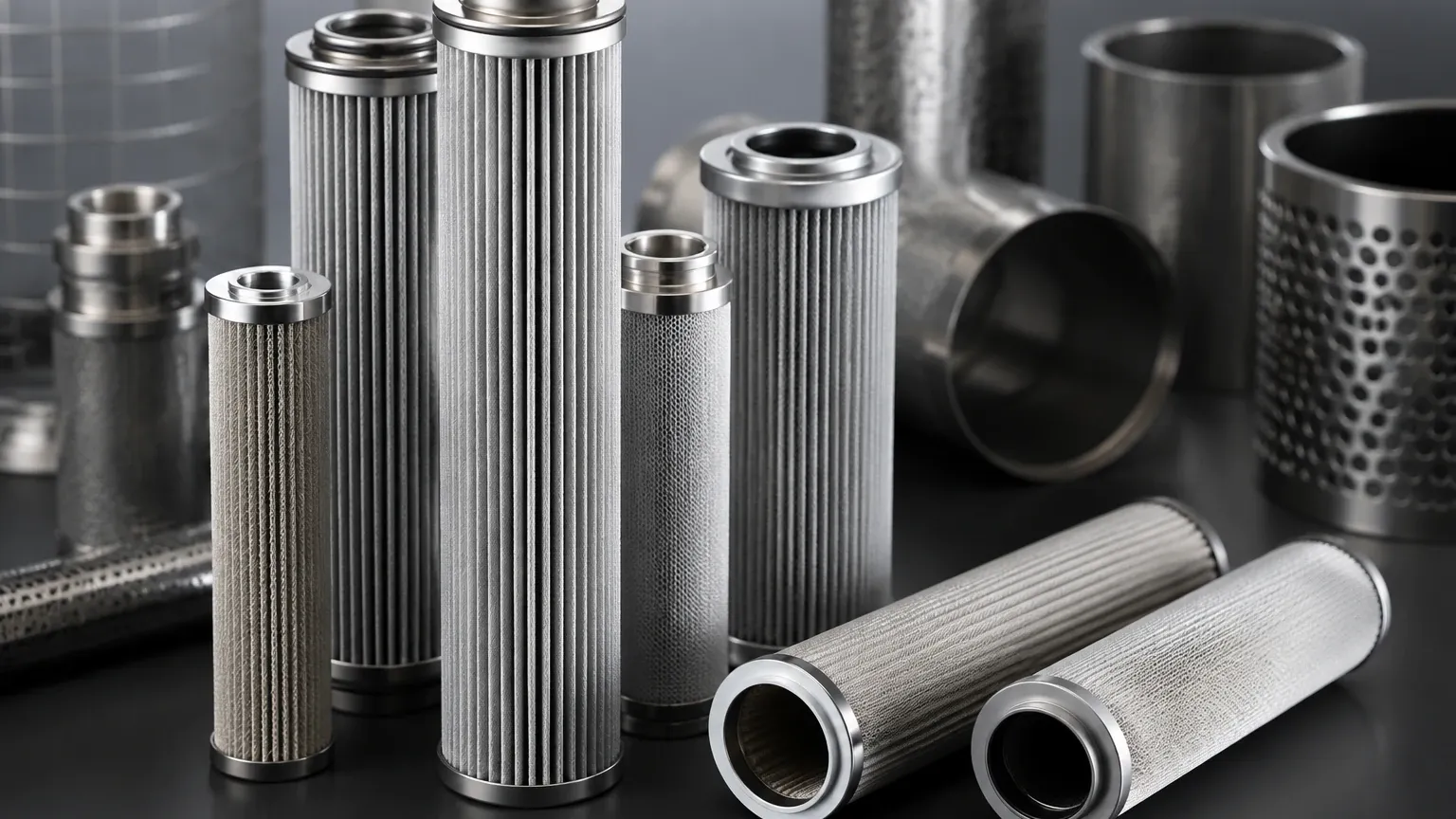
While polymer-based filters (such as polypropylene or PES) are common in water treatment, industrial applications often demand the durability of metal. Stainless steel filter cartridges, particularly those utilizing 304 or 316L alloys, offer several engineering advantages in the 5-micron range.
Temperature and Pressure Resistance
Polymer filters often lose structural integrity or experience pore migration when temperatures exceed 60°C (140°F). In contrast, stainless steel 5-micron elements can operate in environments exceeding 300°C. Furthermore, metal cartridges can withstand much higher differential pressures (ΔP) before collapsing, which is vital in high-viscosity fluid filtration or hydraulic systems.
Chemical Compatibility
In chemical processing, the fluid may be aggressive enough to dissolve or swell synthetic fibers. 316L stainless steel provides excellent resistance to a wide range of acids, alkalis, and organic solvents. This ensures that the filter media does not leach contaminants into the process stream, a critical requirement for high-purity applications.
Cleanability and Longevity
One of the primary drivers for selecting stainless steel 5 micron filter cartridges is the total cost of ownership. Unlike disposable cartridges, stainless steel mesh or sintered metal filters can be cleaned via backwashing, ultrasonic cleaning, or chemical baths. This reusability reduces waste and long-term procurement costs, especially in continuous production lines.
Performance Metrics: Flow Velocity and Pressure Differential
Integrating a 5-micron filter into an existing system requires a careful analysis of the impact on flow dynamics. As the pore size decreases, the resistance to flow naturally increases.
1. Clean Pressure Drop: This is the initial resistance the filter presents to the fluid flow. A well-designed 5-micron cartridge should provide a low clean pressure drop to maximize the available energy for the process.
2. Dirt-Holding Capacity: This refers to the amount of contaminant the cartridge can retain before the pressure drop reaches a terminal point (the point where the filter must be cleaned or replaced). Pleated designs are often used in 5-micron stainless steel filters to increase the surface area, thereby significantly extending the service life between cleaning cycles.
3. Flow Velocity: High velocity through a fine 5-micron media can lead to "particle bypass" or media deformation. Engineers must size the filter housing and the number of cartridges to ensure the velocity remains within the manufacturer’s recommended parameters for the specific fluid viscosity.
Industrial Applications of 5 Micron Filter Cartridges
The versatility of the 5-micron rating makes it a staple across various sectors. Understanding these applications helps in selecting the right configuration for the task.
Chemical and Petrochemical Processing
In these industries, 5 micron filter cartridges are used to protect catalysts and prevent the clogging of fine injection nozzles. Stainless steel is preferred here due to the presence of volatile compounds and high-temperature reactions.
Food and Beverage Production
For liquid products like bottled water, beer, or syrups, 5-micron filtration serves as a clarification stage. It removes yeast cells and fine sediment to ensure product clarity and shelf stability. In these cases, the use of food-grade 316L stainless steel is essential to meet FDA or equivalent regulatory standards.
Pharmaceutical Manufacturing
Precision is paramount in pharmaceutical secondary processing. 5-micron filters are often used as pre-filters for 0.22-micron sterilizing-grade membranes. By capturing the bulk of the particulate load at the 5-micron level, the more expensive downstream sterile filters are protected from premature fouling.
Hydraulic and Lube Oil Systems
Modern high-pressure hydraulic systems have extremely tight tolerances. Particles as small as 5 microns can cause silt silting in servo-valves, leading to erratic machine behavior or catastrophic failure. Using high-strength stainless steel wire mesh filters ensures that the oil remains within ISO 4406 cleanliness codes.
Selection Criteria and Total Cost of Ownership (TCO)
When specifying 5 micron filter cartridges, B2B buyers should look beyond the initial purchase price. The Total Cost of Ownership (TCO) is a more accurate metric for industrial efficiency. Key factors include:
* Replacement Frequency: How often does the process need to be stopped to change or clean the filter?
* Disposal Costs: Disposable filters generate hazardous waste if used with chemicals; permanent stainless steel filters eliminate this stream.
* Energy Consumption: A filter with a high pressure drop requires more pump power, increasing utility costs over time.
* Customization Options: Does the application require specific end-cap configurations (e.g., Code 7, 222, 226, or DOE)? Customization ensures a bypass-free seal within the housing.
Kaifil's engineering approach focuses on these variables, providing customized filtration solutions that align with the specific mechanical and chemical demands of the client's infrastructure.
Avoiding Common Risks in 5-Micron Filter Implementation
Failure to account for certain variables can lead to sub-optimal filtration or system damage. Engineers should be aware of the following risks:
* Media Migration: In low-quality fiber filters, the 5-micron fibers themselves can break off and enter the downstream flow. Using sintered metal or high-quality wire mesh eliminates this risk.
* Bypass Leakage: If the cartridge is not seated correctly or if the O-rings are incompatible with the fluid, contaminated fluid will bypass the 5-micron media entirely. Proper end-cap selection is vital.
* Incompatibility with Fluid Viscosity: A 5-micron filter that works perfectly for water may clog instantly with heavy oil. The filter surface area must be scaled according to the fluid's viscosity and the expected contaminant load.
* Pressure Surges: Sudden spikes in pressure can rupture delicate 5-micron membranes. Stainless steel cartridges offer the mechanical strength to withstand these transients without compromising the filtration barrier.
Conclusion: Confirming Technical Requirements
Before finalizing a purchase of 5 micron filter cartridges, technical teams should confirm the following data points with their supplier:
1. Fluid Characteristics: Temperature, pH levels, and viscosity.
2. Contaminant Profile: Type of particles (hard vs. deformable) and concentration (ppm).
3. Operational Parameters: Maximum flow rate and maximum allowable pressure drop.
4. Housing Compatibility: Length (10", 20", 30", 40") and end-cap style.
By focusing on these factual boundaries and engineering realities, organizations can ensure they implement a filtration strategy that protects their equipment and optimizes their production output. For specialized requirements, exploring custom-engineered Filter Cartridges allows for the development of solutions tailored to unique industrial challenges, ensuring durability and precise performance in the most demanding environments.
