


Atlas Filtri Filter Cartridges
In the landscape of industrial water treatment and fluid processing, selecting the appropriate filtration media is a critical engineering decision that impacts system longevity, operational efficiency, and product purity. Atlas Filtri filter cartridges represent a significant segment of the global market, offering a diverse array of standardized solutions for sediment removal, chemical treatment, and biological stabilization. For engineers and procurement professionals, understanding the technical nuances of these components—ranging from material science to structural configuration—is essential for optimizing filtration stages.
Industrial filtration often requires a balance between initial capital expenditure and long-term operational costs. While many applications rely on the versatility of synthetic media, demanding environments involving high temperatures, aggressive chemicals, or high-pressure differentials necessitate a deeper look at how these cartridges perform under stress. This guide examines the technical specifications, application logic, and selection criteria for Atlas Filtri filter cartridges while providing a comparative framework for when to transition to high-performance metal alternatives.
Technical Configurations and Housing Compatibility
One of the defining characteristics of Atlas Filtri filter cartridges is their adherence to specific structural standards designed to ensure leak-proof performance within their proprietary and universal housing systems. For an engineer, the primary consideration is the end-cap configuration, which dictates the sealing mechanism and the ease of maintenance.
SX and BX Configurations
The SX configuration is the industry-standard Double Open End (DOE) design. It relies on flat gaskets at both ends to create a seal against the housing's internal seats. This is a versatile format compatible with most standard 10-inch and 20-inch housings globally. However, for applications where bypass prevention is critical, the BX configuration offers a proprietary "Quick-Fit" solution. The BX design features a single 45mm collar with double O-rings, ensuring a more secure, centered fit that minimizes the risk of untreated fluid bypassing the filter media.
CX and Specialized Formats
Beyond the standard SX and BX, the CX configuration utilizes a double O-ring interface specifically designed for high-flow or high-pressure environments where mechanical stability is paramount. Understanding these interfaces is the first step in ensuring that a replacement cartridge will maintain the integrity of the filtration circuit.
Material Science and Filtration Media Types
The performance of a filter cartridge is fundamentally determined by its media. Atlas Filtri utilizes several distinct technologies to address different contaminant profiles.
Depth Filtration: Melt-Blown and String-Wound
Depth filtration is the primary method for handling high concentrations of suspended solids.
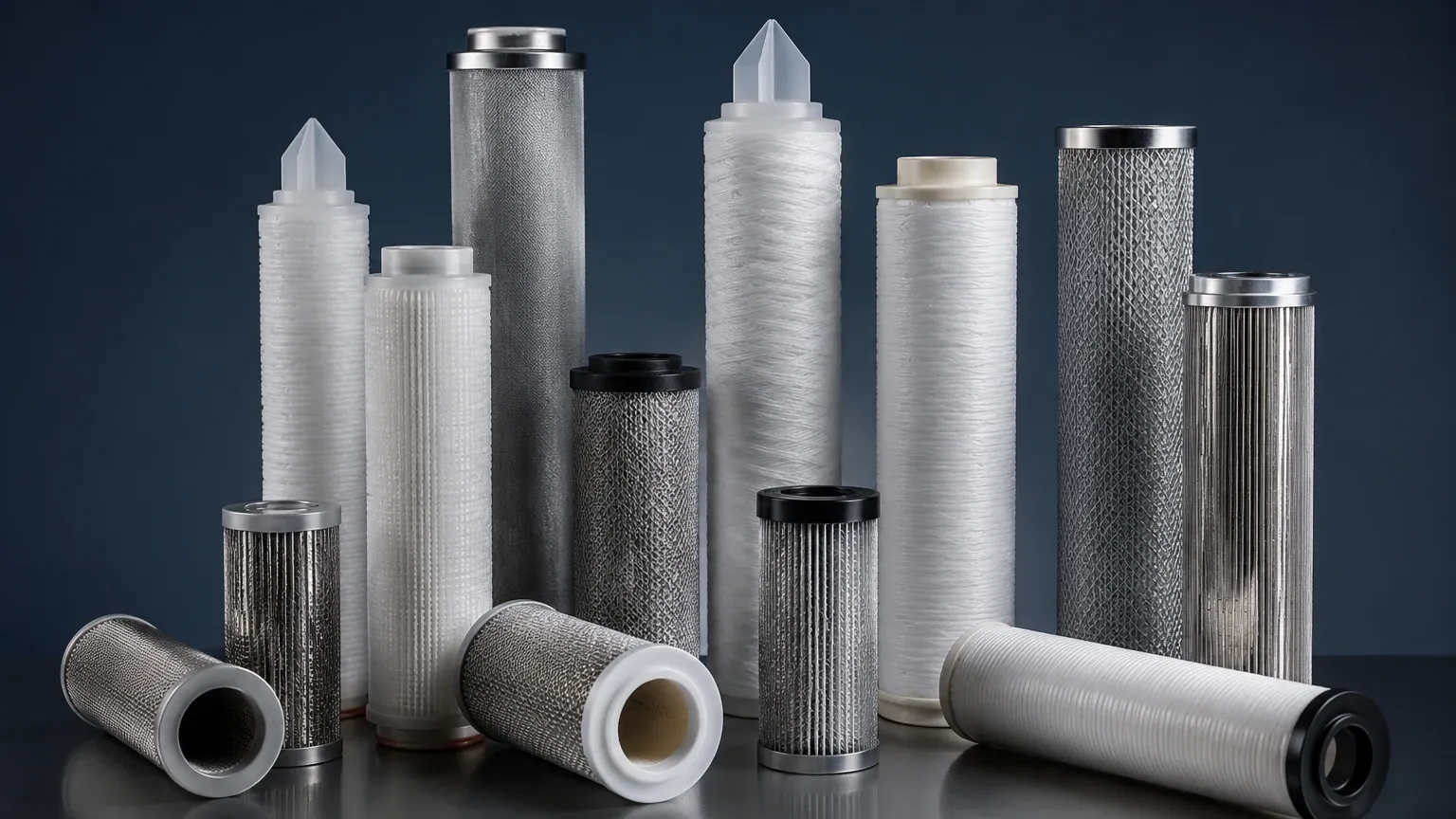
- Melt-Blown Polypropylene (DP Series): These cartridges are manufactured through a continuous extrusion process that creates a gradient density structure. The outer layers capture larger particles, while the inner core provides the final micron rating. This design allows for a high dirt-holding capacity and a low initial pressure drop.
- String-Wound (FA Series): Often considered the traditional choice, string-wound cartridges are produced by winding yarn (polypropylene, cotton, or polyester) around a central core. The winding pattern creates diamond-shaped chambers that trap particles. These are particularly effective in pre-filtration for reverse osmosis (RO) systems and general industrial water use.
Surface Filtration: Pleated and Washable Net
Surface filtration is preferred when precise micron ratings or the ability to clean and reuse the media is required.
- Pleated Media (AC and CS Series): By pleating polyester or polypropylene fabric, the surface area of the filter is vastly increased. This allows for higher flow rates compared to depth filters of the same size. Pleated cartridges are often used when low pressure loss is a priority.
- Washable Net (RL and RA Series): Constructed from polyester or stainless steel mesh, these cartridges are designed for coarse filtration (typically 50 to 200 microns). Their primary advantage is reusability; they can be cleaned and reinstalled, reducing the total cost of ownership in high-sediment applications.
Engineering Considerations: Flow Rates and Pressure Drop
When integrating Filter Cartridges into an industrial process, engineers must calculate the Clean Pressure Drop (ΔP). Every filter media introduces resistance to the flow. If the initial pressure drop is too high, the system’s pump efficiency decreases, and the effective life of the cartridge is shortened.
Factors Influencing Flow Performance
1. Viscosity of the Fluid: Most standard ratings are based on water at 20°C. If the process fluid is more viscous (e.g., oils or glycol solutions), the flow rate will decrease significantly for the same pressure differential.
2. Micron Rating: A 1-micron cartridge will naturally offer more resistance than a 50-micron cartridge. Over-specifying filtration (choosing a finer filter than necessary) leads to premature clogging and increased energy consumption.
3. Surface Area: Pleated cartridges generally provide the best flow-to-size ratio, making them ideal for compact system designs.
In industrial settings, it is standard practice to replace cartridges when the differential pressure reaches a specific threshold—typically between 1.0 and 1.5 bar—regardless of the cartridge's physical appearance. Operating beyond this limit risks "media migration" or structural collapse of the cartridge core.
Chemical Compatibility and Temperature Limits
Standard Atlas Filtri filter cartridges are primarily constructed from synthetic polymers like polypropylene and polyester. While these materials are excellent for water-based applications and many dilute chemicals, they have distinct thermal and chemical boundaries.
- Temperature Constraints: Most polypropylene cartridges are rated for a maximum operating temperature of 45°C to 60°C. In steam sterilization or high-temperature chemical processing, these materials will soften, lose structural integrity, and fail to maintain their micron rating.
- Chemical Resistance: Polypropylene offers broad resistance to acids and bases but may swell or degrade when exposed to certain hydrocarbons or organic solvents. For these demanding environments, engineers must evaluate the compatibility of both the filter media and the elastomers (O-rings/gaskets).
When a process exceeds these limits—such as in steam filtration, high-temperature oil processing, or aggressive solvent recovery—the transition to stainless steel filtration components becomes necessary. Stainless steel filters provide the mechanical strength and thermal stability that synthetic cartridges cannot match.
Maintenance, Replacement Cycles, and TCO
The Total Cost of Ownership (TCO) of a filtration system involves more than the purchase price of the cartridges. It includes the cost of downtime during change-outs, the labor required for maintenance, and the disposal costs of used media.
Disposable vs. Cleanable Media
Disposable cartridges (melt-blown, string-wound) are convenient for low-maintenance applications but generate significant waste. In high-volume industrial processes, the cumulative cost of replacements can be substantial.
Cleanable cartridges, such as the RA series (stainless steel net), offer a sustainable alternative. By implementing a regular cleaning schedule—using ultrasonic baths or backwashing—the service life of the filter can be extended from weeks to years. This is particularly relevant in heavy industrial sectors where sediment loads are consistently high.
Monitoring Performance
To maximize the value of Atlas Filtri filter cartridges, systems should be equipped with upstream and downstream pressure gauges. Monitoring the ΔP allows maintenance teams to predict replacement cycles rather than reacting to a total loss of flow. This proactive approach prevents process interruptions and ensures consistent product quality.
Selecting the Right Solution for Industrial Applications
Choosing the correct filter cartridge requires a systematic evaluation of the process requirements. Engineers should confirm the following data points before finalizing a selection:
1. Target Contaminant: Is it organic matter, sand, scale, or chemical chlorine? This determines if mechanical filtration or carbon treatment is needed.
2. Required Micron Rating: Does the application require nominal filtration (general clarity) or absolute filtration (protection of sensitive downstream components)?
3. Operating Environment: What are the maximum pressure, temperature, and chemical exposures?
4. Flow Requirements: What is the peak demand (Liters per hour), and what is the allowable pressure drop?
While Atlas Filtri provides a robust range of standardized solutions, some industrial applications fall outside the capabilities of standard plastic-based cartridges. In cases involving extreme hydraulic shock, high-viscosity fluids, or the need for repeated sterilization, custom-engineered stainless steel solutions are the preferred choice. These metal components offer the precision of wire mesh and the durability required for the most demanding industrial environments.
Conclusion
Atlas Filtri filter cartridges offer a versatile and reliable foundation for a wide range of water treatment and industrial fluid applications. By understanding the differences between depth and surface media, and by carefully matching the cartridge configuration to the housing and process requirements, engineers can achieve efficient and cost-effective filtration. However, the key to long-term success lies in recognizing the physical limits of synthetic media and knowing when to specify high-performance alternatives to ensure system reliability and performance integrity.
