


Can You Reuse Water Filter Cartridges
In industrial water treatment and process filtration, the question of whether you can reuse water filter cartridges is a critical consideration for operational efficiency and cost management. While the short answer depends heavily on the construction material and the nature of the contaminants being filtered, the engineering reality is more complex. For procurement teams and plant engineers, understanding the distinction between disposable and cleanable media is the first step in optimizing a filtration system.
In many high-volume industrial applications, the transition from disposable polymer-based media to cleanable stainless steel solutions is driven by the need for sustainability and reduced total cost of ownership (TCO). This article examines the technical boundaries of cartridge reusability, the risks associated with improper reuse, and the engineering criteria for selecting truly reusable filtration components.
The Fundamental Distinction: Disposable vs. Reusable Media
To answer the question "can you reuse water filter cartridges," one must first identify the filtration mechanism and the material of the filter media. Industrial Filter Cartridges generally fall into two categories: depth filters and surface filters.
Depth Filtration (Typically Disposable)
Depth filters, such as melt-blown polypropylene, string-wound, or resin-bonded cartridges, are designed to trap particles throughout the entire thickness of the medium. As fluid passes through the tortuous path of the fibers, contaminants become embedded deep within the structure. Because the particles are trapped internally, cleaning these cartridges is virtually impossible without damaging the integrity of the fibers. Attempting to wash or backflush a depth filter usually results in "media migration," where the filter fibers break loose and contaminate the downstream fluid, or the trapped particles are pushed further in, permanently plugging the cartridge.
Surface Filtration (Potentially Reusable)
Surface filters, including pleated wire mesh and sintered metal cartridges, capture contaminants on the outermost layer of the media. Because the particles do not penetrate deep into the structure, they can often be removed through mechanical or chemical means. Stainless steel filter cartridges are the primary example of reusable surface filtration. These components are engineered to withstand the stresses of cleaning cycles, making them a preferred choice for applications where frequent replacement of disposable cartridges is economically or logistically unfeasible.
Can You Reuse Water Filter Cartridges? Technical Risks of Improper Reuse
When operators attempt to reuse cartridges that were designed for single-use, several technical and safety risks arise. In a B2B environment, these risks can lead to significant downtime or product spoilage.
1. Bacterial Growth and Biofilms: In water filtration, organic matter trapped in a disposable cartridge serves as a breeding ground for bacteria. Even if the cartridge is rinsed, biofilms can persist within the internal matrix. Reusing such a cartridge introduces biological contaminants back into the process stream.
2. Structural Integrity Failure: Disposable cartridges are often made of polymers that degrade over time when exposed to pressure fluctuations or cleaning agents. A compromised cartridge may bypass fluid, allowing unfiltered water to reach sensitive downstream equipment like RO membranes or high-pressure pumps.
3. Increased Differential Pressure (ΔP): A "cleaned" disposable cartridge rarely returns to its original clean pressure drop. Residual contaminants remain lodged in the pores, meaning the cartridge will reach its terminal pressure drop much faster than a new one, leading to inefficient pump operation and increased energy consumption.
4. Pore Size Distortion: Mechanical scrubbing or high-pressure rinsing of polymer filters can stretch the pores, effectively changing a 5-micron filter into a 10-micron or 20-micron filter without the operator’s knowledge.
The Engineering of Cleanable Stainless Steel Cartridges
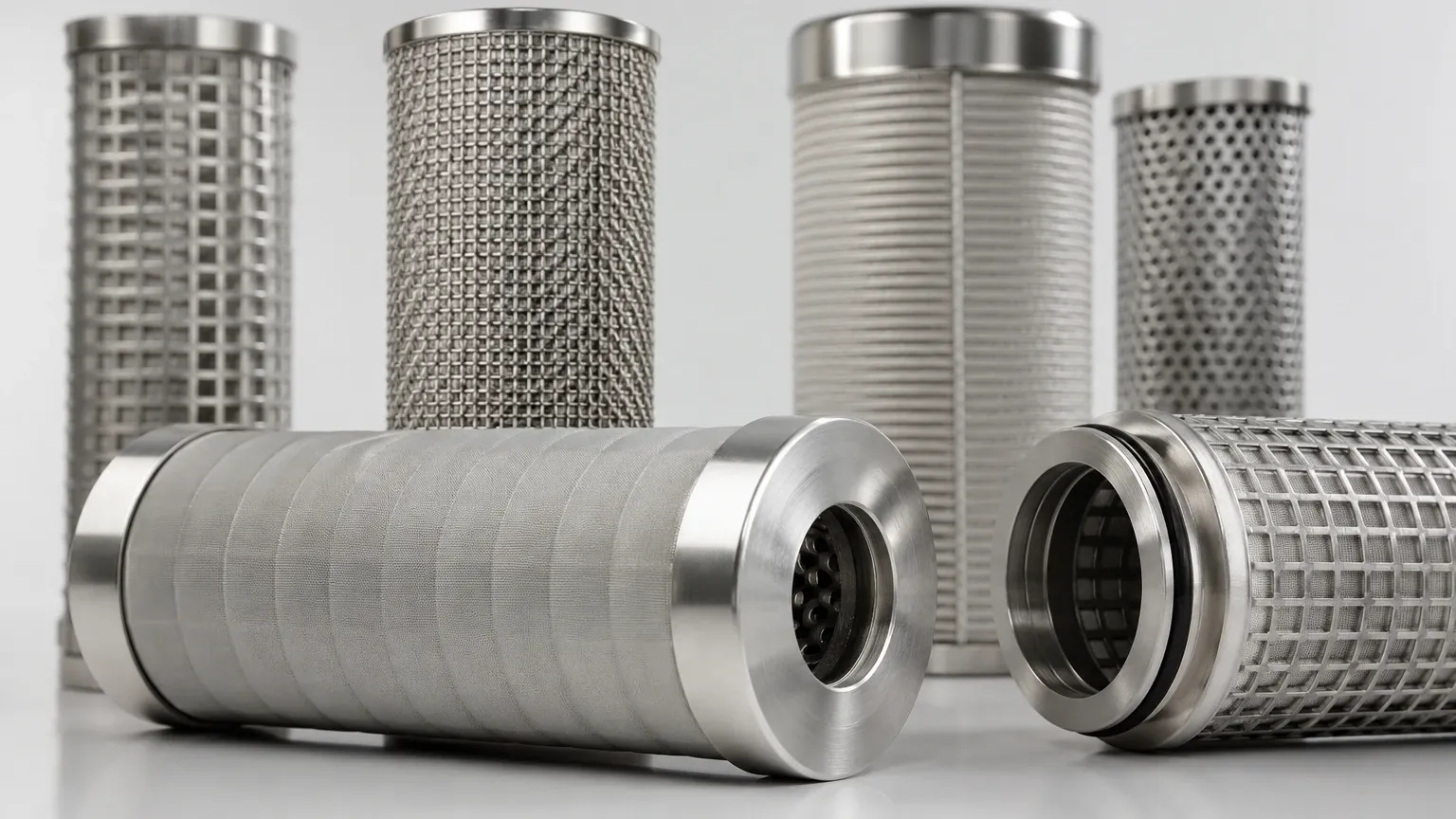
For industries asking "can you reuse water filter cartridges" with the intent of reducing waste, the solution lies in stainless steel filtration. These cartridges are specifically engineered for longevity and repeat usage. The reusability of a metal filter is determined by its construction:
* Plain Square Weave Mesh: Best for coarse filtration where easy surface cleaning is required.
* Dutch Weave Mesh: Provides higher mechanical strength and finer filtration ratings while remaining cleanable via backwashing.
* Sintered Metal Mesh: Multiple layers of wire mesh are bonded together through heat and pressure (sintering) to create a robust, fixed-pore structure. These are the gold standard for reusable industrial cartridges, as they can withstand high differential pressures and aggressive cleaning protocols.
By utilizing 304 or 316L stainless steel, these cartridges resist corrosion and high temperatures, allowing them to be sterilized or chemically cleaned multiple times without losing their filtration efficiency.
Methods for Effectively Reusing Metal Filter Cartridges
If you have invested in cleanable Filter Cartridges, the method of cleaning is just as important as the material itself. To ensure a cartridge is truly "reused" rather than just "rinsed," industrial facilities typically employ one of the following validated cleaning methods:
Ultrasonic Cleaning
This is one of the most effective methods for metal filters. Ultrasonic waves create microscopic cavitation bubbles in a cleaning solvent. When these bubbles collapse, they release energy that dislodges fine particles from deep within the mesh or sintered structure. This method is ideal for removing non-soluble particulates that backwashing cannot reach.
Chemical Cleaning (CIP – Clean-In-Place)
In food, beverage, and pharmaceutical applications, cartridges are often cleaned using caustic or acidic solutions. This process dissolves organic scaling, mineral deposits, or proteins. Because stainless steel is chemically resistant, these cartridges can endure repeated CIP cycles that would destroy a standard polymer filter.
Backpulsing and Backwashing
Automated filtration systems often use a reverse flow of clean fluid or compressed air to knock the "filter cake" off the surface of the cartridge. This is a common practice in continuous water treatment plants. While this extends the life of the cartridge significantly, a periodic deep clean (like ultrasonics) is still recommended to maintain the original flow characteristics.
Economic Evaluation: Disposable vs. Reusable Cartridges
When determining the viability of reusable cartridges, engineers must look beyond the initial purchase price. A disposable polypropylene cartridge may cost a fraction of a stainless steel version, but the total cost of ownership tells a different story.
* Replacement Costs: Frequent purchasing, shipping, and inventory management of disposable filters.
* Labor Costs: The man-hours required to shut down a system, bleed the lines, and manually replace cartridges.
* Disposal Costs: In many regions, used industrial filters are classified as regulated waste, incurring high disposal fees.
* Product Loss: Every time a filter housing is opened for a change-out, there is a potential for fluid loss and system contamination.
In contrast, a stainless steel cartridge can often last for several years if maintained correctly. For high-temperature, high-pressure, or highly corrosive environments, the question isn't just "can you reuse water filter cartridges," but rather "can you afford not to?"
When Should a Reusable Filter Finally Be Replaced?
Even the highest-quality stainless steel filters have a finite lifespan. Reusability does not mean immortality. Engineers should monitor specific indicators to determine when a reusable cartridge has reached the end of its functional life:
1. Permanent Pressure Drop: If, after a thorough ultrasonic cleaning, the clean differential pressure remains significantly higher than the original factory specifications, the media is likely permanently fouled.
2. Mechanical Damage: Inspect for signs of pleat collapse, broken wires, or corrosion pitting. Any breach in the physical structure allows bypass.
3. Bubble Point Test Failure: This is a standard integrity test used to verify the maximum pore size of a filter. If a cartridge fails a bubble point test, it means the pores have enlarged or the media has been breached, and it must be decommissioned.
Selecting the Right Cartridge for Your Application
Choosing between a disposable and a reusable system requires a thorough analysis of your process fluid. If the contaminant load is extremely high and the particles are "slimy" or gelatinous (like certain oils or biological sludges), even a stainless steel filter may blind too quickly to be practical. However, for most industrial water, chemical, and hydraulic applications, the transition to reusable Filter Cartridges offers superior reliability and long-term savings.
When sourcing these components, it is essential to work with a manufacturer that understands the nuances of wire mesh selection and sintering techniques. Customization in length, diameter, and end-cap configuration (such as DOE, 222, or 226 fittings) ensures that the reusable cartridge integrates seamlessly into existing housings without requiring expensive hardware modifications.
Conclusion
So, can you reuse water filter cartridges? In the context of standard disposable polymer filters, the answer is generally no; the risks of contamination and failure far outweigh the marginal cost savings. However, in the context of industrial-grade stainless steel filtration, reusability is a core design feature. By shifting toward cleanable metal media, facilities can achieve more consistent filtration performance, reduce their environmental footprint, and lower their overall operational expenses. Proper maintenance, validated cleaning protocols, and regular integrity testing are the keys to successfully implementing a reusable filtration strategy in any demanding industrial environment.
