


How Do You Clean Pool Filter Cartridges
Maintaining water clarity and system efficiency in any filtration setup requires a disciplined approach to component maintenance. In both commercial aquatic facilities and industrial water treatment systems, the performance of filter cartridges is the primary determinant of water quality. Understanding how do you clean pool filter cartridges is not merely a matter of routine hygiene; it is a technical requirement to manage differential pressure, ensure flow rates, and extend the service life of the filtration media.
From an engineering perspective, a filter cartridge acts as a physical barrier that captures suspended solids through mechanical straining. Over time, these particles accumulate within the pleats or on the surface of the media, leading to increased resistance. This article provides a comprehensive technical guide on the cleaning process, the chemical considerations involved, and the criteria for determining when a cartridge has reached the end of its functional life.
The Engineering Principles of Cartridge Filtration Maintenance
Filter cartridges typically utilize pleated media to maximize surface area within a compact footprint. This design allows for high dirt-holding capacity while maintaining a manageable pressure drop. However, as the media traps debris—ranging from organic matter and oils to mineral scales—the effective open area of the filter decreases.
In industrial and commercial applications, the cleaning cycle is governed by the "clean start" pressure. When a system is first commissioned with new Filter Cartridges, the pressure gauge provides a baseline reading. As the filter loads with contaminants, the internal pressure rises. Cleaning is generally required when the pressure increases by 8 to 10 PSI (pounds per square inch) over the initial baseline. Neglecting this threshold forces the pump to work harder, increasing energy consumption and potentially causing the bypass of unfiltered water or structural failure of the cartridge core.
Monitoring Performance: When to Initiate the Cleaning Process
Before addressing the question of how do you clean pool filter cartridges, operators must identify the indicators of fouling. While pressure gauges are the most reliable metric, other signs include:
1. Reduced Flow Velocity: A noticeable drop in the volume of water returning to the pool or process tank suggests the media is saturated.
2. Water Turbidity: If the filtration system fails to clear the water within a standard turnover cycle, the media may be blinded by fine particulates or oils.
3. Shortened Cycles: If the time between required cleanings is rapidly decreasing, it indicates that either the cleaning method is insufficient or the media is reaching permanent fouling.
For technical professionals managing large-scale systems, logging these intervals is essential for calculating the total cost of ownership and determining if a transition to more durable materials, such as stainless steel mesh, is warranted.
Step-by-Step Procedure: How Do You Clean Pool Filter Cartridges Effectively
The cleaning process must be performed carefully to avoid damaging the delicate polyester or synthetic fibers common in standard pool filters. Following a standardized protocol ensures consistency and protects the structural integrity of the unit.
System Shutdown and Depressurization
Safety is paramount when dealing with pressurized vessels. Turn off the circulation pump and any automated controllers. Open the air release valve on top of the filter tank to bleed off internal pressure. Failure to depressurize the system can lead to equipment damage or injury when attempting to open the filter canister.
Removal and Initial Inspection
Open the tank lid and carefully remove the cartridges. At this stage, perform a visual inspection. Look for signs of "bridging," where debris has completely filled the gaps between the pleats. Check the end caps for cracks and ensure the internal O-rings are intact. If the plastic support structure is warped or the fabric is frayed, cleaning will not restore performance, and the cartridge must be replaced.
Mechanical Rinsing
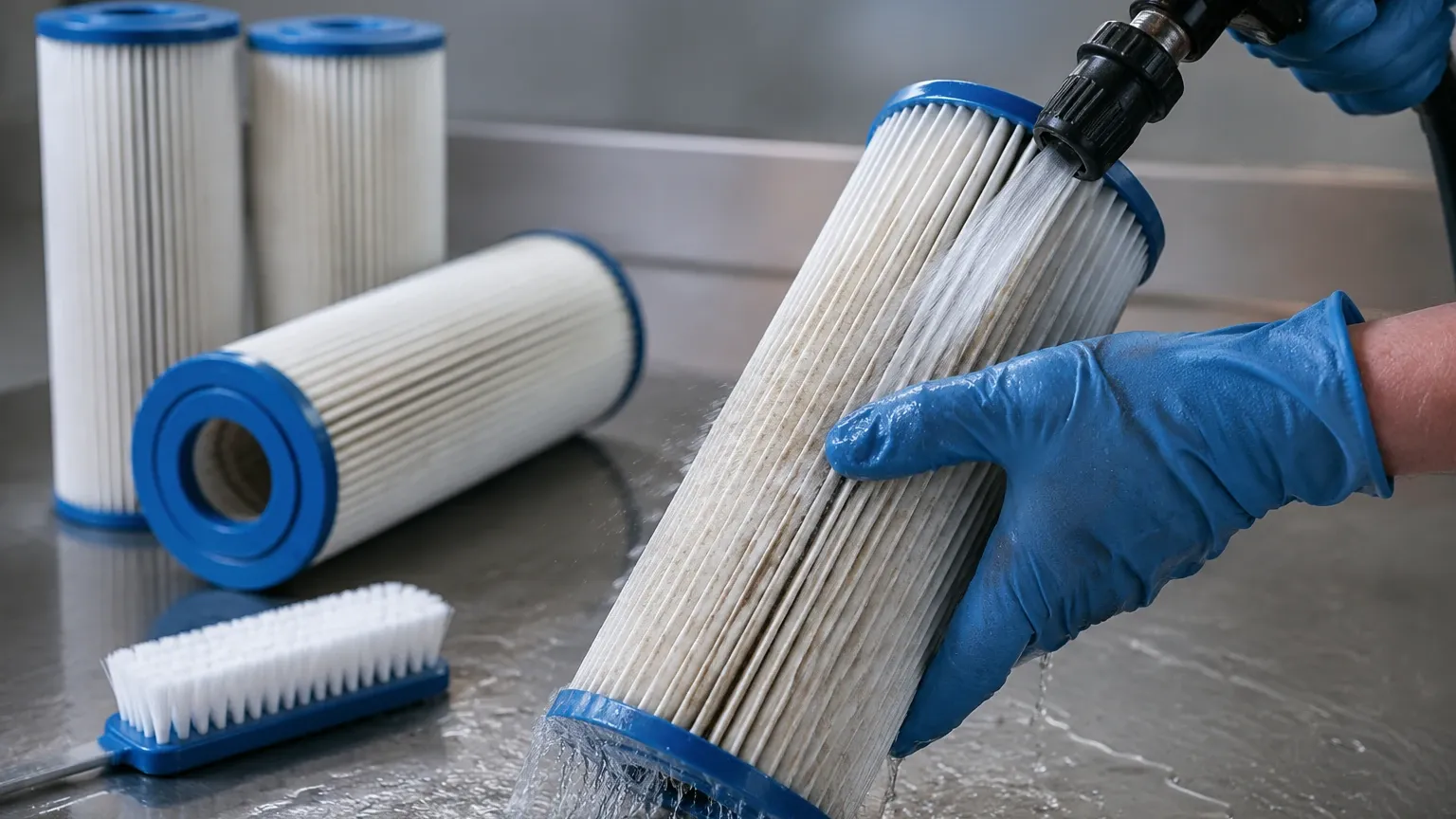
Using a standard garden hose with a spray nozzle, rinse the cartridge from top to bottom. The nozzle should be held at a 45-degree angle to the pleats. It is critical to avoid using a high-pressure power washer. High-pressure streams can tear the filter media or force dirt deeper into the fibers, effectively "locking" the contaminants in place. Work systematically around the circumference of the cartridge, ensuring the spray reaches the deepest part of the pleats where the majority of debris accumulates.
Advanced Cleaning: Degreasing and Acid Washing Protocols
Simple rinsing often fails to remove oils, lotions, and mineral deposits. When mechanical rinsing does not return the pressure gauge to near-baseline levels, chemical intervention is required.
Degreasing (Removing Oils and Organics)
Body oils, sunscreens, and organic pollutants create a sticky film on the media that repels water and traps fine dust. To remove this, the cartridge should be soaked in a specialized filter cleaner or a solution of Trisodium Phosphate (TSP).
* Method: Submerge the cartridge in a plastic container filled with the cleaning solution for 12 to 24 hours.
* Caution: Always degrease the filter *before* attempting any acid wash. If acid is applied to an oily filter, it can create a permanent, sludge-like coating that ruins the media.
Acid Washing (Removing Mineral Scale)
In regions with hard water, calcium carbonate and other minerals can crystallize on the filter media, making it stiff and brittle. An acid wash using a weak solution of muriatic acid (typically a 1:20 ratio of acid to water) can dissolve these deposits.
* Method: After degreasing and rinsing, soak the cartridge in the acid solution until the bubbling stops (usually 10-20 minutes).
* Safety: Always add acid to water, never water to acid. Wear appropriate PPE, including gloves and eye protection.
Structural Integrity and Replacement Criteria
Even with meticulous cleaning, every filter cartridge has a finite lifespan. In a commercial or high-use environment, synthetic cartridges typically last 1 to 2 years. Engineers should look for the following "end-of-life" markers:
* Permanent Pressure Elevation: If the "clean" pressure remains 5 PSI or more above the original factory baseline after a thorough chemical cleaning, the media fibers have become permanently constricted.
* Media Fraying: "Fuzzing" of the polyester fabric indicates that the fibers are breaking down, which significantly reduces filtration fineness.
* Band Failure: Most cartridges have plastic bands that maintain pleat spacing. If these bands snap, the pleats will collapse against each other, drastically reducing the effective surface area.
* End Cap Cracking: The polyurethane or plastisol end caps provide the seal. Any cracks here allow unfiltered water to bypass the media entirely.
Transitioning to Industrial Solutions: The Role of Stainless Steel Filter Cartridges
While the question of how do you clean pool filter cartridges usually pertains to synthetic media, industrial applications often require a more robust solution. For facilities dealing with high temperatures, aggressive chemicals, or high solids loading, traditional polyester cartridges may prove inefficient due to frequent replacement costs and downtime.
This is where advanced Filter Cartridges manufactured from stainless steel wire mesh or sintered metal provide a superior alternative. Unlike synthetic media, stainless steel filters offer several technical advantages:
* Backwash Capability: Many metal filters can be cleaned in-place (CIP) via backpulsing or backwashing, eliminating the need to manually remove and hose down the units.
* Ultrasonic Cleaning: For deep cleaning of fine particulates, stainless steel cartridges can withstand ultrasonic baths and high-temperature caustic cleaning that would destroy polymer filters.
* Durability: A high-quality stainless steel filter can last for years, resisting the structural collapses and media fraying common in pool-grade cartridges.
* Precision: Metal mesh allows for absolute filtration ratings, ensuring that specific particle sizes are consistently removed, which is critical for sensitive industrial processes downstream of the water treatment system.
Conclusion
Understanding how do you clean pool filter cartridges is essential for maintaining the hydraulic balance and water quality of any circulation system. By monitoring differential pressure, employing a two-stage cleaning process (degreasing followed by descaling), and recognizing the physical signs of media fatigue, operators can maximize the ROI of their filtration components.
For industrial users and engineers looking to move beyond the limitations of disposable synthetic filters, exploring professional-grade stainless steel Filter Cartridges is the next logical step. These components provide the durability and ease of maintenance required for demanding environments where system uptime and filtration precision are non-negotiable. Whether you are managing a commercial aquatic center or a complex industrial water circuit, the principles of effective cleaning and material selection remain the foundation of efficient operation.
