


Cartridge Filter in Ro
In industrial water treatment, the reverse osmosis (RO) process is a cornerstone for achieving high-purity water. However, the heart of these systems—the semi-permeable membrane—is highly susceptible to fouling and physical damage from suspended solids, colloids, and particulates. This is where the cartridge filter in ro systems plays a critical role. Positioned as a final barrier before the high-pressure pump and the RO membranes, these filters serve as the primary defense mechanism to ensure system longevity and operational efficiency.
For engineers and procurement professionals, understanding the technical nuances of Filter Cartridges is essential for optimizing the Total Cost of Ownership (TCO) of an RO plant. This article examines the engineering considerations, material selections, and performance metrics associated with cartridge filtration in the context of reverse osmosis.
The Role of Pre-filtration in Reverse Osmosis
Reverse osmosis membranes are designed to remove dissolved ions and organic molecules. They are not intended to handle suspended solids. If raw or partially treated feed water enters the RO pressure vessels containing particulates, several failure modes can occur:
1. Membrane Fouling: Particulates accumulate on the membrane surface, increasing the resistance to flow and requiring higher feed pressures to maintain permeate flux.
2. Mechanical Abrasion: Sharp or hard particles can physically score the delicate polyamide layer of the RO membrane, leading to a permanent loss of salt rejection capabilities.
3. Feed Spacer Plugging: Larger particles can become trapped in the diamond-shaped feed spacers of spiral-wound elements, causing localized pressure drops and uneven flow distribution.
By utilizing a dedicated cartridge filter in ro configurations, operators can remove these contaminants. These filters are typically "sacrificial" components, meaning they are designed to be replaced or cleaned regularly to protect the much more expensive RO membranes.
Technical Specifications: Micron Ratings and Efficiency
When selecting filter cartridges for RO pre-treatment, the micron rating is the most critical specification. In industrial applications, two types of ratings are commonly discussed:
Nominal vs. Absolute Ratings
A nominal rating indicates that the filter will retain a majority of particles of a certain size (typically 60% to 90%). An absolute rating, however, signifies that the filter has been tested to retain 99.9% or more of particles at that specific micron size. For RO protection, a 5-micron nominal filter is the industry standard for general applications, while a 1-micron absolute filter is often specified for high-fouling environments or where the Silt Density Index (SDI) must be strictly controlled.
The Importance of the Silt Density Index (SDI)
The Silt Density Index is a standardized measurement used to determine the fouling potential of feed water. Most RO membrane manufacturers require the feed water to have an SDI15 value of less than 5.0, with a preferred value below 3.0. The performance of the cartridge filter in ro systems is directly measured by its ability to reduce the SDI to these acceptable levels. If the SDI remains high after the cartridge stage, it indicates that the filtration media is either too coarse or that bypass is occurring within the filter housing.
Material Science in Cartridge Filtration
The choice of material for a cartridge filter in ro depends on the chemical composition of the feed water, the operating temperature, and the required durability. While disposable polymer filters are common, specialized industrial applications often require more robust solutions.
Polypropylene (PP) Cartridges
Polypropylene is the most common material for RO pre-filters due to its broad chemical compatibility and low cost. These are typically available as melt-blown depth filters or string-wound filters. Melt-blown filters offer a graded density structure, where larger particles are trapped on the outer layers and smaller particles are captured deeper within the media, providing a high dirt-holding capacity.
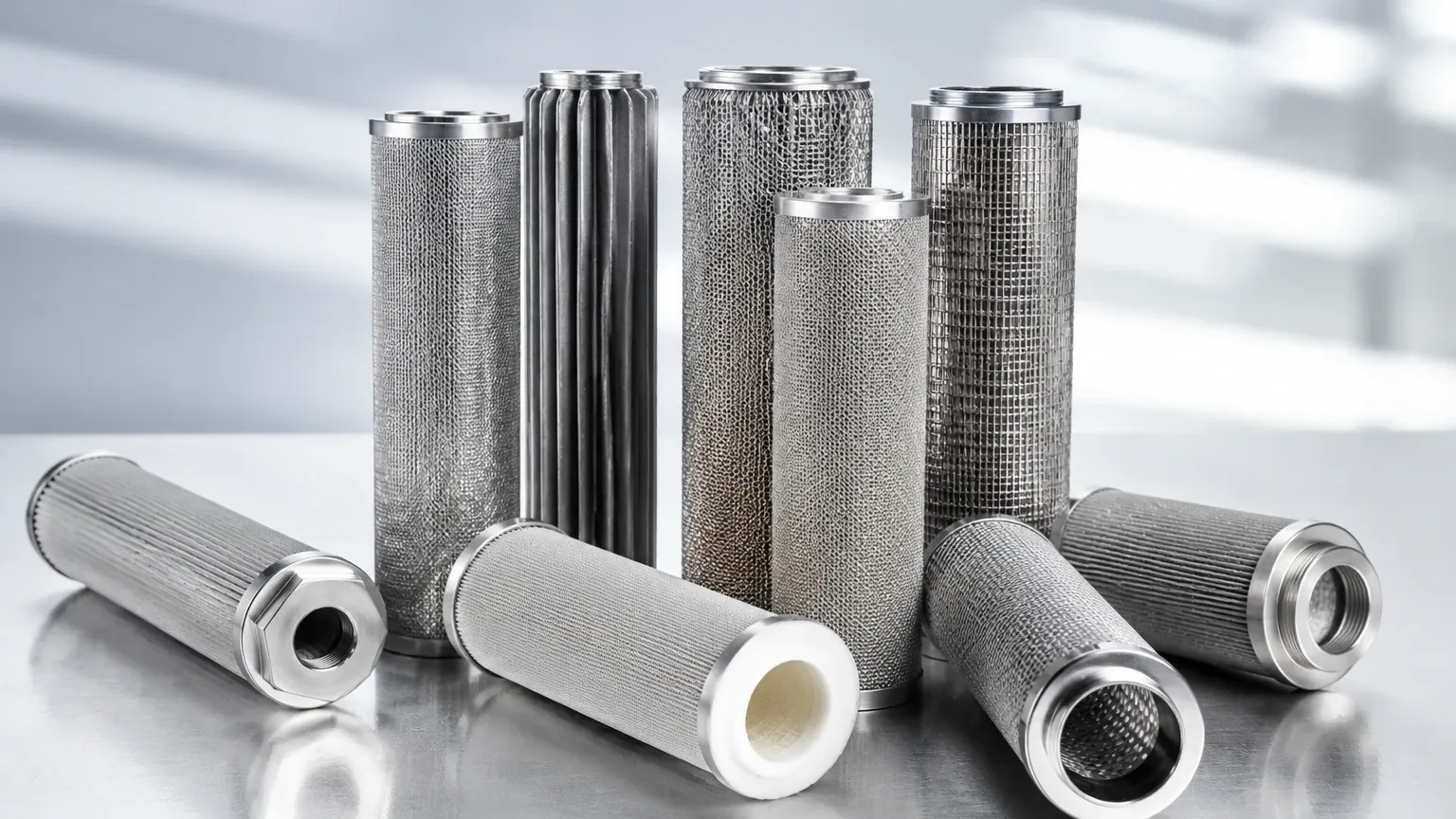
Stainless Steel Filter Cartridges
In demanding industrial environments, such as those involving high temperatures, high pressures, or aggressive chemical cleaning cycles, stainless steel filter cartridges are the preferred choice. Manufactured from 304 or 316L stainless steel, these components offer several advantages:
* Thermal Stability: Unlike polymers, stainless steel maintains structural integrity at elevated temperatures, which is vital for hot-water sanitizable systems.
* Mechanical Strength: They can withstand high differential pressures without collapsing or unloading captured contaminants.
* Cleanability: Stainless steel mesh or sintered metal cartridges can often be backwashed or ultrasonically cleaned, reducing the waste stream associated with disposable filters.
Kaifil specializes in these high-performance metal filtration solutions, providing custom-engineered stainless steel cartridges that meet the rigorous demands of industrial RO pre-treatment.
Engineering Considerations for System Integration
Integrating a cartridge filter in ro systems requires careful calculation of hydraulic parameters to prevent premature failure or system inefficiency.
Flow Velocity and Flux Rate
The flux rate (flow per unit of surface area) through the cartridge media affects both filtration efficiency and the rate of pressure drop increase. Operating at a lower flux rate generally improves the retention of fine particles and extends the life of the cartridge. Engineers must size the filter housing to accommodate enough cartridges to keep the flux within the manufacturer’s recommended limits.
Differential Pressure (Delta P)
As the filter traps contaminants, the differential pressure across the media increases. A clean cartridge filter in ro usually exhibits a pressure drop of 2 to 5 psi. Standard operating procedures typically dictate a cartridge change-out when the differential pressure reaches 15 to 25 psi. Allowing the pressure drop to exceed these limits can result in "breakthrough," where the pressure forces captured particles through the media and into the RO membranes.
Housing Design and Seal Integrity
The effectiveness of a filter cartridge is only as good as the seal within its housing. Common end-cap configurations include:
* Double Open End (DOE): Relies on compression gaskets at both ends. While common, these are more prone to bypass if the housing is not tightened correctly.
* Code 7 (226 O-ring/Fin): Features a locking tab and double O-rings to ensure a positive, leak-proof seal. This is the preferred configuration for critical RO pre-filtration to ensure no water bypasses the media.
Common Risks and Mitigation Strategies
Using an inappropriate cartridge filter in ro systems can lead to significant operational risks. Understanding these risks allows for better system design and maintenance planning.
Media Migration
In low-quality string-wound or melt-blown filters, fibers from the filter media itself can break loose and travel downstream. These fibers can clog the RO membrane feed spacers just as effectively as the silt they were meant to stop. Specifying high-quality, thermally bonded media or stainless steel mesh eliminates the risk of media migration.
Biological Growth
Because cartridge filters trap organic matter, they can become breeding grounds for bacteria. If biofouling occurs in the cartridge housing, it can lead to the seeding of the RO membranes with bacteria, resulting in rapid biofilm formation. Regular monitoring of the differential pressure and periodic sanitization of the filter housing are necessary mitigation steps.
Inadequate Pre-treatment Upstream
It is a common mistake to rely solely on the cartridge filter in ro to handle high turbidity. If the feed water has high levels of suspended solids, the cartridges will plug rapidly, leading to excessive replacement costs and system downtime. In such cases, upstream multi-media filters (MMF) or ultrafiltration (UF) should be utilized to handle the bulk solids loading, leaving the cartridge filter as a final safety polish.
Customization and OEM Solutions
For many industrial equipment manufacturers, standard off-the-shelf filters may not meet specific footprint or performance requirements. Customization of the cartridge filter in ro allows for optimized performance tailored to specific water chemistries.
Kaifil provides comprehensive OEM services, allowing for the adjustment of:
* Length and Diameter: To fit unique housing constraints.
* Micron Precision: Tailoring the weave or pore size of stainless steel media to target specific particle distributions.
* End-Cap Adapters: Ensuring compatibility with existing housing hardware across different global standards.
By working closely with a manufacturer that understands the engineering behind filtration, purchasing teams can ensure they are receiving components that are not only durable but also precisely matched to their RO system's requirements.
Conclusion: Optimizing RO Performance
The cartridge filter in ro is more than a simple consumable; it is a critical engineering component that dictates the health and efficiency of the entire reverse osmosis system. By selecting the correct micron rating, material, and seal configuration, and by adhering to strict maintenance protocols, industrial operators can significantly extend the life of their RO membranes and reduce unplanned downtime.
When evaluating filtration options, consider the long-term benefits of high-quality materials. While polymer filters offer low initial costs, stainless steel alternatives provide the durability and reliability needed for the most demanding industrial environments. For those seeking specialized solutions, exploring professional Filter Cartridges options is the first step toward a more robust and cost-effective water treatment process.
