


Filter Cartridge 4
In industrial filtration, the designation of a "filter cartridge 4" typically refers to specific dimensional standards or sizing categories, most commonly associated with 4-inch diameter housings or high-flow configurations. For engineers and procurement specialists, selecting the correct stainless steel filter cartridge requires a deep understanding of how these dimensions interact with flow dynamics, pressure constraints, and the chemical nature of the process fluid. Stainless steel cartridges, unlike their polymer counterparts, offer the structural integrity and thermal resistance necessary for demanding B2B applications in chemical processing, food and beverage production, and hydraulic systems.
When evaluating a filter cartridge 4 configuration, technical professionals must look beyond simple fitment. The transition from disposable media to permanent, cleanable stainless steel elements involves calculating the total cost of ownership (TCO) and ensuring that the micron rating and structural design align with the specific particulate load of the system. This guide explores the engineering considerations, material science, and selection criteria essential for integrating high-performance metal Filter Cartridges into industrial workflows.
Engineering Specifications of 4-Inch Diameter Filter Cartridges
The physical dimensions of a filter cartridge 4—specifically those with a 4-inch (approx. 101mm to 115mm) outer diameter—are often chosen for applications requiring higher surface area than standard 2.5-inch cartridges but without the footprint of multi-round housing arrays. At this size, the choice of construction method—pleated versus cylindrical—becomes a critical engineering decision.
Material Selection: 304 vs. 316L Stainless Steel
Most industrial metal cartridges are manufactured from either Grade 304 or Grade 316L stainless steel. While 304 is suitable for many water treatment and general industrial applications, 316L is the preferred choice for environments involving high chloride concentrations or aggressive chemicals. The "L" in 316L denotes low carbon content, which is essential for components that undergo welding during fabrication, as it prevents carbide precipitation and ensures the long-term integrity of the filter seams under high pressure.
Structural Reinforcement
Because a filter cartridge 4 has a larger surface area, it is subject to higher total force when differential pressure increases. Engineers must specify the internal support core and external cage requirements. A heavy-duty perforated core prevents the mesh or sintered media from collapsing inward under vacuum or high-viscosity flow, while an outer cage protects the delicate filtration layers during installation and cleaning cycles.
Performance Evaluation: Flow Rates and Pressure Drop
One of the primary reasons for selecting a larger filter cartridge 4 format is to manage flow velocity. In any filtration system, the relationship between flow rate and pressure drop (Delta P) determines the efficiency of the process. A larger diameter allows for more pleats or a larger circumference, which effectively reduces the "face velocity" of the fluid passing through the media.
Calculating Initial Clean Pressure Drop
For a filter cartridge 4, the initial clean pressure drop should ideally be kept below 2-3 PSI (0.14-0.21 bar). If the initial pressure drop is too high, the cartridge will reach its terminal pressure drop (the point where cleaning or replacement is required) much faster, leading to increased downtime. Engineers must account for the viscosity of the fluid; for example, a 100-centipoise hydraulic oil will exhibit a significantly higher pressure drop through a 10-micron mesh than water would at the same flow rate.
Effective Filtration Area (EFA)
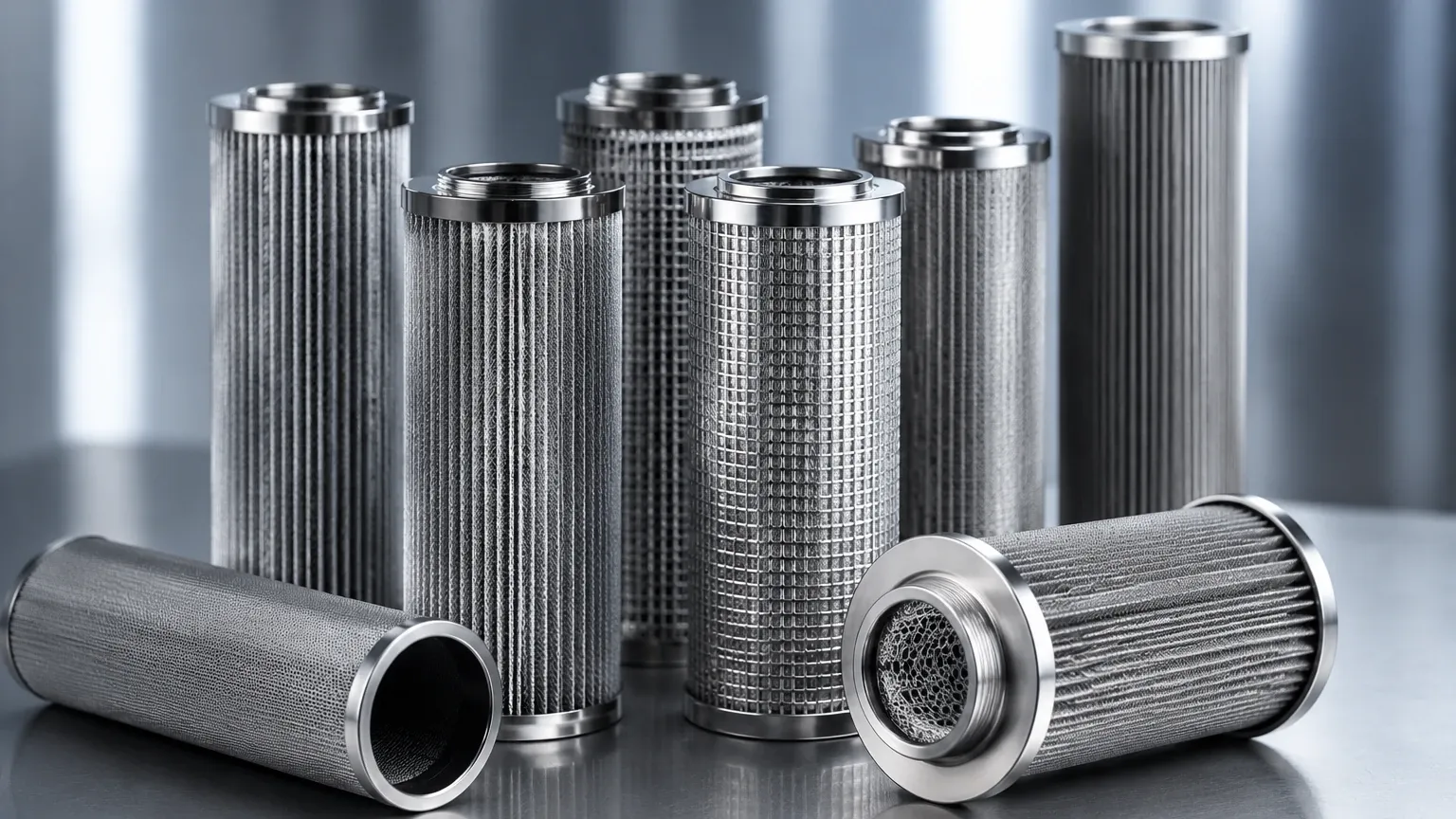
The EFA of a pleated stainless steel cartridge is significantly higher than that of a plain cylindrical wrap. By pleating the wire mesh, manufacturers can increase the surface area by a factor of 3 to 9. This increased area directly correlates to a higher dirt-holding capacity, allowing the system to run longer between maintenance intervals. For high-solids applications, the filter cartridge 4 size provides a robust balance between compact housing size and extended service life.
Chemical Compatibility and Thermal Resistance
Stainless steel Filter Cartridges are frequently utilized where synthetic fibers like polypropylene or polyester would fail. This includes high-temperature steam filtration, cryogenic applications, and the filtration of caustic solvents.
Temperature Thresholds
Standard stainless steel cartridges can typically operate in environments ranging from -269°C to over 500°C, depending on the sealing materials used. While the metal itself remains stable, the gaskets and O-rings are the limiting factors. For extreme temperatures, metal-to-metal seals or specialized graphite gaskets are required. In standard industrial settings, Viton (FKM) or EPDM are common for temperatures up to 200°C, while PTFE is used for its near-universal chemical resistance.
Corrosion Resistance in Specific Media
In the pharmaceutical and food industries, the resistance to Clean-in-Place (CIP) chemicals is paramount. A filter cartridge 4 made of 316L stainless steel can withstand repeated exposure to nitric acid, phosphoric acid, and sodium hydroxide solutions used for sterilization. This durability ensures that the filtration media does not shed particles or leach contaminants into the product stream, maintaining the purity levels required by FDA or equivalent regulatory standards.
Customization Options for Specialized Industrial Applications
Industrial filtration is rarely a one-size-fits-all solution. The filter cartridge 4 must be configured to interface perfectly with existing piping and housing hardware. Customization extends from the micron rating to the specific geometry of the end caps.
End Cap Configurations
To ensure a bypass-free seal, the end caps must match the housing's internal seat. Common configurations include:
* Double Open End (DOE): Features flat gaskets on both ends; common in older or lower-pressure systems.
* Code 7 (226 O-ring with Locking Fins): Provides a high-integrity seal with a bayonet-style lock, ideal for critical applications where cartridge movement must be prevented.
* Code 3 (222 O-ring): A double O-ring seal without the locking fins, used in many standard liquid housings.
Media Types: Sintered vs. Wire Mesh
Depending on the required precision, the cartridge may utilize different types of metal media. Sintered metal felt provides high porosity and excellent depth filtration, making it suitable for removing gel-like contaminants. In contrast, plain square weave or Dutch weave wire mesh provides precise surface filtration, which is easier to clean via backwashing. For a filter cartridge 4, a multi-layer sintered mesh construction is often used to combine the strength of a coarse support layer with the precision of a fine filtration layer.
Maintenance, Cleaning, and Total Cost of Ownership (TCO)
The primary advantage of a stainless steel filter cartridge 4 over disposable options is its ability to be cleaned and reused. This sustainability factor is a major driver for B2B procurement in large-scale industrial plants.
Cleaning Methodologies
Effective cleaning restores the cartridge to near-original pressure drop levels. Common methods include:
1. Ultrasonic Cleaning: Uses high-frequency sound waves in a detergent bath to dislodge fine particulates from deep within the mesh or sintered pores.
2. Backwashing/Back-pulsing: Reverses the flow of the fluid to push contaminants off the surface of the media; often automated in continuous process systems.
3. Chemical Soaking: Dissolves organic or mineral deposits that cannot be removed mechanically.
4. Burn-off (Pyrolysis): Used for removing polymer resins or heavy oils by heating the cartridge in a controlled vacuum oven.
TCO Analysis
While the initial purchase price of a stainless steel filter cartridge 4 is higher than a pleated paper or melt-blown cartridge, the TCO is often lower over a 24-to-36-month period. Factors contributing to this include the elimination of disposal costs (especially for hazardous waste), reduced inventory management, and the prevention of system downtime caused by frequent filter changes. Engineers should calculate the "cost per gallon filtered" to accurately compare metal versus disposable media.
Selection Criteria for Procurement Teams
Before finalizing an order for a filter cartridge 4, technical teams should confirm several key data points with the manufacturer to ensure application success:
* Micron Rating (Absolute vs. Nominal): Ensure the manufacturer specifies whether the rating is absolute (99.9% efficiency) or nominal. For critical protection of downstream equipment like high-pressure pumps or spray nozzles, an absolute rating is mandatory.
* Maximum Differential Pressure: Confirm the "collapse pressure" rating. In hydraulic systems, where pressure spikes are common, the cartridge must be able to withstand the full system pressure in the event of a total blockage.
* Compliance Requirements: For food or pharmaceutical use, verify that the materials are FDA-compliant and that the manufacturing process is free from silicone or other contaminants.
* Housing Compatibility: Verify the exact length (e.g., 10, 20, 30, or 40 inches) and the specific O-ring material to prevent bypass or chemical degradation of the seals.
By focusing on these technical parameters, engineering teams can implement Filter Cartridges that provide reliable, long-term performance in the most challenging industrial environments. The transition to high-quality stainless steel filtration components is an investment in process stability and operational efficiency.
