


Filter Cartridge 40 Inch
In the landscape of industrial liquid and gas filtration, the 40-inch length has established itself as a standard for high-capacity systems. A filter cartridge 40 inch in length offers a strategic balance between surface area and vessel footprint, making it a staple in sectors ranging from chemical processing to large-scale water treatment. For engineers and procurement specialists, selecting the right 40-inch cartridge involves more than just matching dimensions; it requires a deep understanding of material science, structural integrity, and the specific fluid dynamics of the application.
As a professional manufacturer, Kaifil specializes in providing high-performance Filter Cartridges designed to withstand the rigors of demanding industrial environments. When dealing with 40-inch formats, the choice of construction—particularly the use of stainless steel—becomes critical due to the physical stresses placed on longer filter elements.
The Engineering Significance of the 40-Inch Length
The 40-inch (approx. 1016 mm) format is widely utilized because it maximizes the filtration surface area within a single housing unit. In large-scale industrial operations, using fewer, longer cartridges is often more efficient than using multiple shorter ones. This approach reduces the number of seal points, simplifies the internal support structure of the filter vessel, and streamlines the change-out process.
However, the increased length introduces specific engineering challenges. A filter cartridge 40 inch long is more susceptible to structural bypass or mechanical failure if the core and outer support are not engineered correctly. In high-pressure or high-viscosity applications, the longitudinal stability of the cartridge is paramount to prevent bending or collapsing under differential pressure.
Material Selection: Why Stainless Steel Dominates Industrial Applications
While polymer-based cartridges are common in light-duty applications, industrial-grade 40-inch cartridges frequently utilize stainless steel (typically 304 or 316L) for several technical reasons:
1. Thermal Stability
Industrial processes often involve high temperatures that would cause polypropylene or polyester cartridges to soften or lose their pore structure. Stainless steel 40-inch cartridges maintain their mechanical properties and filtration accuracy at temperatures exceeding 250°C (482°F), depending on the seal materials used.
2. Chemical Compatibility
In chemical processing and pharmaceutical manufacturing, the filter must resist corrosion from aggressive solvents, acids, or alkalis. 316L stainless steel provides superior resistance to pitting and crevice corrosion, ensuring that the filter does not leach contaminants into the process stream.
3. Structural Rigidity
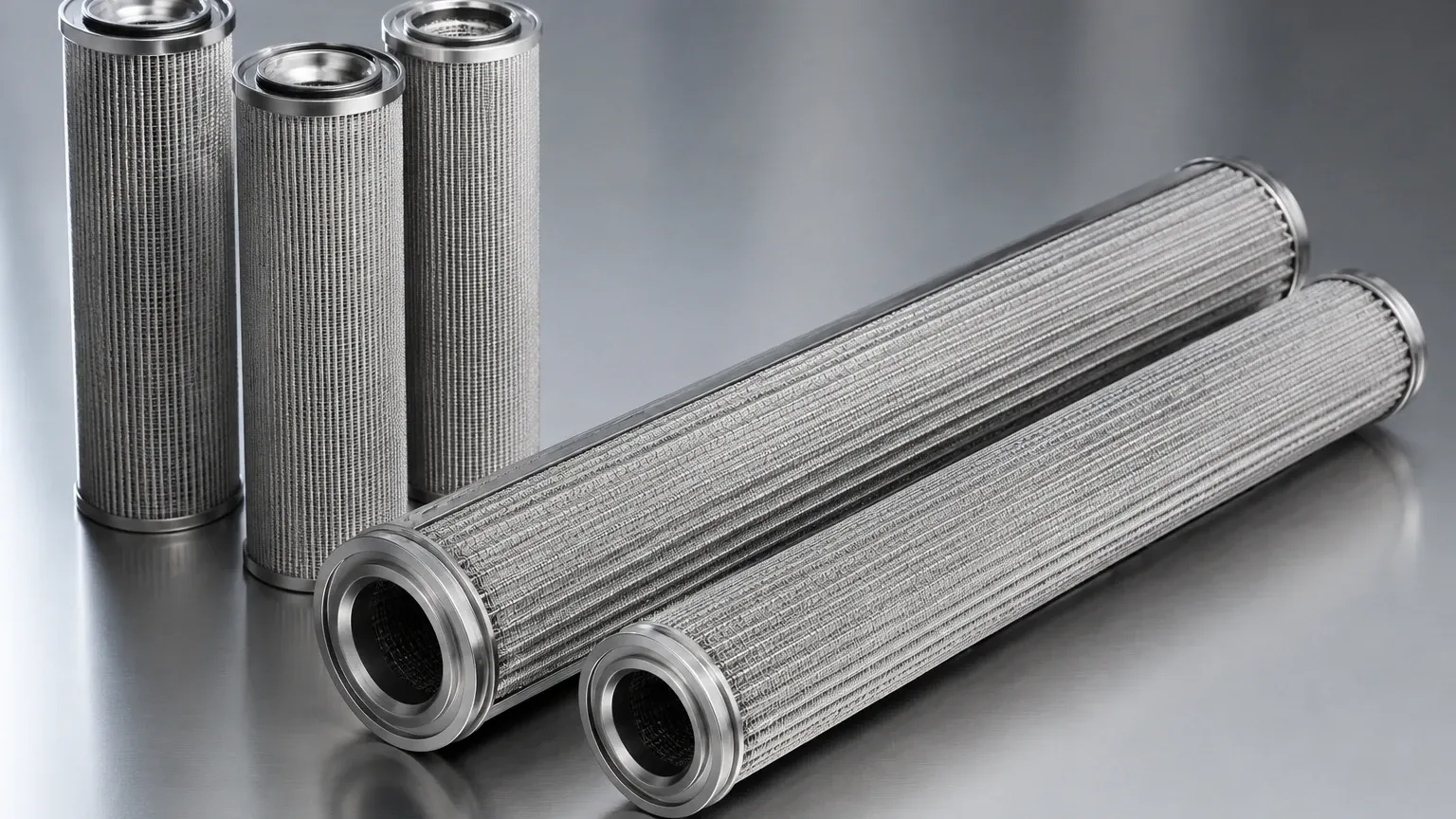
At a length of 40 inches, the cartridge must resist the hydraulic forces of the fluid flow. Stainless steel wire mesh and sintered metal fibers offer the necessary tensile strength to maintain a consistent pore size even during pressure surges. This is particularly important in hydraulic systems and high-pressure water injection wells.
Structural Configurations for 40-Inch Cartridges
To meet diverse filtration requirements, a filter cartridge 40 inch in length can be manufactured in several structural configurations, each offering distinct performance characteristics.
Pleated Wire Mesh Cartridges
Pleating the stainless steel wire mesh significantly increases the effective filtration area compared to a standard cylindrical design. For a 40-inch cartridge, pleating allows for higher flow rates and lower initial pressure drops. This configuration is ideal for removing solid particles from liquids where high dirt-holding capacity is required.
Sintered Metal Fiber Cartridges
Sintered metal fibers are produced by bonding random metal fibers together through a high-temperature sintering process. This creates a depth-filtration medium with high porosity (up to 80%). In a 40-inch format, sintered fiber cartridges provide exceptional filtration efficiency for fine particulates and are often used in polymer filtration and gas purification.
Cylindrical (Plain) Mesh Cartridges
For applications where surface filtration is sufficient and ease of cleaning is a priority, a simple cylindrical mesh design is used. These are often employed as pre-filters or strainers to protect downstream equipment from large debris.
End-Cap Configurations and Sealing Integrity
The performance of a filter cartridge 40 inch long is only as reliable as its seals. Because the cartridge is long, any misalignment during installation can lead to bypass. Standard end-cap configurations include:
* DOE (Double Open End): These require gaskets at both ends and rely on the housing's compression to create a seal. While common, they are more prone to bypass if not seated perfectly.
* Code 7 (226 O-Rings/Fin): This features two 226 O-rings and a locking tab (bayonet) to ensure a secure, leak-proof fit. This is the preferred choice for critical applications in the pharmaceutical and food and beverage industries.
* Code 3 (222 O-Rings/Flat): Similar to Code 7 but without the locking tabs, utilizing two 222 O-rings for a tight friction fit.
Selecting the correct O-ring material (Viton, EPDM, Silicone, or PTFE) is equally important to ensure compatibility with the process fluid and operating temperature.
Performance Evaluation: Flow Rate and Pressure Drop
When specifying a filter cartridge 40 inch for a system, engineers must calculate the clean pressure drop (Delta P) to ensure the pump capacity is sufficient. The flow rate through a 40-inch cartridge is influenced by:
1. Fluid Viscosity: Higher viscosity fluids require more pressure to pass through the same micron rating.
2. Micron Rating: Finer filtration (lower micron) increases resistance to flow.
3. Effective Filtration Area: Pleated designs will have a lower pressure drop than cylindrical designs for the same flow rate.
Typically, a 40-inch pleated stainless steel cartridge can handle significantly higher flow volumes than its 10-inch or 20-inch counterparts, allowing for a more compact filter housing design for a given total system flow.
Applications of 40-Inch Filter Cartridges
The versatility of the 40-inch format allows it to serve various critical roles across multiple industries:
Chemical and Petrochemical Processing
In these environments, 40-inch cartridges are used to remove catalysts, scale, and impurities from process streams. The durability of stainless steel ensures that the cartridges can handle the aggressive nature of hydrocarbons and chemical intermediates.
Food and Beverage Industry
For the filtration of edible oils, syrups, and beverages, 40-inch cartridges provide the high throughput required for industrial production lines. Stainless steel construction ensures compliance with food safety standards and allows for repeated steam sterilization (SIP).
Water Treatment and Desalination
Large-scale reverse osmosis (RO) systems use 40-inch cartridges as pre-filters to protect the sensitive RO membranes from particulate matter. The long format reduces the number of cartridges needed in the massive multi-round housings typical of desalination plants.
Pharmaceutical Manufacturing
Precision is key in pharma. 40-inch cartridges with absolute micron ratings are used for the clarification of bulk active pharmaceutical ingredients (APIs) and the filtration of process gases.
Maintenance and Cleaning Cycles
One of the primary advantages of stainless steel 40-inch filter cartridges is their cleanability. Unlike disposable plastic cartridges, metal elements can be regenerated, which significantly reduces the total cost of ownership (TCO) over the life of the system.
Cleaning Methods
* Backwashing: Reversing the flow of the fluid to dislodge particles from the surface of the mesh.
* Ultrasonic Cleaning: Using high-frequency sound waves in a cleaning solvent to remove fine particulates trapped deep within the sintered fiber or mesh layers.
* Chemical Cleaning: Using specific solvents or acids to dissolve organic or inorganic fouling that cannot be removed mechanically.
Replacement Indicators
Even with regular cleaning, cartridges will eventually reach a point where the permanent pressure drop is too high, or the structural integrity is compromised. Monitoring the differential pressure across the filter housing is the most reliable way to determine when a cleaning cycle or replacement is necessary.
Customization and OEM Support from Kaifil
Every industrial process has unique requirements. At Kaifil, we understand that a standard filter cartridge 40 inch might not always fit a specialized housing or meet a specific filtration challenge. We offer extensive customization options, including:
* Custom Micron Ratings: Tailoring the mesh or fiber density to achieve specific retention efficiencies.
* Specialized End-Caps: Designing custom fittings to match legacy filter housings or unique equipment interfaces.
* Reinforced Cores: For high-viscosity or high-differential pressure applications where extra structural support is required.
* Material Upgrades: Offering specialized alloys for extreme corrosive environments.
By working closely with engineering teams, Kaifil ensures that each filtration component is optimized for the specific operational parameters of the project, from initial material selection to the final quality control checks.
Conclusion
The selection of a filter cartridge 40 inch in length is a critical decision that impacts the efficiency, safety, and cost-effectiveness of industrial operations. By prioritizing high-quality materials like stainless steel and ensuring the structural design matches the application's demands, engineers can achieve reliable filtration performance and long-term durability. Whether you are managing a chemical plant, a food production facility, or a water treatment system, understanding the technical nuances of these long-format cartridges is essential for optimized system design.
For more information on technical specifications and custom solutions, explore our range of Filter Cartridges or contact our engineering team to discuss your specific application requirements.
