


Filter Cartridge 5 Micron
In industrial filtration, the selection of a specific micron rating is a critical engineering decision that directly impacts process efficiency, equipment longevity, and product purity. A filter cartridge 5 micron rating is one of the most common specifications encountered across diverse sectors, including chemical processing, food and beverage production, and hydraulic systems. This level of filtration is fine enough to remove most visible suspended solids and many microscopic contaminants, serving as either a high-efficiency pre-filter or a final polishing stage depending on the application requirements.
Understanding the technical nuances of 5-micron filtration—specifically the difference between nominal and absolute ratings, material compatibility, and structural integrity—is essential for engineers and procurement teams tasked with maintaining system performance. When selecting Filter Cartridges, technical professionals must look beyond the micron number and evaluate the specific environment in which the filter will operate.
Understanding the 5-Micron Threshold
To put the 5-micron scale into perspective, the human eye can typically only see particles down to approximately 40 microns. A 5-micron particle is significantly smaller than a red blood cell (which is roughly 8 microns). In industrial fluids, particles in the 5-micron range are often responsible for accelerated wear in precision components, such as hydraulic valves and high-pressure pumps.
When an application specifies a filter cartridge 5 micron, it indicates a requirement to capture silt, fine sand, scale, and certain types of precipitated solids. However, the effectiveness of this capture depends entirely on the efficiency rating of the cartridge.
Nominal vs. Absolute Ratings
One of the most frequent points of confusion in filter procurement is the distinction between nominal and absolute ratings.
* Nominal Rating: This is an arbitrary micron value assigned by the manufacturer, indicating that the filter can trap a large percentage of particles of that size. A nominal 5-micron filter might only capture 60% to 80% of 5-micron particles. These are typically used for non-critical applications or as primary stages to protect finer downstream filters.
* Absolute Rating: This refers to a filter's ability to remove 99.9% (or higher) of particles at the specified micron size. This is often verified through a glass bead test or a multi-pass test (Beta Ratio). For critical pharmaceutical or chemical processes, an absolute 5-micron rating is usually mandatory to ensure consistent output quality.
Material Considerations for Stainless Steel Filtration
While disposable polymer cartridges are common in low-temperature water treatment, industrial environments involving high temperatures, aggressive chemicals, or high pressure-differentials require more robust materials. Stainless steel filter cartridges are the preferred choice for these demanding conditions.
Stainless Steel Wire Mesh
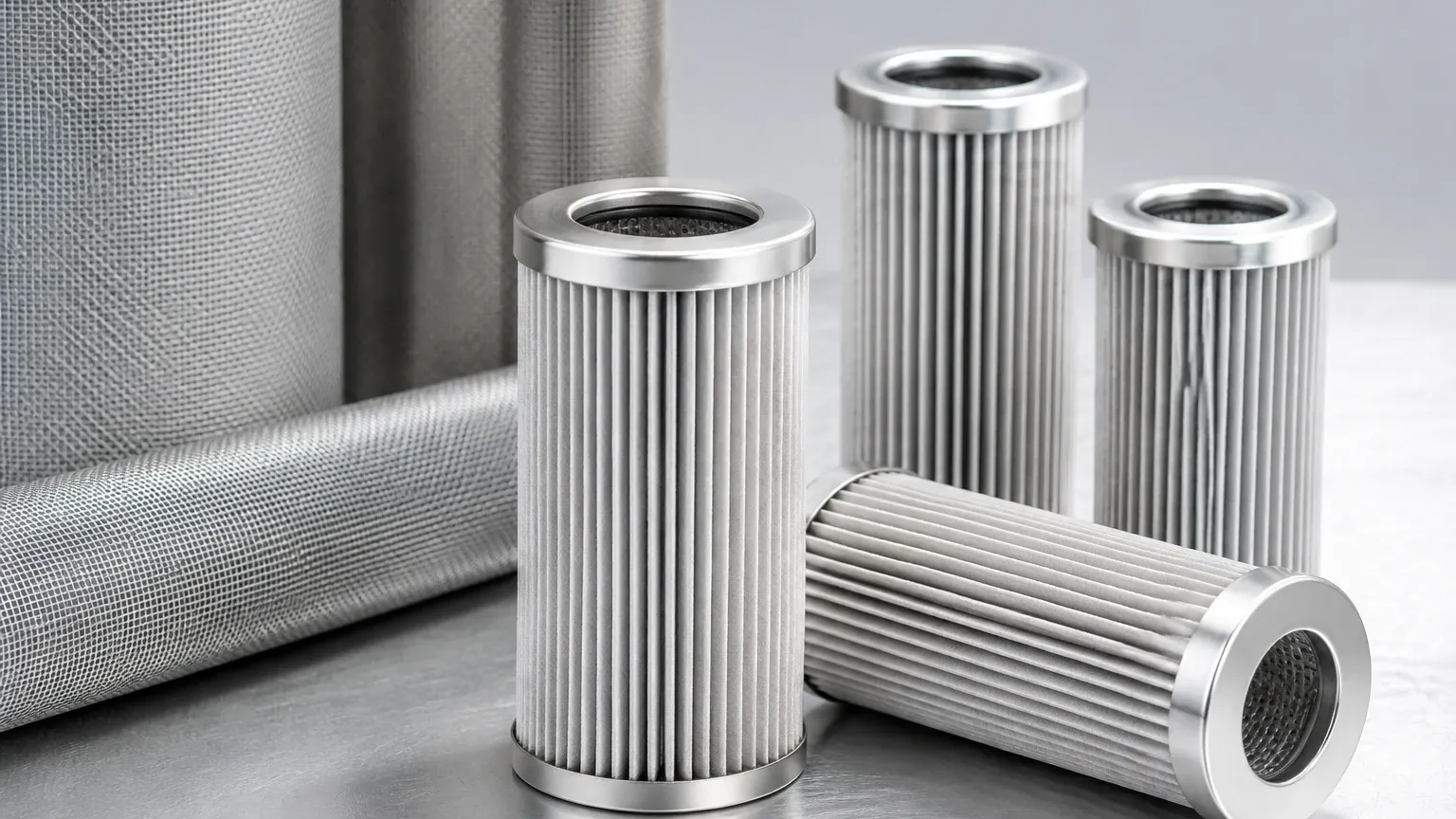
Kaifil specializes in manufacturing 5-micron filters using high-grade stainless steel wire mesh (typically 304 or 316L). The precision of the weave determines the filtration accuracy. For a 5-micron requirement, a specialized twilled Dutch weave or a multi-layered sintered mesh is often employed. The advantage of stainless steel mesh is its fixed pore structure, which prevents "media migration"—a common failure in fiber-based filters where the filter material itself sheds into the filtrate under pressure.
Sintered Metal Media
For applications requiring maximum structural integrity and absolute filtration, sintered metal cartridges are used. These are created by fusing layers of wire mesh or metallic fibers through a high-temperature sintering process. This creates a porous metal structure that is exceptionally strong and capable of withstanding extreme back-pressure during cleaning cycles.
Engineering Performance: Pressure Drop and Flow Rate
When integrating a filter cartridge 5 micron into a system, engineers must account for the Clean Pressure Drop (ΔP). Because a 5-micron pore size is relatively tight, it naturally offers more resistance to flow than a 20 or 50-micron filter.
The Impact of Viscosity
The flow rate through a 5-micron cartridge is heavily influenced by the viscosity of the fluid. Water flows relatively easily, but oils, resins, or syrups require significant surface area to maintain an acceptable flow rate without exceeding the recommended pressure drop. To counteract this, pleated designs are frequently used. Pleating increases the effective surface area of the filter media within the same cartridge footprint, allowing for higher flow rates and a higher dirt-holding capacity.
Dirt-Holding Capacity and Service Life
The service life of a 5-micron filter is determined by its dirt-holding capacity—the amount of contaminant it can trap before the pressure drop reaches a terminal point (usually 15-25 PSI, depending on the housing and pump specs). If a 5-micron filter clogs too quickly, it often indicates that the upstream pre-filtration is insufficient. Engineers should evaluate the particle size distribution (PSD) of the influent to determine if a multi-stage approach is more cost-effective.
Industrial Applications for 5-Micron Cartridges
Chemical and Petrochemical Processing
In chemical manufacturing, 5-micron stainless steel cartridges are used to filter catalysts, remove precipitates from reagents, and protect downstream analytical equipment. The chemical compatibility of 316L stainless steel ensures that the filter does not react with aggressive solvents or acids, maintaining the purity of the chemical stream.
Food and Beverage Production
For the food industry, 5-micron filtration is often used for the clarification of oils, syrups, and beverages. Stainless steel construction is vital here because it can withstand Steam-in-Place (SIP) and Clean-in-Place (CIP) sterilization processes. Unlike plastic filters, metal cartridges do not leach surfactants or chemicals into the food product.
Hydraulic and Lube Oil Systems
High-performance hydraulic systems require extremely clean oil to prevent the erosion of servo-valves. A 5-micron absolute filter is often the standard for protecting these sensitive components. In these applications, the filter must be able to handle high-pressure surges without collapsing, a requirement that makes stainless steel the ideal material choice.
Pharmaceutical Manufacturing
In the pharmaceutical sector, a filter cartridge 5 micron may serve as a pre-filter for 0.22-micron sterile membranes. By removing the bulk of the particulate matter at the 5-micron stage, the more expensive sterile filters are protected from premature clogging, significantly reducing total operational costs.
Customization and OEM Capabilities
Standard off-the-shelf filters do not always meet the specific geometric or performance requirements of specialized industrial machinery. Customization is a core strength of manufacturers like Kaifil, where filtration solutions are engineered to fit specific housing dimensions and flow characteristics.
Connection Types and End Caps
Proper sealing is critical for 5-micron filtration. If the seal fails, fluid will bypass the filter media, rendering the micron rating irrelevant. Common configurations include:
* Double Open End (DOE): Requires gaskets at both ends; suitable for standard housings.
* Code 7 (226 O-rings): Features a bayonet lock for high-security sealing in critical applications.
* NPT/Threaded Connections: Often used in high-pressure hydraulic or chemical lines to ensure a leak-proof metal-to-metal or gasketed fit.
Reinforced Cores and Outer Cages
For applications involving high-viscosity fluids or high differential pressures, a filter cartridge 5 micron may require an internal perforated core for crush resistance and an outer shroud to protect the pleated media during handling and installation.
Maintenance and Total Cost of Ownership (TCO)
One of the primary advantages of choosing stainless steel for 5-micron filtration is reusability. While the initial investment in a stainless steel cartridge is higher than a disposable polypropylene or glass fiber filter, the TCO is often lower in the long run.
Cleaning Procedures
Stainless steel 5-micron filters can be cleaned using several methods:
1. Ultrasonic Cleaning: High-frequency sound waves create cavitation bubbles that dislodge fine particles from deep within the mesh.
2. Backwashing: Reversing the flow of clean fluid or gas to push contaminants out of the pores.
3. Chemical Cleaning: Using compatible solvents or acids to dissolve organic or inorganic buildup.
By cleaning and reusing the cartridges, facilities can significantly reduce their waste stream and the recurring costs associated with purchasing and disposing of single-use filters.
Selection Checklist for Engineers
Before finalizing a purchase for a filter cartridge 5 micron, technical teams should confirm the following parameters with the manufacturer:
* Fluid Properties: What is the chemical composition, temperature, and viscosity?
* Flow Requirements: What is the target flow rate (GPM or LPM) and the maximum allowable pressure drop?
* Contaminant Profile: What is the nature of the solids being removed? Are they hard, slimy, or deformable?
* Efficiency Requirement: Is a nominal rating sufficient, or does the process demand an absolute 5-micron rating?
* Housing Compatibility: Does the cartridge length and end-cap configuration match the existing filter vessel?
By addressing these factors, engineers can ensure they select a filtration solution that provides the necessary precision without compromising system throughput or safety. For those seeking high-performance, durable, and customized options, exploring professional Filter Cartridges is the first step toward optimizing industrial filtration performance.
