


Filter Cartridge Cto
In industrial water treatment and process fluid management, the removal of chlorine, organic contaminants, and volatile organic compounds (VOCs) is critical for protecting downstream equipment and ensuring product purity. The filter cartridge cto—an acronym representing Chlorine, Taste, and Odor—is a specialized component designed primarily for these adsorption-based tasks. Unlike mechanical filters that rely solely on pore size to trap particulates, CTO cartridges utilize activated carbon to perform chemical and physical adsorption.
For engineers and procurement professionals, selecting the correct Filter Cartridges requires a deep understanding of carbon block technology, flow dynamics, and the specific requirements of the industrial application. This article examines the technical specifications, performance metrics, and integration strategies for CTO filtration in professional environments.
Understanding the Role of CTO Filtration in Industrial Systems
CTO filtration serves as a primary defense mechanism against chemical impurities that can compromise industrial processes. In many municipal and industrial water supplies, chlorine is added as a disinfectant. While effective for biological control, chlorine can damage reverse osmosis (RO) membranes, cause oxidative stress in chemical reactions, and impart unwanted flavors in food and beverage production.
Adsorption is the primary mechanism at work within a filter cartridge cto. As fluid passes through the carbon media, the high surface area of the activated carbon attracts and holds dissolved chemicals. This process is distinct from absorption; in adsorption, the contaminants adhere to the surface of the internal pores of the carbon. This makes the quality and porosity of the carbon media the most critical factors in determining the cartridge's efficacy.
In a multi-stage filtration system, the CTO stage is typically positioned after a sediment pre-filter. By removing larger particulates first—often using stainless steel wire mesh or pleated synthetic media—the carbon block is protected from premature clogging, allowing its surface area to be dedicated entirely to chemical adsorption.
The Technical Composition of Carbon Block CTO Cartridges
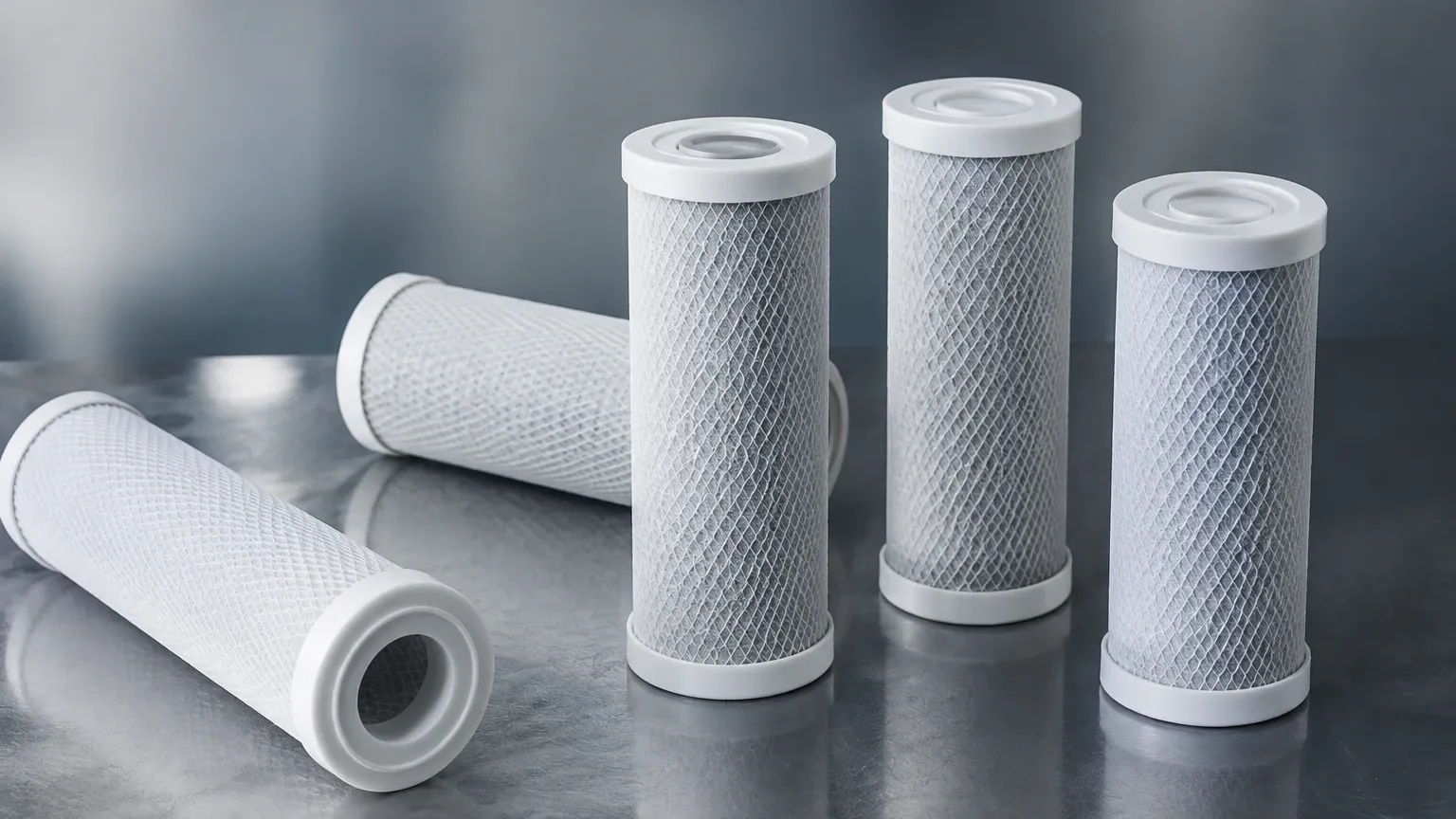
Most modern industrial CTO filters are constructed as "carbon blocks." This manufacturing process involves grinding activated carbon (often derived from bituminous coal or coconut shells) into a fine powder, mixing it with a food-grade binder, and extruding or compression-molding it into a solid cylindrical shape.
Extruded vs. Granular Activated Carbon (GAC)
While Granular Activated Carbon (GAC) filters contain loose carbon granules, the extruded carbon block in a filter cartridge cto offers several engineering advantages:
1. Uniformity: The extrusion process ensures a consistent density throughout the cartridge, preventing "channeling" where fluid finds a path of least resistance and bypasses the media.
2. Integrated Sediment Filtration: Because the carbon is compressed, the block itself acts as a mechanical filter. Most industrial CTO blocks are rated for 5 to 10 microns, providing a secondary layer of particulate removal.
3. No Carbon Fines: Unlike GAC filters, which can release carbon dust (fines) into the effluent during startup or pressure surges, bonded carbon blocks are structurally stable and minimize downstream contamination.
Material Selection: Coconut Shell vs. Coal
Coconut shell-based activated carbon is frequently preferred for CTO applications due to its high microporosity. It possesses a significantly higher surface area per gram compared to coal-based carbon, making it exceptionally efficient at removing low-molecular-weight organic compounds and chlorine. For heavy industrial applications involving larger organic molecules or color removal, coal-based carbon may be selected for its broader pore structure.
Key Performance Parameters: Micron Rating and Flow Dynamics
When evaluating Filter Cartridges for CTO applications, engineers must balance filtration efficiency with system throughput. The performance of a carbon block is governed by several measurable variables:
Micron Rating
CTO cartridges are generally offered with nominal micron ratings. A 5-micron CTO cartridge will remove the majority of particles 5 microns and larger while providing significant chlorine reduction. It is important to note that as the micron rating decreases (e.g., moving to a 1-micron block), the pressure drop across the filter increases, which may necessitate larger pumps or more frequent cartridge changes.
Flow Rate and Contact Time
Adsorption is a time-dependent process. The effectiveness of a filter cartridge cto is directly related to the "Empty Bed Contact Time" (EBCT). If the flow rate is too high, the fluid passes through the carbon block too quickly for the chemical bonds to form between the contaminants and the carbon surface.
Industrial specifications typically provide a "Rated Service Flow." Exceeding this flow rate will result in a "leakage" of chlorine or organics into the effluent. For high-volume applications, engineers often install multiple cartridges in a multi-round housing to distribute the flow and maintain adequate contact time.
Pressure Drop ($ΔP$)
Every filter introduces resistance to the system. A clean CTO cartridge will typically exhibit a pressure drop of 1 to 5 PSI at its rated flow. As the filter traps sediment and its pores become saturated, this pressure drop increases. In industrial settings, a differential pressure gauge is used to monitor this; once the $ΔP$ reaches a predetermined limit (usually 15-20 PSI), the cartridge is considered exhausted.
Industrial Application Scenarios for CTO Filter Cartridges
The versatility of the filter cartridge cto makes it a staple in various sectors where fluid purity is non-negotiable.
Food and Beverage Processing
In breweries, soft drink bottling plants, and commercial kitchens, chlorine must be removed to prevent off-flavors. Furthermore, the removal of VOCs ensures that the final product meets strict sensory and safety standards. In these environments, CTO filters must often meet FDA or NSF/ANSI 42 standards for material safety.
Pharmaceutical and Laboratory Water
Process water used in pharmaceutical manufacturing requires the removal of organic precursors that could interfere with sensitive chemical synthesis or biological cultures. CTO cartridges often serve as pre-treatment for deionization (DI) and ultrafiltration (UF) systems, protecting expensive resins and membranes from organic fouling.
Pre-treatment for Reverse Osmosis (RO)
Thin-film composite (TFC) RO membranes are highly susceptible to permanent damage from chlorine. A CTO filter stage is essential in industrial RO systems to neutralize chlorine before it reaches the membrane surface. This application requires high-capacity carbon blocks to ensure zero chlorine breakthrough over long operational cycles.
Selection Criteria for Engineering and Procurement Teams
To ensure optimal performance and cost-effectiveness, the following factors should be confirmed during the procurement process:
* Chemical Compatibility: While the carbon media is generally inert, the end caps, gaskets, and netting of the cartridge must be compatible with the process fluid. Common gasket materials include EPDM, Buna-N, and Silicone. For high-temperature or aggressive chemical applications, specialized housings and components may be required.
* Chlorine Reduction Capacity: This is measured in gallons (or liters). A cartridge rated for 10,000 gallons at 1 GPM will effectively remove chlorine for that volume, provided the flow rate is maintained. Procurement teams should compare the capacity-to-cost ratio rather than just the unit price.
* Physical Dimensions: Industrial standards include the "Standard" (2.5" diameter) and "Big Blue" (4.5" diameter) formats, with lengths typically ranging from 10 to 40 inches. Custom lengths and diameters may be necessary for specialized OEM equipment.
Integration with Stainless Steel Filtration Components
While the filter cartridge cto handles chemical adsorption, industrial systems often rely on stainless steel filtration components for the heavy-duty aspects of the process. Manufacturers like Kaifil specialize in these durable metal solutions, which complement carbon-based stages in several ways:
1. Protective Pre-filtration: Stainless steel wire mesh filters or sintered metal elements are used upstream of CTO cartridges to remove abrasive or heavy sediment. Unlike disposable polypropylene pre-filters, stainless steel elements can be cleaned and reused, reducing the total waste stream and protecting the carbon block from premature surface blinding.
2. High-Pressure Housings: Carbon cartridges require robust housings to operate safely in industrial environments. Stainless steel filter housings provide the pressure ratings and corrosion resistance necessary for chemical processing and high-pressure water lines.
3. Post-filtration Security: In some critical applications, a fine stainless steel mesh or a pleated metal filter is placed after the CTO stage as a "police filter" to ensure that no carbon fines or escaped particulates enter the final product stream, especially in high-vibration or high-surge environments.
Maintenance, Replacement Cycles, and Total Cost of Ownership (TCO)
Unlike mechanical filters that can sometimes be backwashed, a filter cartridge cto is a consumable component. Once the adsorption sites on the activated carbon are filled, the cartridge can no longer remove contaminants.
Determining Replacement Intervals
There are three primary indicators that a CTO cartridge needs replacement:
1. Chlorine Breakthrough: Regular testing of the effluent using DPD (N,N-diethyl-p-phenylenediamine) test kits or electronic sensors. Any detectable chlorine indicates the carbon is exhausted.
2. Pressure Differential: If the $ΔP$ exceeds the manufacturer's recommended limit, the physical pores are clogged with sediment.
3. Time-Based Replacement: In some regulated industries, cartridges are replaced on a fixed schedule (e.g., every 6 months) to prevent bacterial biofilm growth on the carbon surface, regardless of the remaining adsorption capacity.
Total Cost of Ownership
When calculating the TCO for filtration, engineers must consider the cost of the cartridges, the labor required for change-outs, and the potential cost of downstream equipment damage if a filter fails. High-quality carbon blocks with higher capacities may have a higher initial price but offer a lower TCO by extending the time between maintenance intervals and providing more reliable protection for sensitive components like RO membranes.
By integrating high-performance CTO cartridges with durable stainless steel pre-filtration and robust housing systems, industrial facilities can achieve a balanced filtration strategy that addresses both particulate and chemical contaminants efficiently. For specialized requirements, consulting with a manufacturer experienced in custom filtration solutions ensures that the selected components are perfectly matched to the specific flow, pressure, and chemical demands of the application.
