


Finest Filters Water Filter Cartridges
In the landscape of industrial water treatment, the requirement for high-precision filtration has moved beyond simple sediment removal. For sectors such as pharmaceutical manufacturing, semiconductor fabrication, and high-pressure hydraulic systems, the implementation of finest filters water filter cartridges is a prerequisite for operational stability. These components are designed to capture microscopic contaminants that could otherwise compromise product purity or damage sensitive downstream equipment.
When evaluating Filter Cartridges, engineers must look past generic specifications and focus on the technical nuances of material compatibility, structural integrity under pressure, and the specific filtration mechanisms required for their unique fluid dynamics. This guide examines the engineering principles and selection criteria essential for sourcing high-performance filtration solutions.
Defining "Finest" in Industrial Water Filtration
The term "finest" in a B2B filtration context refers to the absolute micron rating and the efficiency with which a cartridge retains particles at that specific size. While standard commercial filters might offer nominal ratings—where a percentage of particles at a given size are captured—industrial-grade finest filters water filter cartridges typically provide absolute ratings.
An absolute rating implies that the filter medium has been tested to ensure that no particle larger than the specified micron size can pass through the mesh or sintered structure. This is achieved through rigorous manufacturing processes where the pore size distribution is tightly controlled. In water treatment, achieving "fine" filtration often involves moving into the sub-micron range or the 1-to-5 micron range, where traditional depth filters may fail to provide consistent results. For critical applications, the Beta ratio (the ratio of particles upstream versus downstream) serves as the primary metric for defining the "finest" performance levels.
Material Science: Why Stainless Steel Dominates High-End Water Filtration
While polymer-based cartridges are common in residential or light commercial use, industrial water systems often demand the durability of metallic media. Stainless steel, specifically grades 304 and 316L, is the material of choice for finest filters water filter cartridges due to several engineering advantages:
1. Corrosion Resistance: Grade 316L contains molybdenum, which provides superior resistance to pitting and crevice corrosion in chloride-rich environments or treated water containing residual oxidants.
2. Thermal Stability: Industrial water loops may operate at elevated temperatures or undergo steam-in-place (SIP) sterilization. Stainless steel maintains its structural properties at temperatures far exceeding the melting points of polypropylene or polyester.
3. Mechanical Strength: High-pressure water systems can subject filter media to significant differential pressure. Stainless steel cartridges resist collapsing or shedding fibers, ensuring that the filtration integrity remains intact even during pressure surges.
4. Chemical Compatibility: Beyond pure water, many industrial processes involve water mixed with solvents, acids, or alkalis. Stainless steel offers a broad spectrum of chemical resistance, preventing material degradation that could lead to process contamination.
Structural Engineering of Filter Cartridges
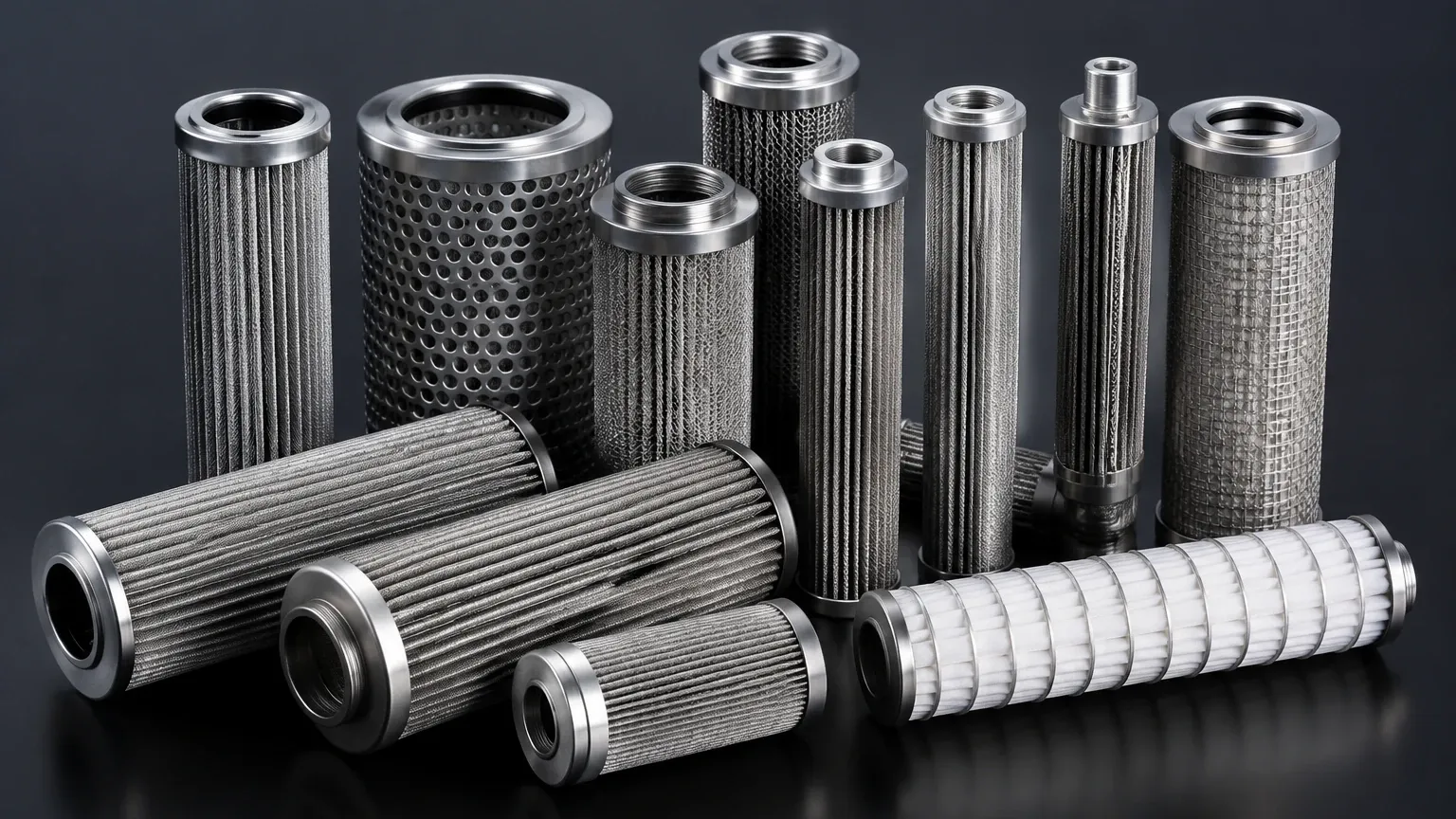
The architecture of a filter cartridge determines its surface area, flow capacity, and dirt-holding capacity. For high-precision water filtration, two primary structures are utilized: pleated wire mesh and sintered metal.
Pleated Wire Mesh Cartridges
Pleating is a mechanical process that folds the wire mesh media to significantly increase the effective surface area within a standard cartridge footprint. This design is ideal for high-flow applications where low initial pressure drop is required. By increasing the surface area, the flux rate (flow per unit area) is reduced, which can improve the retention efficiency of the finest filters water filter cartridges and extend the time between cleaning cycles.
Sintered Metal Cartridges
Sintering involves bonding multiple layers of stainless steel wire mesh or metal fibers through a high-temperature vacuum process called diffusion bonding. This creates a rigid, porous structure that does not require an internal support core in many instances. Sintered cartridges are preferred for the most demanding applications where absolute pore size stability is required under extreme mechanical stress. They are also highly effective for backwashing, as the bonded layers do not shift or distort during reverse flow.
Performance Metrics: Micron Ratings and Pressure Differentials
Selecting the correct Filter Cartridges requires a deep dive into the relationship between micron ratings and pressure differentials (ΔP).
* Micron Rating: Engineers must determine the smallest particle size that can be tolerated in the downstream process. In water filtration, this might range from 0.5 microns for microbial control to 20 microns for pre-filtration before a Reverse Osmosis (RO) membrane.
* Clean Pressure Drop: This is the initial resistance to flow when the filter is new. A high-quality cartridge is designed to minimize this value to reduce energy consumption by the system pumps.
* Terminal Pressure Drop: This is the point at which the filter is considered "blinded" or full of contaminants and must be cleaned or replaced. For stainless steel cartridges, this threshold is often higher than for disposables, allowing for longer service intervals.
Understanding the fluid's viscosity and the expected solid loading is crucial. In water systems, viscosity is generally low, but the presence of biological films or fine mineral scale can rapidly increase the pressure drop if the surface area of the cartridge is insufficient.
Industry-Specific Applications for Precision Water Filters
The application of finest filters water filter cartridges varies across different B2B sectors, each with its own set of regulatory and performance standards.
Food and Beverage Processing
In this sector, water is often an ingredient. Filtration must not only remove physical contaminants but also ensure that no materials from the filter itself leach into the product. Stainless steel cartridges used here must comply with FDA standards, often requiring 316L grade with smooth, polished finishes to prevent bacterial growth in crevices.
Pharmaceutical and Biotech
Water for Injection (WFI) and purified water systems require the highest levels of filtration. Here, cartridges are used as vent filters for storage tanks or as final polishing stages. The ability to withstand repeated sterilization cycles without losing filtration efficiency is the primary reason engineers specify sintered stainless steel for these "finest" applications.
Chemical and Petrochemical
Water used in cooling towers or as a solvent in chemical reactions often contains aggressive chemicals. The durability of metal filter cartridges ensures that the filtration system does not become a point of failure in a continuous production line, where downtime can cost thousands of dollars per hour.
Maintenance Strategies and Cleaning Protocols
One of the primary B2B advantages of stainless steel finest filters water filter cartridges over disposable options is their cleanability. A well-maintained metal cartridge can last for years, significantly lowering the total cost of ownership (TCO).
* Backwashing: For automated systems, reverse flow (backwashing) can dislodge accumulated solids from the surface of the mesh. This is most effective with surface-loading pleated filters.
* Ultrasonic Cleaning: For deep-seated contaminants in sintered media, ultrasonic baths use high-frequency sound waves to create cavitation bubbles that scrub the internal pores of the metal.
* Chemical Cleaning: Soaking cartridges in caustic or acidic solutions can dissolve organic or mineral scaling. It is essential to verify that the cleaning agents are compatible with the specific grade of stainless steel and the gasket materials (such as Viton, EPDM, or PTFE).
Engineers should establish a maintenance schedule based on the rate of pressure drop increase. Monitoring the ΔP across the filter housing provides real-time data on the health of the filtration system.
Sourcing and Customization: The OEM Advantage
Standard off-the-shelf solutions do not always meet the requirements of specialized industrial equipment. This is where OEM (Original Equipment Manufacturer) and customization capabilities become vital. When sourcing finest filters water filter cartridges, working with a manufacturer that can customize the following parameters is beneficial:
* End Cap Configurations: Compatibility with existing filter housings (e.g., Code 7, 222, 226, or NPT threaded ends) is necessary for seamless integration.
* Custom Dimensions: Non-standard lengths or diameters may be required for compact machinery or legacy systems.
* Layering and Reinforcement: For high-pressure applications, additional support layers can be sintered into the media to prevent deformation.
By collaborating with a manufacturer that understands the engineering behind the mesh, procurement teams can ensure they receive a product that balances filtration precision with mechanical longevity.
Conclusion
The selection of finest filters water filter cartridges is a critical decision for any industrial facility where water purity impacts process efficiency and product quality. By focusing on high-grade materials like 316L stainless steel, understanding the structural benefits of pleated and sintered designs, and prioritizing absolute micron ratings, engineers can implement a filtration strategy that is both reliable and cost-effective.
Investing in durable, cleanable Filter Cartridges reduces the environmental impact of disposable waste and provides the mechanical robustness required for the most demanding industrial environments. As water quality standards continue to tighten globally, the role of precision-engineered metal filtration will only become more central to industrial success.
