


How to Clean Pool Filter Cartridges
In commercial and industrial water treatment applications, the efficiency of a filtration system is directly tied to the maintenance of its core components. For facilities managing large-scale aquatic environments, such as municipal swimming centers, resort water parks, or industrial cooling ponds, understanding how to clean pool filter cartridges is essential for maintaining water clarity, ensuring equipment longevity, and optimizing operational costs.
While the basic principles of filtration remain consistent, the engineering demands of high-traffic or industrial-scale systems require a more rigorous approach to maintenance than residential setups. This guide explores the technical procedures for cleaning Filter Cartridges, the chemical considerations for media restoration, and the indicators that suggest a transition from cleaning to replacement is necessary.
Understanding the Engineering of Filter Cartridges
Before addressing the cleaning process, it is vital to understand the construction and material science of the cartridges involved. Most commercial pool filters utilize pleated media, typically made of spun-bond polyester or reinforced synthetic fibers. The pleating design maximizes the surface area within a compact cylindrical footprint, allowing for high flow rates and high dirt-holding capacity.
In more demanding industrial water treatment scenarios, facilities may opt for stainless steel wire mesh or sintered metal cartridges. These components offer superior structural integrity and are capable of withstanding higher pressure differentials (ΔP) and aggressive chemical environments. Regardless of the material, the filtration mechanism is primarily mechanical straining. Over time, particulates such as calcium scale, body oils, organic debris, and chemical precipitates lodge within the pores of the media. This buildup increases resistance to flow, which, if left unaddressed, can lead to pump strain, media deformation, or complete system failure.
Indicators for Maintenance: When to Clean
Effective maintenance is driven by data rather than a fixed schedule. Engineering teams should monitor specific performance metrics to determine the optimal time for cleaning.
Pressure Differential (ΔP)
The most reliable indicator is the pressure gauge located on the filter tank. As the media becomes loaded with contaminants, the internal pressure rises. A standard industry benchmark for cleaning is when the pressure increases by 8 to 10 PSI (0.55 to 0.69 bar) over the "clean" starting pressure. Operating beyond this threshold reduces the flow rate and forces debris deeper into the media, making it significantly harder to clean.
Flow Rate Degradation
In systems equipped with flow meters, a noticeable drop in Gallons Per Minute (GPM) indicates that the cartridges are reaching their saturation point. Maintaining a consistent flow is critical for proper chemical distribution and turnover rates required by health and safety regulations.
Visual and Water Quality Analysis
Cloudy water or the presence of fine particulates despite chemical balancing often suggests that the filter media is either bypassed or so fouled that it can no longer effectively capture contaminants. Visual inspection of the cartridges may reveal "bridging," where debris completely fills the gaps between pleats.
Step-by-Step Technical Process: How to Clean Pool Filter Cartridges
Executing a professional cleaning requires a systematic approach to protect the structural integrity of the cartridge while maximizing the removal of embedded contaminants.
1. System Isolation and Safety
Before beginning, shut down the circulation pump and close the intake and return valves to isolate the filter tank. Open the air release valve on top of the tank to relieve internal pressure. Only after the pressure gauge reads zero should the tank lid be removed.
2. Removal and Initial Rinse
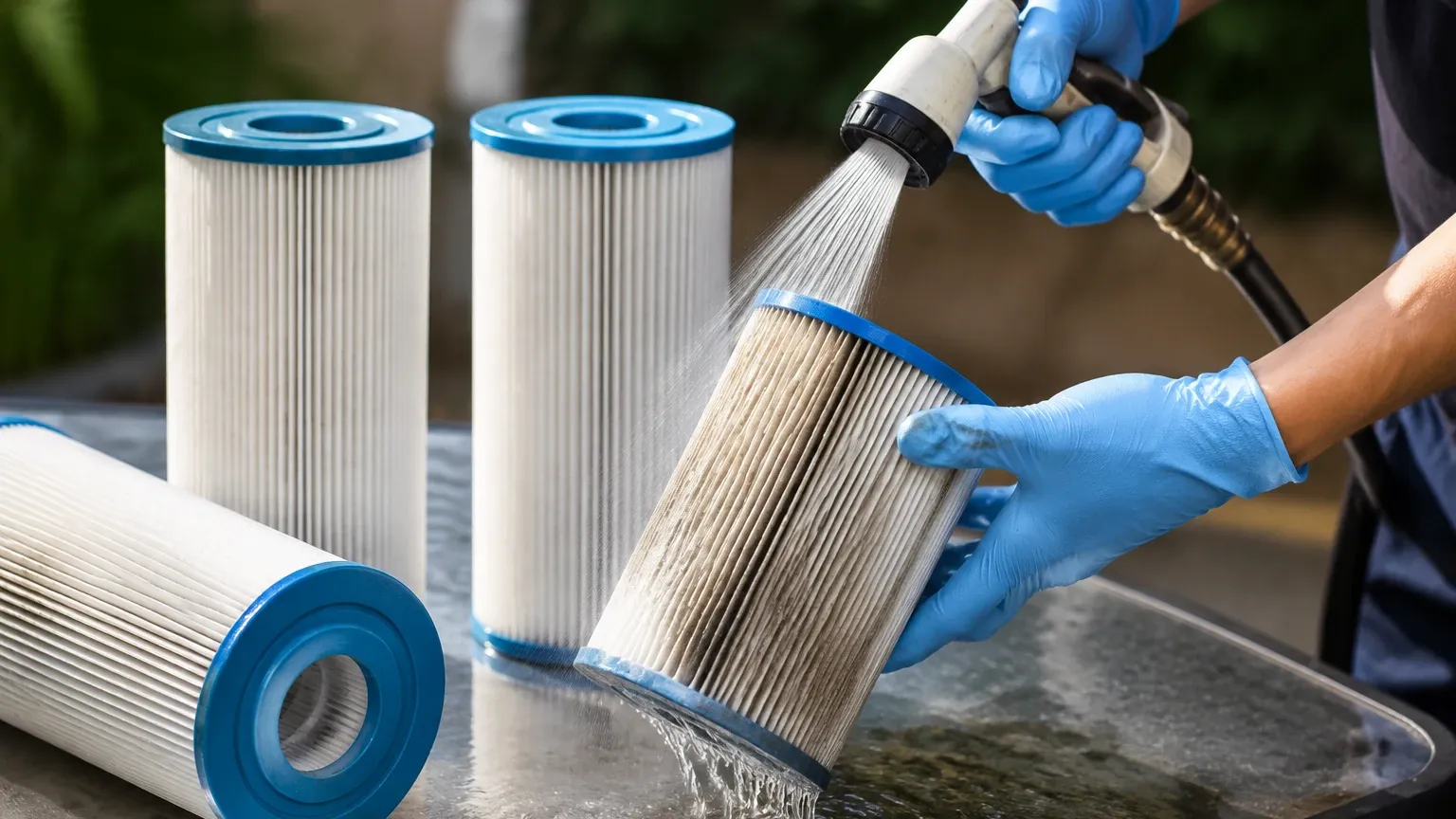
Carefully extract the cartridges from the manifold. Inspect the end caps for cracks and the internal core for signs of collapse. Perform an initial rinse using a high-volume, low-pressure water source. A standard garden hose with a spray nozzle is preferred; high-pressure power washers should be avoided as they can tear synthetic fibers or widen the pore structure of the media, permanently compromising filtration accuracy.
3. Degreasing (The Critical Step)
One of the most common mistakes in learning how to clean pool filter cartridges is skipping the degreasing phase. Oils from bathers or industrial lubricants create a film over the media. If an acid wash is applied before these oils are removed, the acid can "set" the oils into the fabric, creating a permanent barrier. Soak the cartridges in a specialized filter cleaner or a solution of trisodium phosphate (TSP) and water for at least 12 to 24 hours.
4. Mineral and Scale Removal
If the cartridges show signs of calcium buildup or mineral scaling (common in hard water areas), an acid soak is required. Use a diluted solution of muriatic acid or a commercially available descaler. Ensure the cartridge is thoroughly rinsed of all degreasing agents before moving to the acid bath to avoid dangerous chemical reactions.
5. Final Rinse and Inspection
After soaking, rinse the cartridges thoroughly until the water runs clear. Inspect the pleats for any remaining debris. Allow the cartridges to dry completely if possible; this allows any remaining organic matter to desiccate and drop off, and it can also help reset the fibers in synthetic media.
Chemical Cleaning Solutions and Material Compatibility
The choice of cleaning agents must align with the material of the filter cartridge. For standard polyester Filter Cartridges, mild alkaline degreasers are effective. However, when dealing with specialized industrial filtration components, such as those manufactured from 304 or 316 stainless steel, the chemical resistance is much higher.
Stainless steel cartridges can often be cleaned using more aggressive solvents or ultrasonic cleaning methods that would destroy synthetic media. This durability is a primary reason why industrial facilities often transition to metal filtration solutions. When cleaning metal mesh, it is important to avoid chlorine-based cleaners in high concentrations for extended periods, as they can cause pitting corrosion in certain grades of stainless steel. Always verify the compatibility of the cleaning agent with the specific alloy and the gaskets or seals used in the cartridge assembly.
Evaluating Structural Integrity and Replacement Cycles
Cleaning cannot restore a cartridge indefinitely. Engineers must be able to identify the point of diminishing returns where cleaning no longer restores sufficient flow or filtration quality. Key signs that a cartridge requires replacement include:
* Permanent Pressure Elevation: If the "clean" pressure after a thorough cleaning is significantly higher than the original baseline pressure of a new cartridge, the media is likely fouled at a microscopic level (depth fouling).
* Media Fraying or "Fuzzing": In synthetic cartridges, the breakdown of fibers leads to a fuzzy appearance. This indicates that the pore structure has been compromised, allowing larger particles to pass through.
* End Cap Separation: The bond between the filtration media and the plastisol or polyurethane end caps is a common failure point. If this bond breaks, water will bypass the filter entirely.
* Core Collapse: If the internal support structure is warped or crushed, the cartridge will not seat properly in the manifold, leading to bypass and potential damage to the pump.
From a Total Cost of Ownership (TCO) perspective, the labor and chemical costs of frequent cleaning must be weighed against the cost of replacement. In high-demand commercial environments, upgrading to high-performance stainless steel filters can often reduce the frequency of replacement and simplify the cleaning process due to the material's robust nature.
Transitioning to High-Performance Industrial Filtration
While the process of how to clean pool filter cartridges is standard for many facilities, those facing extreme debris loads or aggressive chemical conditions may find that standard synthetic cartridges are insufficient. This is where custom engineering becomes valuable.
Custom stainless steel filtration solutions provide a level of durability that synthetic media cannot match. These components are designed to handle higher temperatures, greater pressure drops, and repeated cleaning cycles without losing their micron rating. For engineers managing complex water treatment systems, selecting a manufacturer capable of providing precision-engineered metal filter components is a strategic move toward operational efficiency.
By following a rigorous cleaning protocol—focusing on pressure monitoring, proper degreasing, and careful material handling—facility managers can ensure their filtration systems perform at peak capacity. Whether maintaining a commercial aquatic center or an industrial process water loop, the longevity of the filter cartridge is a direct reflection of the technical care applied during its maintenance cycle.
