


Jandy Replacement Filter Cartridges
In industrial and commercial water management, the efficiency of a filtration system is fundamentally tied to the quality and specifications of its internal components. Among the most widely utilized systems in large-scale aquatic facilities, commercial pools, and light industrial pre-filtration setups are those utilizing Jandy-compatible housings. Selecting appropriate jandy replacement filter cartridges requires a deep understanding of hydraulic flow, material science, and the specific mechanical stresses placed on pleated media during high-volume operation.
For engineers and facility managers, the choice of a replacement cartridge is not merely a maintenance task but a critical decision affecting the total cost of ownership (TCO), pump longevity, and water quality. This guide examines the technical parameters of these Filter Cartridges, focusing on engineering considerations, material durability, and the transition from standard synthetic media to high-performance industrial alternatives.
The Engineering of Pleated Cartridge Filtration
Cartridge filtration operates primarily on the principle of surface filtration. Unlike sand filters, which utilize depth filtration through a thick bed of media, jandy replacement filter cartridges employ a pleated design to maximize the available surface area within a compact cylindrical footprint. This high surface-area-to-volume ratio is essential for maintaining low pressure drops while achieving high dirt-holding capacities.
Surface Area and Flux Rates
The effective filtration area of a cartridge is determined by the number of pleats, the depth of each pleat, and the total length of the cartridge. In commercial Jandy systems, such as the CV or CL series, multiple cartridges are often used in tandem. For example, a 580-square-foot filter system typically utilizes four individual 145-square-foot cartridges.
From an engineering perspective, the "flux rate"—the volume of water passing through a specific area of filter media over time (measured in GPM/ft²)—is a vital metric. Operating at a lower flux rate by utilizing high-quality, high-surface-area cartridges reduces the velocity of particles hitting the media. This leads to deeper particle penetration into the media fibers without immediate blinding, extending the time between cleaning cycles and reducing the mechanical strain on the filter core.
Material Specifications and Structural Integrity
The performance of jandy replacement filter cartridges is heavily dependent on three structural components: the filter media, the center core, and the end caps.
Filter Media (Polyester vs. Specialized Alloys)
Most standard replacements utilize point-bonded polyester. The denier and weight of the polyester determine the micron rating, typically ranging from 10 to 20 microns for standard applications. However, in demanding industrial environments where chemical compatibility or high temperatures are factors, standard polyester may degrade.
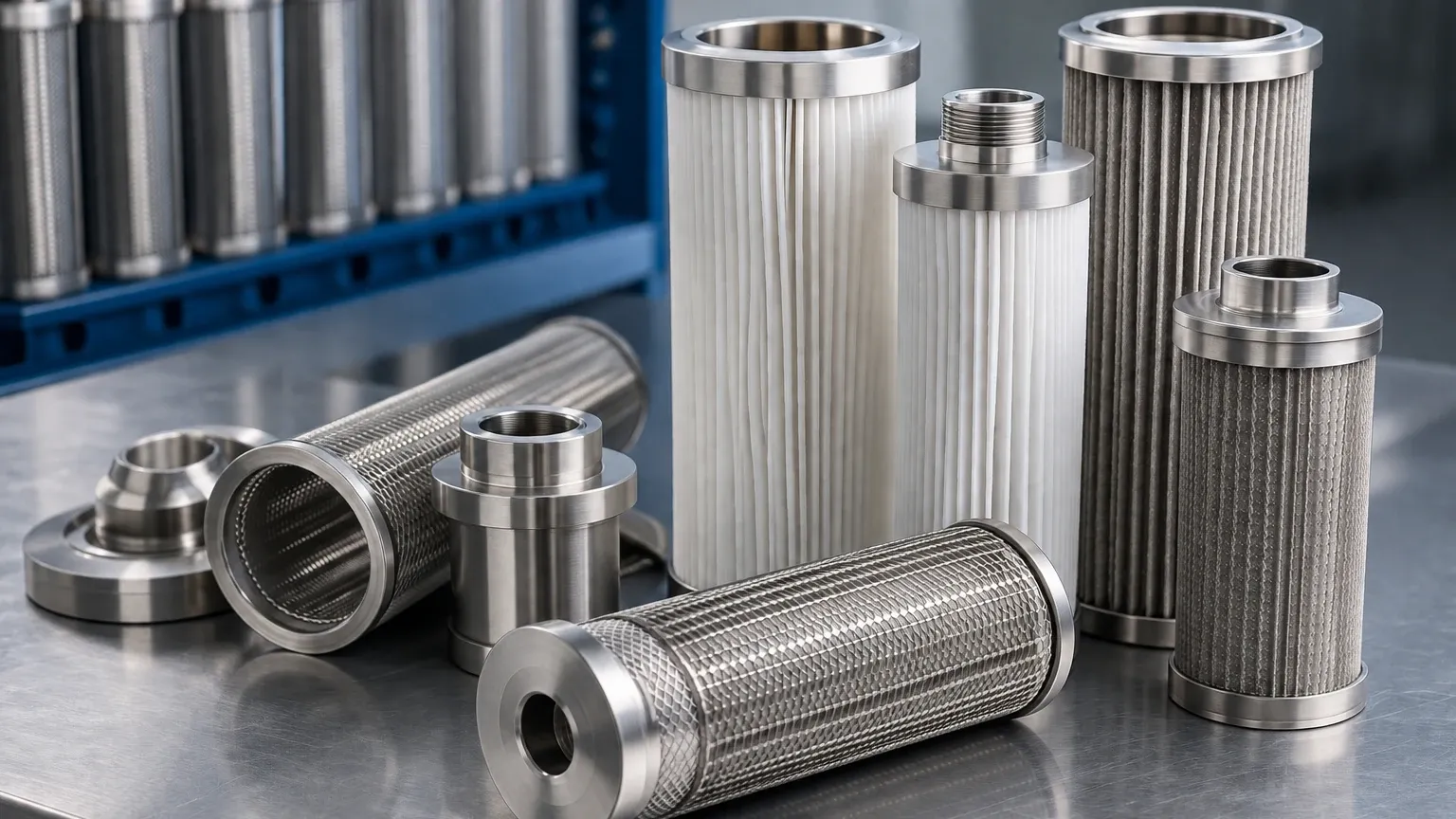
In specialized industrial applications, engineers may look toward stainless steel wire mesh Filter Cartridges to replace synthetic media. While Jandy housings are designed for synthetic pleats, understanding the transition to metal filtration components is crucial for systems handling corrosive fluids or requiring absolute filtration ratings that synthetics cannot consistently provide.
The Reinforced Center Core
One of the most common failure points in low-quality replacement cartridges is the collapse of the center core. Under high differential pressure (ΔP), which occurs as the filter becomes loaded with contaminants, the core must withstand significant inward radial force. High-quality jandy replacement filter cartridges feature cores made of extruded or injection-molded ABS or PVC with engineered flow patterns to ensure even distribution of pressure and prevent structural failure.
End Cap Integrity and Sealing
The end caps serve both as structural supports and as the primary seal within the filter housing. They are typically constructed from high-impact polyurethane or plastisol. A failure in the seal leads to "bypass," where unfiltered water escapes around the cartridge and back into the effluent stream. Precision in the molding of these caps is essential to ensure a tight fit against the manifold of the Jandy filter tank.
Performance Metrics: Micron Ratings and Pressure Drop
When specifying jandy replacement filter cartridges, technical professionals must distinguish between nominal and absolute micron ratings.
* Nominal Micron Rating: Indicates the ability of the filter to retain a majority of particles of a specific size (e.g., 80% of 15-micron particles). Most pleated pool and water cartridges are nominally rated.
* Absolute Micron Rating: Refers to the diameter of the largest hard spherical particle that will pass through the filter under specified test conditions. This is more common in precision industrial Filter Cartridges.
Understanding Differential Pressure (ΔP)
A clean cartridge should exhibit a minimal pressure drop, usually between 1 to 3 PSI, depending on the pump's flow rate. As the media traps debris, the interstitial spaces between the fibers or mesh close, and the ΔP increases. It is generally recommended to clean or replace cartridges when the pressure rises 8 to 10 PSI above the initial "clean" reading. Ignoring this leads to reduced flow rates, increased energy consumption by the pump, and potential damage to the cartridge pleats (pleat bunching).
Maintenance and Replacement Cycles in Commercial Settings
In high-demand environments, the lifecycle of jandy replacement filter cartridges is dictated by the chemical balance of the water and the nature of the contaminant load. In commercial aquatic centers, oils, minerals (calcium carbonate), and organic loads can "blind" the media, a condition where the surface becomes coated in a layer that cannot be easily removed by standard pressurized rinsing.
Cleaning Protocols
1. Mechanical Rinsing: Using a focused water spray to remove loose debris from between the pleats.
2. Degreasing: Utilizing alkaline cleaners to remove body oils and lipids that clog the polyester fibers.
3. Acid Descaling: In areas with hard water, a mild acid soak may be required to remove calcium deposits. However, this should only be done after degreasing to prevent the acid from "setting" the oils into the media.
Despite rigorous cleaning, the fibers in synthetic Filter Cartridges eventually lose their loft and filtration efficiency. In a commercial B2B context, cartridges should typically be replaced every 12 to 24 months, or sooner if the clean starting pressure remains significantly higher than the original baseline.
Risks of Substandard Replacements
The market for aftermarket jandy replacement filter cartridges is vast, but for industrial and commercial users, low-cost alternatives often carry hidden risks:
* Thin Media: Reduced fabric weight leads to premature tearing and lower dirt-holding capacity.
* Inadequate Pleat Count: Fewer pleats mean less surface area, higher flux rates, and more frequent cleaning cycles.
* Weak Cores: Susceptibility to collapse during a pressure spike, which can send debris downstream into sensitive equipment or heat exchangers.
* Poor Chemical Resistance: Substandard end caps may leach chemicals or become brittle when exposed to high levels of chlorine or bromine.
Custom Filtration Solutions and OEM Capabilities
While standard jandy replacement filter cartridges satisfy many requirements, certain industrial processes involve conditions that exceed the capabilities of standard pool-grade equipment. In these instances, custom-engineered filtration components become necessary. Manufacturing experts like Kaifil specialize in bridging the gap between standard designs and high-performance requirements.
For example, if a facility uses a Jandy-style housing for a process involving high-temperature fluids or aggressive solvents, a standard polyester cartridge will fail. Custom-manufactured stainless steel Filter Cartridges can be designed to fit existing dimensions while providing the chemical resistance and structural rigidity of metal.
Key Considerations for Custom Upgrades:
* Material Compatibility: Selecting between 304 or 316L stainless steel based on the corrosive profile of the fluid.
* Filtration Precision: Utilizing sintered wire mesh or wedge wire for specific particle size exclusion.
* Cleanability: Metal cartridges offer the advantage of being backwashable or ultrasonic cleanable, significantly extending the service life compared to disposables.
Conclusion: Optimizing Your Filtration Strategy
Selecting the right jandy replacement filter cartridges involves more than finding a part number that fits the housing. It requires an evaluation of the system's hydraulic demands, the nature of the particulates being filtered, and the long-term operational goals of the facility.
For standard water applications, prioritizing high-quality pleated polyester with reinforced cores and high pleat counts will ensure stable flow and clear water. For more complex industrial applications where standard replacements fall short, exploring custom-engineered metal Filter Cartridges can provide a more durable and cost-effective long-term solution. By focusing on technical specifications and material integrity, engineers can maintain system efficiency and protect downstream assets from contamination.
