


Quooker Water Filter Cartridges
In the realm of high-end water delivery systems, the performance and longevity of the equipment are inextricably linked to the quality of its filtration components. Systems designed for instant boiling, chilled, or sparkling water require specialized media to manage mineral content and chemical impurities. Understanding the technical specifications of quooker water filter cartridges is essential for engineers, facility managers, and technical procurement teams who must ensure that water quality meets both sensory standards and mechanical protection requirements.
As industrial filtration needs evolve, the principles governing precision Filter Cartridges remain constant: material integrity, filtration accuracy, and pressure management. This guide examines the engineering considerations behind high-performance water filtration, the specific roles of various filter media, and the technical criteria used to evaluate replacement components in demanding environments.
The Role of Specialized Filtration in Boiling Water Systems
Boiling water systems operate under unique thermal and pressure conditions that differ significantly from standard cold-water plumbing. The primary function of quooker water filter cartridges in these setups is two-fold: the protection of the internal heating elements and the improvement of the water's chemical profile.
In many regions, tap water contains high levels of calcium and magnesium ions, commonly referred to as "hard water." When this water is heated to boiling temperatures, these minerals precipitate out of the solution, forming calcium carbonate (limescale). Without effective filtration, this scale accumulates on heating elements and inside the vacuum-insulated tank, leading to reduced thermal efficiency, increased energy consumption, and eventual mechanical failure. High-quality cartridges utilize ion-exchange resins or specialized polyphosphate media to sequester these minerals or exchange them for sodium or hydrogen ions, preventing scale buildup.
Beyond scale inhibition, these cartridges address chlorine and organic compounds. Chlorine is frequently used in municipal water treatment for disinfection, but it can impart a sharp metallic taste and unpleasant odor. Furthermore, chlorine can be corrosive to certain metallic components over long exposure periods at high temperatures. Activated carbon stages within the cartridge adsorb these chemicals, ensuring the output is chemically neutral and palatable.
Technical Anatomy of High-Performance Filter Cartridges
When evaluating filter cartridges for precision water systems, it is necessary to look at the internal architecture of the filter. Most modern cartridges are multi-stage units, combining different filtration technologies into a single housing.
1. Sediment Pre-filtration
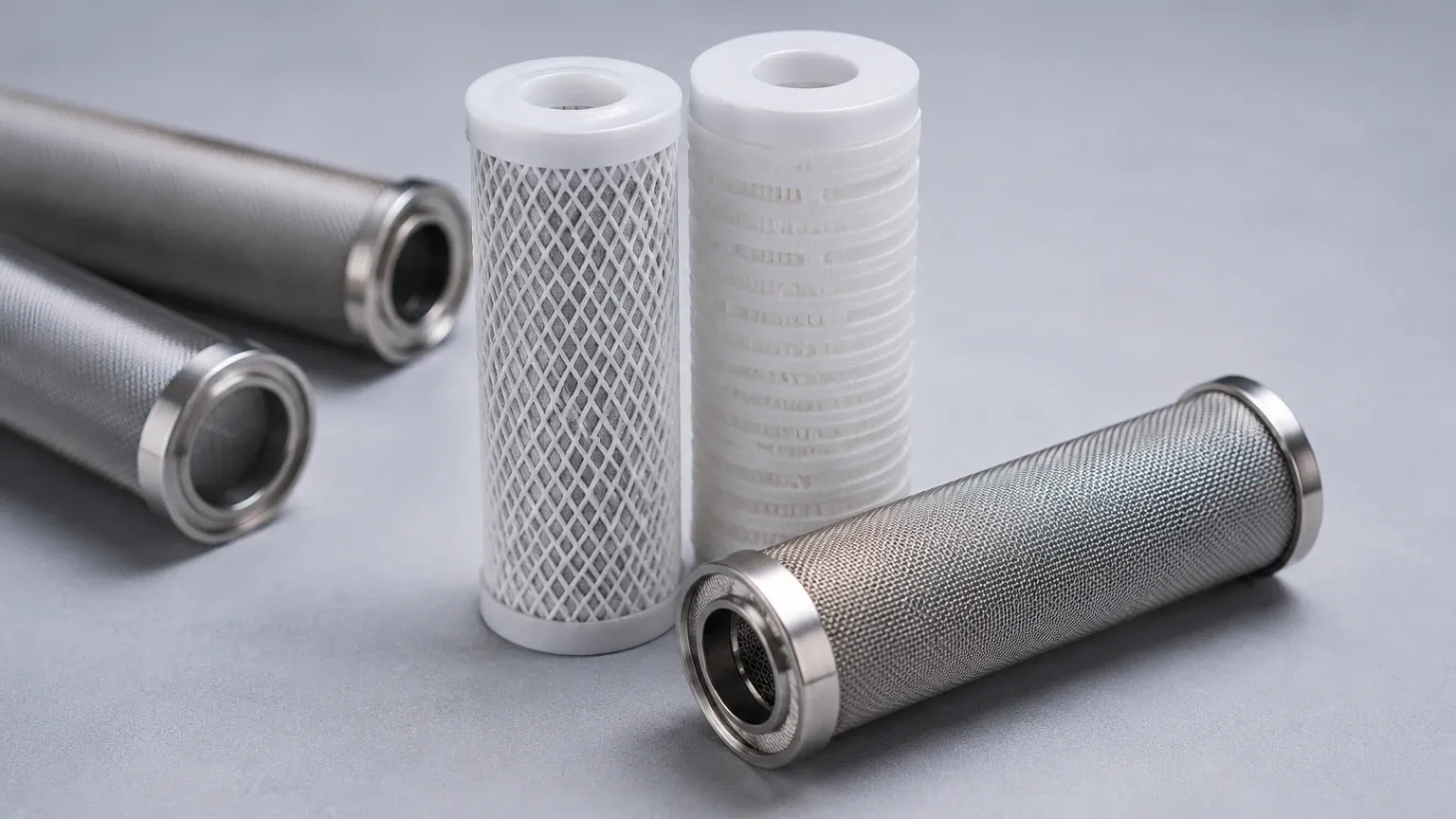
The outermost layer or the initial stage usually consists of a mechanical barrier. In industrial contexts, this might involve stainless steel wire mesh or pleated synthetic fibers. This stage is designed to capture suspended solids, such as rust particles from aging pipework, sand, or silt. By removing these larger particles first, the cartridge prevents the more delicate chemical filtration media (like activated carbon) from becoming clogged, thereby extending the total service life of the unit.
2. Ion-Exchange Resin
For systems focusing on scale reduction, the ion-exchange resin is the core component. These beads are engineered with specific surface chemistries to attract and hold hardness ions. In B2B and industrial applications, the capacity of this resin—measured in grains of hardness or liters of treated water—is a critical metric for determining replacement cycles.
3. Activated Carbon Block
Carbon blocks are preferred over granular activated carbon (GAC) in high-end systems because they offer a more uniform pore structure and prevent "channeling," where water finds a path of least resistance and bypasses the media. Carbon blocks provide high surface area for the adsorption of volatile organic compounds (VOCs) and chlorine.
Engineering Considerations: Flow Rate and Pressure Drop
A common challenge in filtration design is the trade-off between filtration fineness (micron rating) and flow rate. For a boiling water tap to function effectively, it must maintain a consistent flow without excessive splashing or mechanical strain on the pump or tank.
Every filter cartridge introduces a "pressure drop" (delta P) into the system. As the filter captures contaminants, the resistance to flow increases. If the pressure drop becomes too high, the system may experience reduced output or, in extreme cases, internal leaks due to backpressure. Engineers must select cartridges where the initial pressure drop is well within the system's operating parameters. For example, a cartridge rated for 5 liters per minute at 3 bar pressure is a standard benchmark, but this must be verified against the specific pump curves of the water system in use.
Furthermore, the structural integrity of the cartridge housing is paramount. In industrial and commercial settings, water hammers—sudden pressure surges caused by valves closing rapidly—can shatter inferior plastic housings. High-performance cartridges are often tested to withstand pressures far exceeding their rated operating pressure to ensure safety in commercial kitchens and office environments.
Material Science in Filtration: The Shift Toward Stainless Steel
While many consumer-grade quooker water filter cartridges utilize high-impact plastics, industrial-grade filtration often moves toward metal components for enhanced durability. Stainless steel, particularly 304 and 316L grades, is the material of choice for precision filtration components due to its corrosion resistance and ability to withstand high temperatures without leaching chemicals.
In high-purity applications, stainless steel filter cartridges offer several advantages:
- Thermal Stability: Unlike plastics, stainless steel does not soften or deform at boiling temperatures, making it ideal for steam and hot water applications.
- Chemical Compatibility: It is resistant to a wide range of cleaning agents and chemicals used in water treatment.
- Cleanability: Many stainless steel filters are designed to be backwashed or ultrasonically cleaned, providing a sustainable alternative to disposable plastic cartridges in certain industrial pre-filtration stages.
- Mechanical Strength: Steel components can handle higher differential pressures, reducing the risk of bypass—a situation where contaminated water leaks around the filter media due to structural failure.
For facilities looking to optimize their total cost of ownership, integrating stainless steel pre-filters can significantly reduce the burden on the primary disposable cartridges by removing the bulk of the particulate matter before it reaches the finer media.
Evaluation Criteria for Purchasing and Replacement
When procurement teams look for replacement quooker water filter cartridges or similar industrial Filter Cartridges, several technical factors should be confirmed with the manufacturer:
Micron Rating: Absolute vs. Nominal
It is vital to distinguish between nominal and absolute micron ratings. A nominal rating of 5 microns means the filter will trap a large percentage of particles of that size, but some may pass through. An absolute rating implies that 99.9% of particles at that size are retained. For protecting sensitive solenoid valves in boiling water systems, a tighter micron rating is often preferred.
Capacity and Breakthrough Points
Filter capacity is not just about the volume of water; it is about the specific contaminant. A cartridge might have a 5,000-liter capacity for chlorine removal but only a 1,500-liter capacity for scale prevention in hard water areas. Technical data sheets should provide "breakthrough" curves that show when the media becomes saturated.
Certification and Compliance
In the food and beverage sector, compliance with international standards such as NSF/ANSI (National Sanitation Foundation) or WRAS (Water Regulations Approval Scheme) is non-negotiable. These certifications ensure that the materials used in the cartridge do not migrate into the water and that the filtration claims are verified by independent testing.
Maintenance Cycles and System Longevity
The replacement cycle for quooker water filter cartridges is typically dictated by time (e.g., every 6 to 12 months) or volume. However, in industrial and high-use commercial settings, relying solely on a calendar can be risky.
Technical professionals often implement pressure gauges before and after the filtration stage. A significant increase in the differential pressure is a clear indicator that the filter is loaded with sediment and requires replacement. Conversely, if the water begins to show signs of scale (such as cloudy water or white flakes), the ion-exchange capacity has been exhausted, regardless of the pressure readings.
Failure to replace cartridges on time leads to several industrial risks:
1. Energy Inefficiency: As scale builds up on the heating element, it acts as an insulator, requiring more energy to heat the water.
2. Component Failure: Scale can jam the ceramic discs in the tap or cause the safety valves in the tank to seize.
3. Bacterial Growth: While most boiling water systems are inherently hostile to bacteria due to the temperature, the pre-filtration stages (especially carbon) can become a breeding ground for biofilm if left in place long after their chemical effectiveness has expired.
Customization and OEM Filtration Solutions
For manufacturers and large-scale industrial users, off-the-shelf filtration solutions may not always meet specific environmental challenges. This is where custom engineering becomes essential. Custom stainless steel filter cartridges can be designed to fit existing housings while providing superior filtration characteristics for specific water chemistries.
Customization options often include:
- Variable Mesh Sizes: Tailoring the weave of a stainless steel mesh to target specific particle sizes found in local water supplies.
- Reinforced Cores: Designing cartridges that can withstand extreme pressure spikes in industrial plumbing systems.
- Specialized End Caps: Ensuring a perfect, leak-proof seal with various proprietary housing designs.
By working with a manufacturer that understands the nuances of metal fabrication and filtration science, companies can develop proprietary filtration components that enhance the reliability of their water delivery hardware.
Conclusion
Selecting the correct quooker water filter cartridges—or any industrial-grade filtration component—requires a move beyond marketing claims and into the realm of technical specifications. By focusing on micron ratings, material compatibility, and the specific chemical challenges of the local water supply, engineers can protect expensive boiling water hardware and ensure consistent output quality.
Whether the goal is to prevent scale in a commercial kitchen or to ensure high-purity water for industrial processing, the principles of effective filtration remain rooted in precision engineering. As systems become more complex and energy efficiency becomes more critical, the role of high-quality Filter Cartridges will only continue to grow in importance. For those managing high-volume or critical-path water systems, investing in superior filtration is not just a maintenance task; it is a fundamental strategy for operational reliability.
