


Replacement Water Filter Cartridges
In industrial water treatment and process fluid management, the efficiency of a filtration system is fundamentally tied to the performance of its internal components. Among these, filter cartridges serve as the primary barrier against contaminants, ensuring that downstream equipment is protected and product quality remains consistent. Selecting high-quality replacement water filter cartridges is not merely a maintenance task; it is a critical engineering decision that affects operational uptime, energy consumption, and the total cost of ownership.
For engineers and procurement professionals in sectors such as chemical processing, pharmaceuticals, and food and beverage production, understanding the technical nuances of these components is essential. This guide examines the engineering considerations, material science, and performance metrics necessary to optimize the selection and replacement of industrial filtration media.
The Role of Filter Cartridges in Industrial Water Systems
Industrial water systems rely on Filter Cartridges to remove suspended solids, particulates, and microorganisms from process streams. Unlike bulk media filters or sand filters, cartridge-based systems offer high precision and a compact footprint, making them ideal for point-of-use filtration and critical polishing stages.
In a typical industrial cycle, water passes through the filter media, which captures contaminants through various mechanisms such as mechanical straining, depth filtration, or adsorption. Over time, the accumulated debris increases the resistance to flow, leading to a rise in differential pressure (ΔP). When this pressure reaches a predetermined threshold, the cartridges must be cleaned or replaced to prevent system failure or bypass. Choosing the correct replacement water filter cartridges ensures that the system returns to its baseline efficiency without compromising the integrity of the process.
Technical Specifications for Selection
When evaluating replacement options, several technical parameters must be analyzed to ensure compatibility with the existing housing and the specific process requirements.
Micron Rating: Nominal vs. Absolute
One of the most misunderstood aspects of filtration is the micron rating. A nominal rating refers to a filter's ability to retain a major percentage (usually 60% to 90%) of particles of a specific size. In contrast, an absolute rating indicates that 99.9% or more of particles above a certain size will be captured. For critical applications in the pharmaceutical or semiconductor industries, absolute-rated cartridges are often mandatory to ensure process safety.
Flow Rate and Differential Pressure
The relationship between flow rate and differential pressure is a key indicator of filter health. Every cartridge has a "clean pressure drop," which is the initial resistance it offers to the fluid. As the filter loads with contaminants, the ΔP increases. Engineers must select cartridges that can handle the required flow rate without exceeding the pump's capacity or the housing's pressure limits.
Chemical and Thermal Compatibility
In industrial environments, water is rarely just H2O. It may contain solvents, acids, bases, or be processed at extreme temperatures. Stainless steel filter cartridges are frequently preferred over polymeric alternatives in these scenarios due to their superior thermal stability and chemical resistance. For example, 316L stainless steel provides excellent corrosion resistance in chloride-rich environments, which is a common requirement in desalination and chemical processing.
Comparing Materials: Stainless Steel vs. Polymeric Media
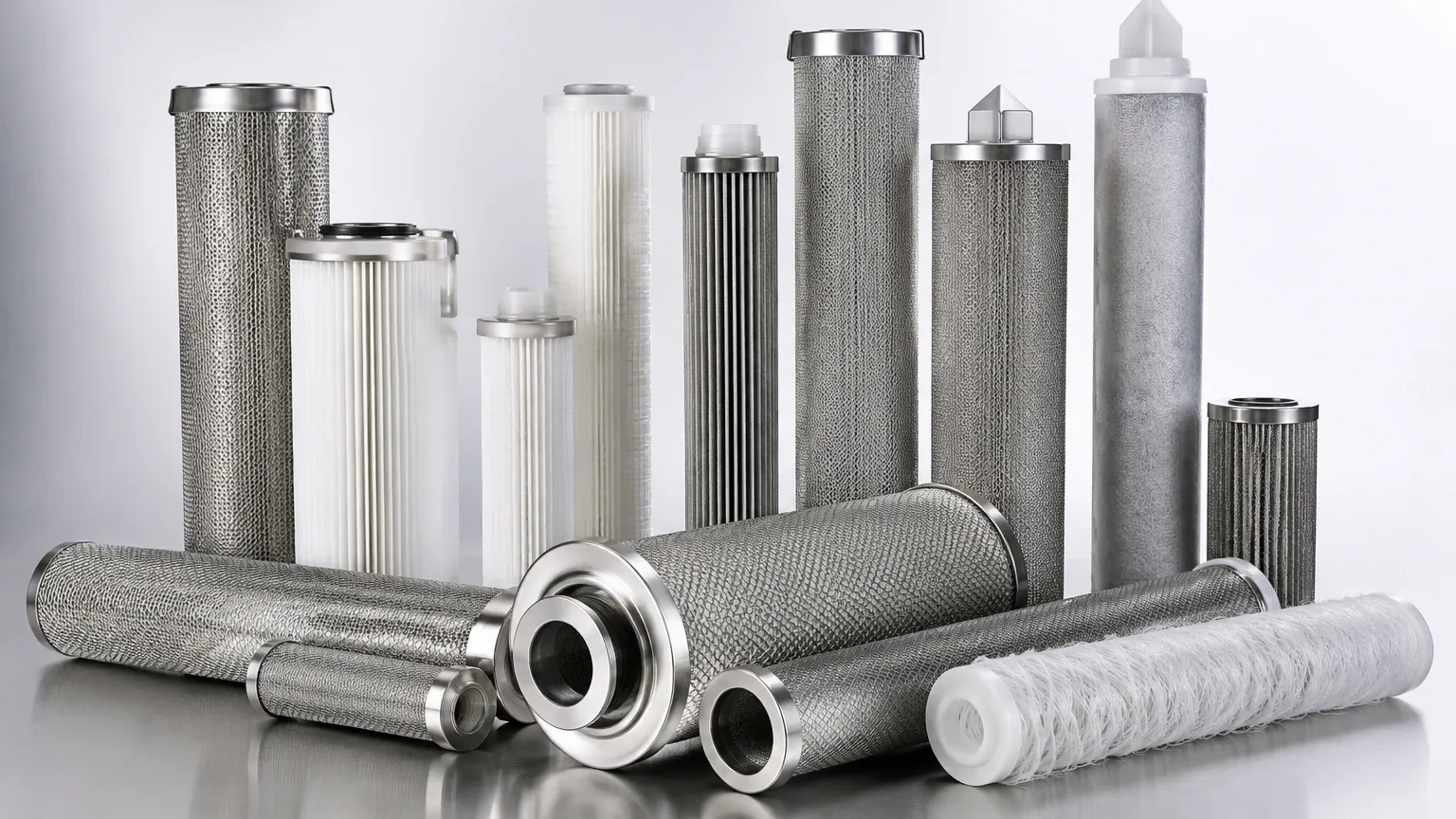
While polypropylene and other synthetic materials are common for low-temperature, non-corrosive applications, many industrial processes demand the durability of metal. As a specialized manufacturer, Kaifil provides advanced stainless steel filtration solutions that address the limitations of disposable media.
Durability and Reusability
Polymeric cartridges are typically single-use. Once they reach their terminal pressure drop, they are discarded, contributing to waste and recurring procurement costs. In contrast, stainless steel wire mesh and sintered metal cartridges are cleanable and reusable. Through ultrasonic cleaning, backwashing, or chemical steeping, these cartridges can be restored to near-original performance levels, significantly extending their service life.
Structural Integrity
Under high-pressure or high-viscosity conditions, synthetic cartridges may suffer from media migration or structural collapse. Stainless steel cartridges maintain their pore geometry even under significant mechanical stress. This ensures that the filtration accuracy remains constant throughout the entire service cycle, preventing "slugs" of contaminants from passing through if a soft filter bypasses or fails.
Identifying the Need for Replacement
Establishing a rigorous monitoring protocol is the only way to ensure that replacement water filter cartridges are installed at the optimal time. Relying on visual inspection is rarely sufficient in industrial settings.
1. Differential Pressure Gauges: The most reliable method is monitoring the ΔP across the filter housing. Most systems are designed for a change-out at approximately 15 to 25 psi (1.0 to 1.7 bar) of differential pressure, depending on the pump curve and housing specifications.
2. Flow Rate Decay: If the system is operating under constant pressure, a noticeable drop in effluent flow rate indicates that the filter media is blinded and requires attention.
3. Downstream Water Quality: Regular sampling of the filtered water for turbidity or particle counts can reveal when a cartridge has reached its capacity or if internal seals have failed.
4. Scheduled Maintenance: In highly stable processes, a time-based replacement schedule may be implemented to prevent any risk of breakthrough, though this is often less cost-effective than condition-based monitoring.
Engineering Considerations for Customization
Standard off-the-shelf solutions do not always meet the rigorous demands of specialized industrial equipment. Customization in the design of replacement water filter cartridges allows engineers to fine-tune performance for specific applications.
End-Cap Configurations
To ensure a leak-proof seal, the cartridge end-caps must match the housing's internal hardware. Common configurations include:
* DOE (Double Open End): Requires flat gaskets at both ends; common in standard housings.
* SOE (Single Open End) with 222 or 226 O-Rings: Features a locking tab or fin for secure positioning, often used in high-purity applications to prevent bypass.
* Threaded Connections: Used in high-pressure or high-vibration environments to ensure the cartridge remains seated.
Pleated vs. Cylindrical Designs
Pleating the filter media significantly increases the available surface area within the same footprint. For a given flow rate, a pleated stainless steel cartridge will have a lower initial pressure drop and a higher dirt-holding capacity than a standard cylindrical design. This leads to longer intervals between cleaning or replacement cycles.
Total Cost of Ownership and Operational Efficiency
When procurement departments evaluate replacement water filter cartridges, the focus is often on the unit price. However, for an engineering team, the Total Cost of Ownership (TCO) is a more accurate metric. TCO includes:
* Purchase Price: The initial cost of the cartridge.
* Labor Costs: The time required for maintenance personnel to change out filters.
* Disposal Costs: The expense associated with disposing of contaminated single-use filters.
* Energy Costs: The extra power required by pumps to push fluid through a partially clogged or inefficient filter.
* Downtime: The lost production value when the system is offline for filter maintenance.
By switching to high-performance, cleanable stainless steel cartridges, many facilities find that while the initial investment is higher, the TCO over a two-to-five-year period is substantially lower. The ability to clean and reuse the media eliminates the constant cycle of purchasing and disposing of synthetic filters.
Technical Support and OEM Capabilities
Navigating the complexities of industrial filtration requires a partner with deep manufacturing expertise. Kaifil specializes in providing custom stainless steel filtration solutions that meet precise engineering specifications. Whether the application involves high-temperature steam filtration, corrosive chemical processing, or high-flow water treatment, the focus remains on delivering durability and precision.
For engineers looking to optimize their systems, confirming the specific operating conditions—including peak flow rates, maximum operating temperature, and the chemical composition of the fluid—is the first step toward selecting the right filtration component. Custom OEM designs can further refine these parameters, ensuring that the replacement water filter cartridges are perfectly aligned with the system's mechanical and hydraulic requirements.
In conclusion, the selection of replacement water filter cartridges is a balance of material science, hydraulic engineering, and economic analysis. By prioritizing high-quality materials like stainless steel and focusing on absolute performance metrics, industrial operators can achieve higher process reliability and improved long-term efficiency.
