


Water Filter Cartridges
In industrial water treatment and process engineering, the efficiency of a system often depends on the reliability of its core components. Industrial water filter cartridges serve as the primary barrier against contaminants, ensuring that process water meets specific purity standards required for downstream equipment protection, product quality, and regulatory compliance. Unlike residential applications, industrial-grade water filter cartridges must withstand high pressure, temperature fluctuations, and potentially corrosive environments while maintaining precise filtration accuracy.
Selecting the appropriate Filter Cartridges requires a deep understanding of fluid dynamics, material science, and the specific contaminants present in the water stream. This guide examines the technical considerations, material selection, and performance metrics essential for engineers and procurement teams evaluating filtration solutions.
Understanding the Role of Filter Cartridges in Industrial Water Treatment
Water filtration in an industrial context is rarely a single-stage process. It typically involves a sequence of filtration steps, where water filter cartridges play a critical role in both pre-filtration and final polishing stages. In pre-filtration, these cartridges protect expensive sensitive equipment, such as reverse osmosis (RO) membranes or high-pressure pumps, by removing suspended solids that could cause fouling or mechanical wear.
In process water applications, the requirements become even more stringent. For industries like pharmaceutical manufacturing or electronics, water must be free of microscopic particulates that could compromise product integrity. Here, the structural stability of the filter media is paramount. Stainless steel filter cartridges are frequently preferred over polymer-based alternatives in these high-stakes environments due to their superior mechanical strength and resistance to media migration—a phenomenon where the filter material itself sheds particles into the filtrate.
Engineering Specifications for Stainless Steel Water Filter Cartridges
When evaluating water filter cartridges for industrial use, the material of construction is the first point of technical assessment. While polypropylene and pleated paper are common for low-demand scenarios, stainless steel (typically 304 or 316L) is the standard for demanding industrial cycles.
Material Integrity and Corrosion Resistance
Stainless steel 316L is particularly valued in water treatment due to its enhanced resistance to pitting and crevice corrosion, especially in water containing chlorides. The use of high-grade alloys ensures that the cartridge does not introduce metallic contaminants into the water stream, which is a critical requirement in food, beverage, and chemical processing.
Filtration Media Types
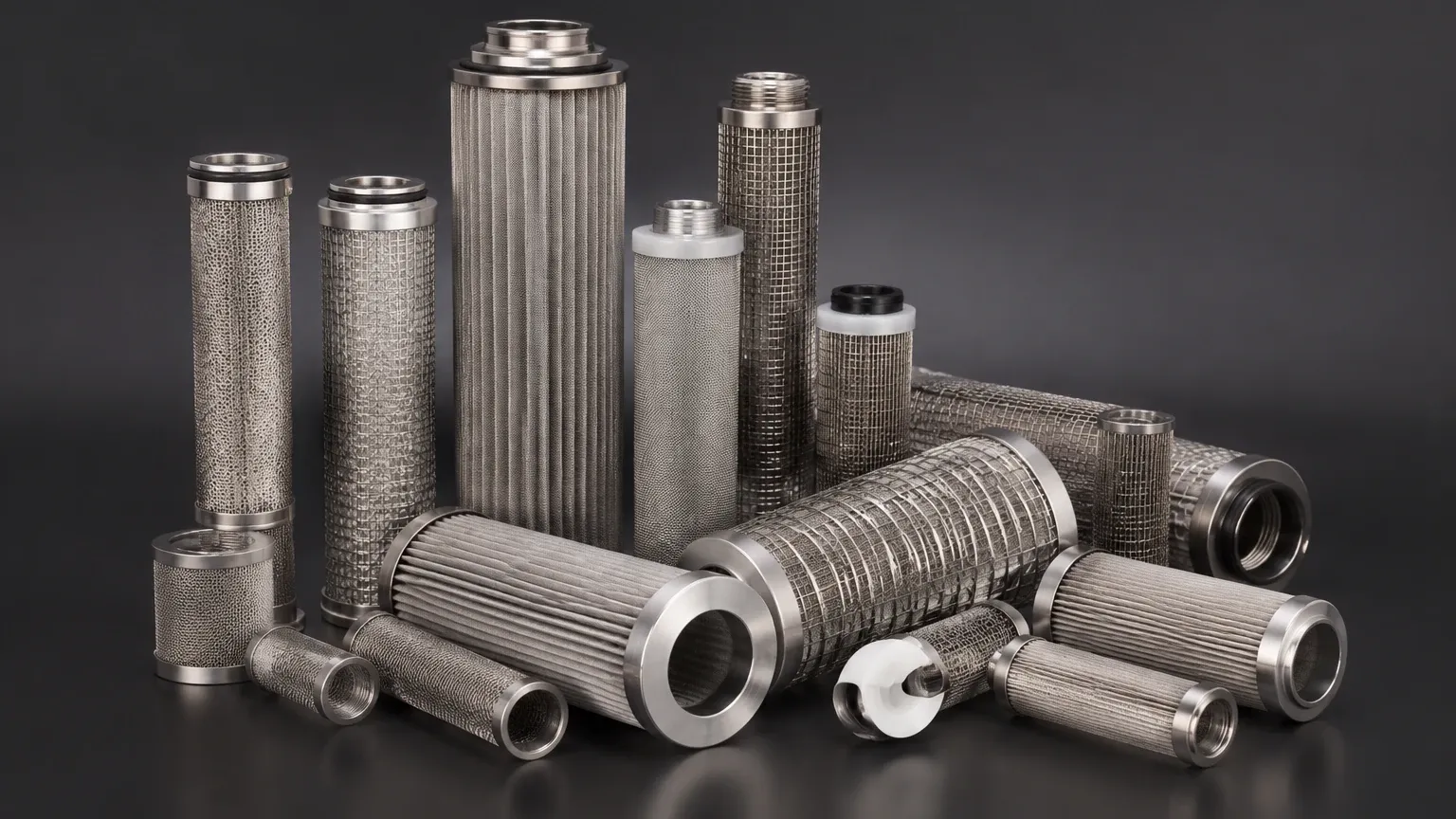
1. Sintered Wire Mesh: This involves multiple layers of stainless steel wire cloth bonded through a vacuum sintering process. This creates a robust, porous structure with precise pore sizes that do not shift under pressure.
2. Pleated Metal Mesh: By pleating the wire mesh, the effective filtration area is significantly increased. This design allows for higher flow rates and a higher dirt-holding capacity within the same footprint, reducing the frequency of maintenance intervals.
3. Sintered Metal Fiber: This media consists of non-woven stainless steel fibers. It offers high porosity and excellent permeability, making it ideal for high-viscosity fluids or applications requiring very low pressure drops.
Key Factors in Selecting Water Filter Cartridges for Demanding Environments
Engineers must look beyond simple micron ratings when specifying water filter cartridges. A comprehensive selection process involves several interdependent variables:
Micron Rating: Absolute vs. Nominal
A "nominal" rating indicates the filter can trap a large percentage of particles of a certain size, but it does not guarantee 100% efficiency. In contrast, an "absolute" rating signifies that the filter will block 99.9% or more of particles at the specified micron level. For critical water applications, such as protecting spray nozzles or fine membranes, absolute-rated stainless steel cartridges are necessary to prevent bypass.
Chemical Compatibility
Industrial water often contains additives, cleaning agents, or varying pH levels. Stainless steel cartridges offer broad chemical compatibility, remaining stable in both highly acidic and alkaline environments where synthetic fibers might degrade or leach chemicals. This stability is vital for "Clean-in-Place" (CIP) systems where harsh chemicals are used to sanitize the entire fluid path.
Temperature and Pressure Thresholds
Polymer cartridges often have a maximum operating temperature of 60°C to 80°C. In contrast, stainless steel water filter cartridges can operate at temperatures exceeding 300°C, making them suitable for steam filtration or hot process water. Furthermore, the high collapse pressure of metal cartridges ensures they remain functional even during sudden pressure spikes or high differential pressure scenarios.
Performance Evaluation: Flow Rate and Filtration Accuracy
The performance of a filter cartridge is measured by its ability to balance filtration fineness with flow efficiency. A common engineering challenge is the "pressure drop" (Delta P). As a filter captures contaminants, the resistance to flow increases.
Optimizing the Pressure Drop
An ideal water filter cartridge provides a low initial pressure drop, which conserves energy by reducing the load on pumps. Stainless steel pleated designs are particularly effective here; by maximizing the surface area, they distribute the flow over a larger region, lowering the velocity through the media and extending the time it takes to reach the terminal pressure drop (the point at which the cartridge must be cleaned or replaced).
Dirt-Holding Capacity
This refers to the total mass of contaminants a cartridge can retain before the pressure drop becomes unacceptable. In industrial water treatment, high dirt-holding capacity is synonymous with lower operational costs. Metal mesh cartridges can be engineered with specific pore structures to maximize depth filtration, allowing particles to be trapped throughout the thickness of the media rather than just on the surface.
Maintenance and Operational Longevity of Metal Filter Elements
One of the primary advantages of stainless steel water filter cartridges over disposable options is their cleanability. In a B2B operational context, the Total Cost of Ownership (TCO) is often lower for permanent metal filters despite a higher initial capital expenditure.
Cleaning Methods
* Backwashing: Reversing the flow of water through the cartridge to dislodge surface contaminants.
* Ultrasonic Cleaning: Using high-frequency sound waves in a solvent bath to remove fine particles trapped deep within the sintered layers.
* Chemical Cleaning: Using specific solvents to dissolve organic or inorganic scaling without damaging the stainless steel structure.
Because these cartridges can be cleaned and reused hundreds of times, they significantly reduce the waste stream and the logistics costs associated with purchasing, storing, and disposing of thousands of single-use polymer filters. This makes them a more sustainable choice for large-scale industrial facilities.
Customization and OEM Solutions for Specialized Water Applications
No two industrial water systems are identical. Factors such as housing dimensions, flow direction, and specific contaminant profiles often necessitate customized filtration components. Customization options for water filter cartridges typically include:
* End Cap Configurations: Standardizing connections such as DOE (Double Open End), SOE (Single Open End) with 222 or 226 O-rings, or threaded connections to ensure a leak-proof fit in existing housings.
* Reinforced Cores: For high-pressure applications, internal support cores can be added to prevent structural collapse.
* Bespoke Micron Grades: Engineering specific mesh weaves to target unique particle shapes or sizes found in specific industrial byproducts.
Working with a manufacturer that provides OEM services allows engineering teams to integrate filtration solutions directly into their equipment designs, ensuring that the filter performance is perfectly matched to the system's mechanical requirements.
Conclusion: Making an Informed Procurement Decision
When specifying water filter cartridges for industrial use, the focus should remain on technical reliability and long-term operational efficiency. While disposable filters may seem cost-effective initially, the durability, temperature resistance, and cleanability of stainless steel components often provide better value in demanding B2B environments.
By confirming the specific micron requirements, flow rates, and chemical exposures of your application, you can select a filtration solution that not only protects your equipment but also optimizes your entire production process. For those seeking high-performance, durable filtration components, exploring specialized Filter Cartridges is a critical step in achieving superior water quality and system longevity.
