


1 2 Disc Filter
In industrial filtration, precision is often measured in millimeters and inches. The 1 2 disc filter—commonly referring to a 1/2-inch diameter filtration component—represents a critical intersection of micro-scale engineering and high-performance material science. These small-diameter Filter Discs & Packs are essential for protecting sensitive downstream components, ensuring the purity of chemical reagents, and maintaining the integrity of hydraulic systems where space is at a premium but filtration demands are high.
Selecting the correct 1 2 disc filter requires a deep understanding of wire mesh geometry, material compatibility, and the mechanical stresses of the operating environment. For engineers and procurement specialists, the challenge lies in balancing the micron rating with the structural stability of the disc, especially when dealing with high-pressure or high-temperature fluids.
The Role of Filter Discs & Packs in Precision Engineering
Industrial filtration is rarely a single-stage process. In many systems, Filter Discs & Packs serve as the final line of defense or as primary filtration elements in compact assemblies. A 1 2 disc filter is typically integrated into valve bodies, nozzle assemblies, or manifold blocks. Despite their small size, these discs must withstand significant differential pressures without deforming or shedding media.
Kaifil specializes in the manufacturing of these components, utilizing advanced punching and sintering technologies to ensure that every disc meets strict dimensional tolerances. In a B2B context, the reliability of a 1/2-inch disc is paramount; a single failure can lead to the contamination of an entire production batch or the catastrophic failure of a high-value hydraulic pump.
Material Science: Beyond Standard Stainless Steel
The performance of a 1 2 disc filter is fundamentally dictated by its material composition. While stainless steel is the industry standard, the specific grade chosen impacts corrosion resistance, thermal expansion, and longevity.
* Stainless Steel 304: The most common choice for general industrial applications. It offers excellent cost-effectiveness and good corrosion resistance for water-based media and mild chemicals.
* Stainless Steel 316L: Preferred for pharmaceutical, food and beverage, and marine applications. The addition of molybdenum provides superior resistance to chlorides and pitting corrosion. The "L" (low carbon) designation is crucial for components that require welding, as it prevents carbide precipitation.
* High-Nickel Alloys: For extreme environments involving high-temperature acids or caustic solutions, alloys like Hastelloy or Inconel may be utilized in disc construction to prevent premature degradation.
Technical Specifications of the 1 2 Disc Filter
When specifying a 1 2 disc filter, engineers must look beyond the outer diameter. The internal structure of the mesh determines how the filter will behave under load.
Weave Types and Their Impact
The weave pattern of the wire mesh within the disc influences both the filtration accuracy and the flow characteristics:
1. Plain Weave: The simplest and most common weave, where each warp wire crosses over and under each weft wire. It provides a high open area and low pressure drop, making it ideal for high-flow 1 2 disc filter applications.
2. Twill Weave: Each warp wire passes over and under two weft wires. This allows for a heavier wire diameter and a tighter mesh count, providing increased strength for finer filtration tasks.
3. Dutch Weave (Plain and Twill): This weave uses a larger diameter warp wire and a smaller diameter weft wire. The result is a dense, strong mesh with very small triangular openings. Dutch weave discs are used when absolute micron ratings and high mechanical strength are required.
Multi-Layer vs. Single-Layer Construction
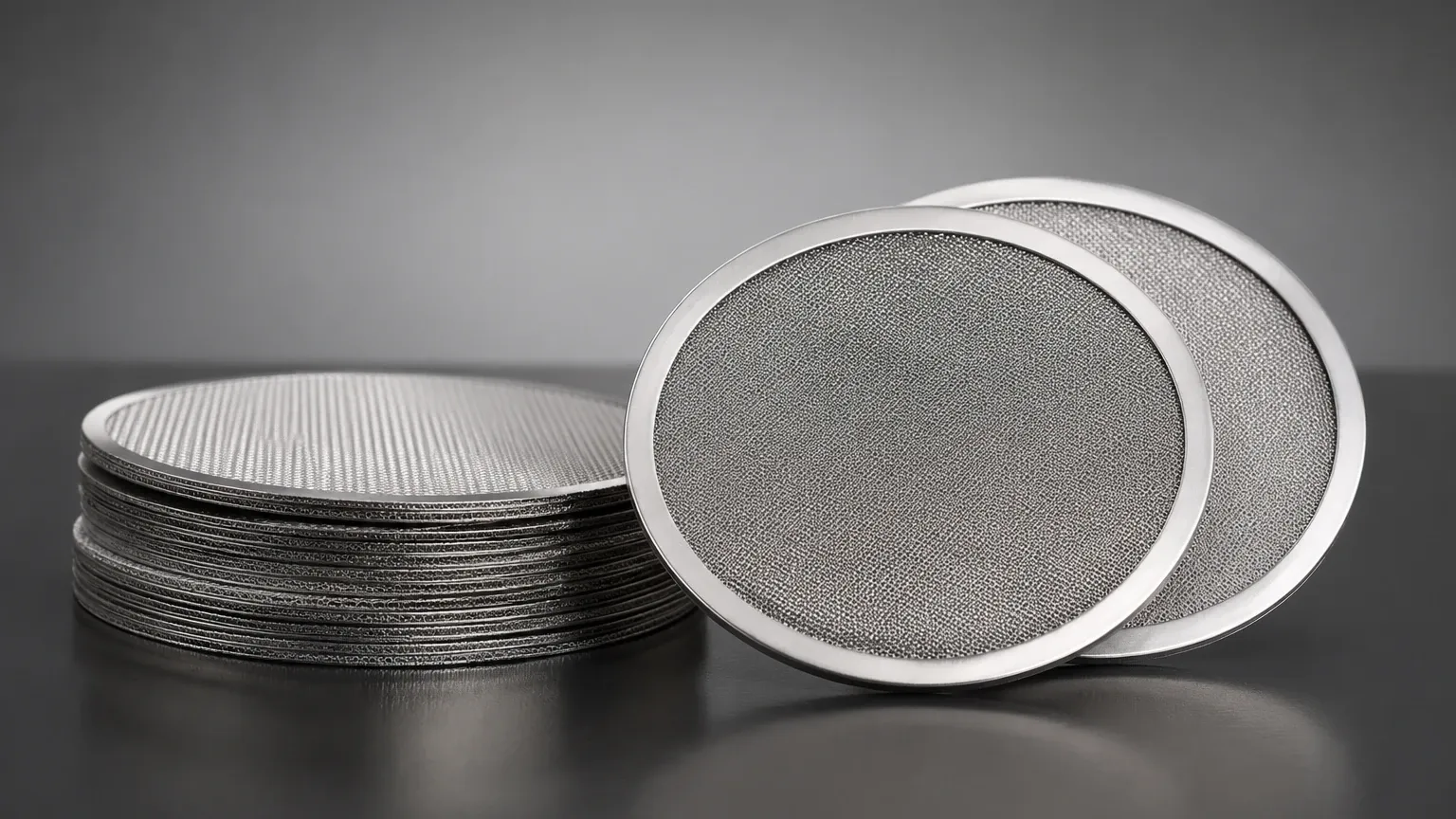
A 1 2 disc filter can be produced as a single layer of mesh or as a multi-layer pack. Single-layer discs are typically used for simple straining or as support layers. However, in most industrial scenarios, multi-layer Filter Discs & Packs are used to provide graduated filtration.
In a multi-layer configuration, a fine filtration layer is sandwiched between coarser support layers. This design protects the delicate fine mesh from mechanical damage and helps distribute the fluid flow evenly across the surface. These layers are often spot-welded or sintered together to form a monolithic structure that prevents bypass and ensures the disc remains intact under high differential pressure.
Engineering Considerations for 1 2 Disc Filter Selection
Selecting a 1 2 disc filter is not a "one size fits all" process. Engineers must evaluate several variables to ensure the component will perform reliably over its intended service life.
Micron Rating: Nominal vs. Absolute
One of the most frequent points of confusion in filtration procurement is the distinction between nominal and absolute micron ratings.
* Nominal Rating: Represents the ability of the filter to retain a certain percentage (usually 60% to 90%) of particles of a specific size. It is an indication of the "average" pore size.
* Absolute Rating: Refers to the diameter of the largest hard spherical particle that will pass through the filter under specified test conditions. For critical applications, such as protecting precision nozzles in a 1 2 disc filter assembly, an absolute rating is often required to ensure no particles above the limit can pass through.
Pressure Drop and Flow Rate
The 1/2-inch diameter provides a relatively small surface area (approximately 0.196 square inches). Therefore, the pressure drop (ΔP) across the 1 2 disc filter is a critical calculation. If the mesh is too dense for the required flow rate, the pressure drop will be excessive, leading to energy inefficiency or system failure. Conversely, if the mesh is too open, filtration efficiency is sacrificed. Engineers must calculate the "Clean Pressure Drop" and account for the "Terminal Pressure Drop"—the point at which the filter is considered blinded and must be replaced.
Edge Treatment and Sealing
How the 1 2 disc filter is held in place is as important as the mesh itself. There are three primary edge treatments:
1. Raw Edges: The mesh is simply punched to size. This is cost-effective but can lead to fraying or loose wires if the disc is not tightly compressed in its housing.
2. Spot Welded Edges: Used for multi-layer packs to keep the layers aligned during installation.
3. Rimmed Edges: The disc is encased in a metal rim (typically aluminum, stainless steel, or copper). The rim provides a positive sealing surface and prevents any bypass around the edges of the filter. For a 1 2 disc filter, a rimmed edge is often preferred to ensure a gas-tight or liquid-tight fit within a threaded housing.
Industrial Applications of 1 2 Disc Filters
The versatility of Filter Discs & Packs allows them to be used across a broad spectrum of industries. The 1 2 disc filter, in particular, is found in several niche but vital applications.
Chemical and Petrochemical Processing
In chemical laboratories and pilot plants, 1/2-inch disc filters are used in sampling lines to protect sensitive analytical instruments from particulate matter. Their ability to be manufactured from corrosion-resistant alloys like 316L or Hastelloy makes them indispensable for handling aggressive reagents.
Plastic and Polymer Extrusion
While large screen changers use massive filter packs, smaller extrusion lines—such as those used for 3D printing filaments or medical tubing—often utilize 1 2 disc filter components. These discs remove gels and unmelted polymer fragments that would otherwise cause defects in the final product.
Hydraulic and Pneumatic Systems
In high-pressure hydraulic circuits, small disc filters are placed before sensitive valves or orifices. They act as "last chance" filters, catching any debris generated by pump wear or seal degradation before it can jam a critical component.
Pharmaceutical and Biotechnology
For small-batch processing or specialized filtration of high-value fluids, 1 2 disc filters provide a controlled environment for removing contaminants. The use of sintered stainless steel mesh allows these filters to be cleaned and sterilized (via autoclave or SIP), supporting sustainable and sterile manufacturing practices.
Maintenance, Cleaning, and Replacement Cycles
Understanding the lifecycle of a 1 2 disc filter is essential for maintaining system uptime. Unlike disposable synthetic filters, stainless steel Filter Discs & Packs offer the advantage of cleanability.
Indicators for Replacement
The primary indicator that a 1 2 disc filter requires attention is an increase in differential pressure. In automated systems, pressure transducers monitor this ΔP. In manual systems, a noticeable drop in flow rate or downstream pressure usually signals that the filter is becoming clogged. It is vital to replace or clean the disc before the pressure reaches a level that could cause the mesh to rupture (the "collapse pressure").
Cleaning Methods
Stainless steel discs can often be restored to near-original performance through various cleaning methods:
* Ultrasonic Cleaning: The most effective method for removing fine particles trapped deep within the mesh pores. High-frequency sound waves create cavitation bubbles that dislodge contaminants.
* Backwashing: Reversing the flow of fluid through the filter to push particles out of the mesh. This is most effective for surface-loading plain weave meshes.
* Chemical Cleaning: Using solvents or acids to dissolve organic or inorganic deposits. This must be done with careful consideration of the filter's material compatibility.
Despite the ability to clean these discs, there comes a point where cumulative mechanical stress or irreversible blinding makes replacement necessary. Establishing a regular maintenance schedule based on historical performance data is recommended.
Customization and OEM Solutions with Kaifil
As a professional manufacturer, Kaifil understands that standard off-the-shelf solutions do not always meet the rigorous demands of specialized industrial applications. Customization is at the core of our service for 1 2 disc filter products.
Tailored Specifications
We work closely with engineering teams to define the exact parameters required for their specific application. This includes:
* Custom Mesh Counts: Adjusting the number of wires per inch to achieve a specific flow-to-filtration ratio.
* Specialized Layering: Designing unique multi-layer stacks that provide both depth filtration and extreme structural rigidity.
* Precision Tolerances: Using CNC punching and laser cutting to ensure that the outer diameter of the 1 2 disc filter fits perfectly into proprietary housings.
Quality Assurance
Every 1 2 disc filter produced undergoes rigorous quality checks. This includes bubble point testing to verify micron ratings, dimensional inspections using high-resolution optical equipment, and material verification through XRF analysis. For B2B partners, this level of documentation is often required to meet regulatory standards and internal quality management systems.
Conclusion: Making Informed Purchasing Decisions
The 1 2 disc filter may be small, but its impact on industrial efficiency and component protection is significant. By focusing on material grade, weave type, and structural design, engineers can ensure they are selecting a component that will withstand the rigors of their specific environment.
When evaluating suppliers for Filter Discs & Packs, it is essential to partner with a manufacturer that possesses both the technical expertise to advise on selection and the manufacturing capability to deliver consistent quality. Whether you are designing a new hydraulic manifold or optimizing a chemical sampling line, the right 1 2 disc filter is a fundamental building block of a reliable system.
For technical professionals looking to optimize their filtration processes, the next step involves a detailed review of flow requirements and contaminant profiles. By confirming these variables early in the design or procurement phase, you can avoid costly downtime and ensure the long-term integrity of your industrial operations.
