


6 Pack Filter
In the demanding landscape of industrial filtration, the efficiency of a process often hinges on the precision and durability of the filtration media. Among the various configurations used in high-pressure and high-temperature environments, the multi-layer filter pack—specifically the 6 pack filter configuration—stands out as a critical component for ensuring product purity and equipment longevity. These components, often categorized under the broader umbrella of Filter Discs & Packs, are engineered to handle the rigorous stresses of polymer extrusion, chemical processing, and hydraulic systems.
For engineers and procurement specialists, understanding the technical nuances of a 6 pack filter is essential. It is not merely about the number of layers; it is about the strategic layering of different mesh counts to achieve a specific filtration objective. This guide explores the engineering principles, material considerations, and application-specific requirements that define high-performance filter packs.
Understanding the 6 Pack Filter Configuration
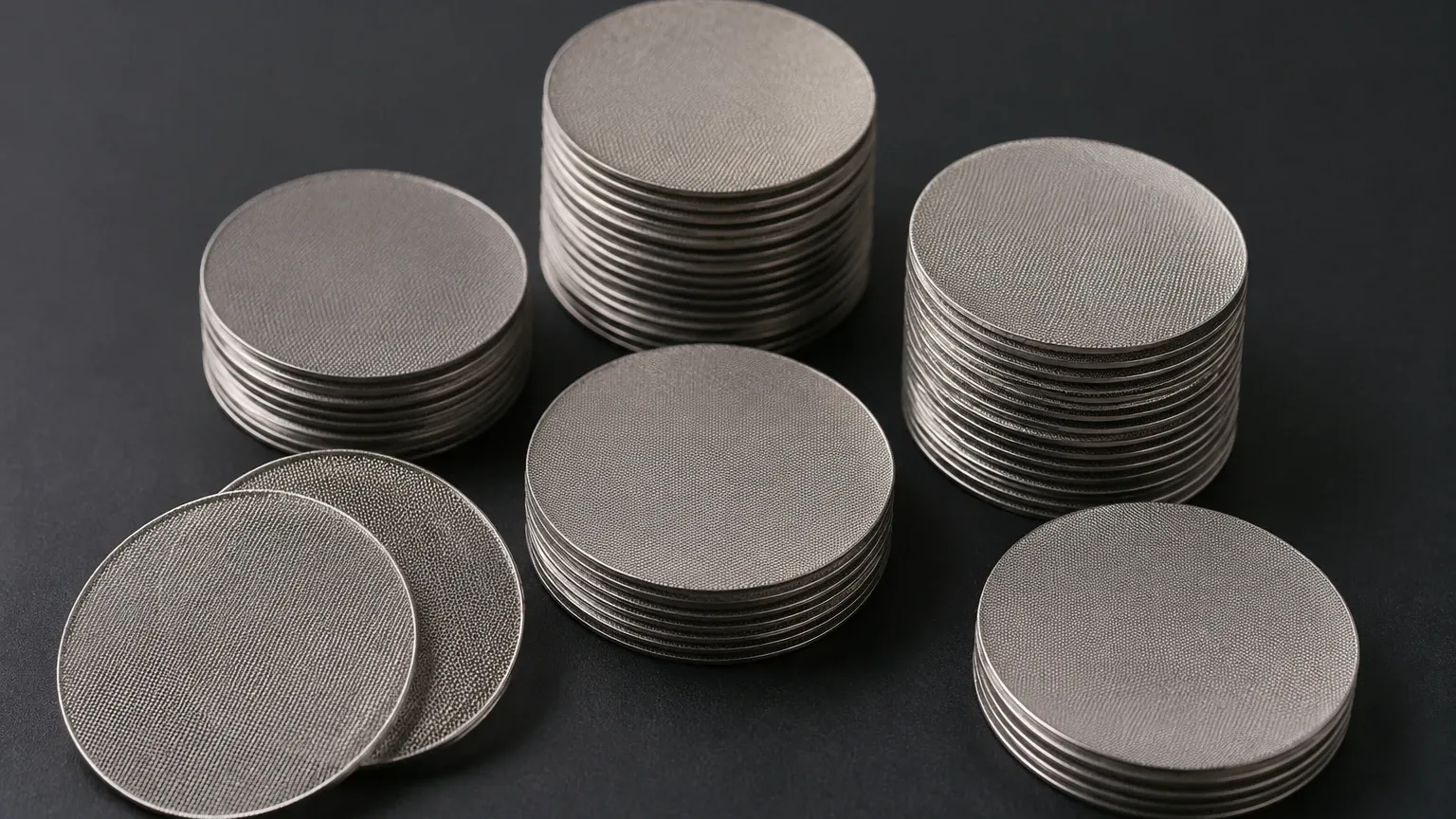
The term "6 pack filter" typically refers to a multi-layer filter disc assembly consisting of six distinct layers of stainless steel wire mesh. In industrial filtration, single-layer discs are often insufficient for high-viscosity fluids or high-pressure differentials. By combining six layers, manufacturers can create a "graduated" filtration effect.
In a standard 6-layer sequence, the layers are arranged symmetrically or progressively. A common configuration might include:
1. Support Mesh (Outer): A coarse mesh providing structural rigidity.
2. Buffer Mesh: A medium-coarse layer to transition the flow.
3. Fine Filtration Mesh (Core): The primary layer that determines the micron rating.
4. Fine Filtration Mesh (Core): A second fine layer for redundant filtration or finer particle capture.
5. Buffer Mesh: A secondary transition layer.
6. Support Mesh (Outer): A final coarse layer to protect the assembly during back-pressure or installation.
This sandwich construction ensures that the finest, most delicate mesh is protected from physical damage and high-pressure surges by the coarser outer layers. This design significantly increases the dirt-holding capacity and the overall lifespan of the filter compared to a single-layer alternative.
Engineering Considerations: Mesh Selection and Weaving
The performance of a 6 pack filter is dictated by the characteristics of the individual wire mesh layers. Engineers must select the appropriate weave type based on the nature of the contaminant and the fluid dynamics of the system.
Plain Weave vs. Dutch Weave
* Plain Weave: The most common type, where wires cross over and under each other in a simple 1:1 pattern. It offers high flow rates and is generally used for the outer support layers of the pack.
* Dutch Weave (Plain or Twilled): This weave uses a heavier warp wire and a finer weft wire. The result is a dense, strong mesh with very small triangular openings. Dutch weave is typically the "working" layer in a 6 pack filter because it provides superior filtration accuracy and can withstand higher pressures without deforming.
Micron Rating and Open Area
When specifying a 6 pack filter, the "absolute" vs. "nominal" micron rating must be clarified. The absolute rating refers to the largest spherical particle that can pass through the mesh under specific test conditions. In a multi-layer pack, the interaction between layers can actually improve the filtration efficiency beyond the rating of a single layer due to the tortuous path created for the particles.
Material Science in Industrial Filtration
Durability in harsh environments is a non-negotiable requirement for industrial filters. Kaifil utilizes high-grade stainless steel alloys to ensure chemical compatibility and thermal stability.
Stainless Steel 304
SS304 is the standard material for most industrial applications. It offers excellent corrosion resistance and can withstand temperatures up to 800°F (427°C). It is widely used in food and beverage applications and general hydraulic systems.
Stainless Steel 316 and 316L
For more aggressive environments, such as those involving acidic chemicals or saltwater, SS316 is preferred. The addition of molybdenum increases resistance to pitting and crevice corrosion. SS316L (low carbon) is used when the filter packs require extensive welding, as it minimizes the risk of intergranular corrosion in the heat-affected zones.
Specialty Alloys
In extreme cases involving high-temperature polymer processing or highly corrosive petrochemicals, specialty alloys like Monel, Inconel, or Hastelloy may be used for specific layers within the 6 pack filter to prevent premature failure due to oxidation or chemical attack.
Construction and Assembly Techniques
A 6 pack filter must maintain its structural integrity under significant differential pressure. There are two primary methods for securing the six layers together:
1. Spot Welding
The layers are aligned and fused at specific points using resistance welding. This is the most cost-effective method and is suitable for applications where the filter is housed in a tight-fitting recessed cavity that prevents edge bypass. Spot welding ensures the layers stay in the correct sequence during handling and installation.
2. Rim Binding (Framed Discs)
For more demanding applications, the 6 pack filter is encased in a metal rim, usually made of aluminum, stainless steel, or copper. The rim is crimped around the edges of the mesh layers. This provides several advantages:
* Elimination of Bypass: The rim acts as a gasket, ensuring that all fluid is forced through the mesh rather than around the edges.
* Increased Rigidity: The frame prevents the mesh from warping or "doming" under high pressure.
* Safety: It covers the sharp edges of the cut wire mesh, making the filters safer for operators to handle.
Key Applications for 6 Pack Filters
Multi-layer Filter Discs & Packs are ubiquitous in industries where fluid purity is directly linked to product quality.
Plastic and Polymer Extrusion
In the production of plastic films, fibers, and resins, contaminants or un-melted gels can cause breaks in the production line or defects in the final product. A 6 pack filter is used in the screen changer of the extruder to capture these impurities. The multi-layer design is essential here because it can withstand the extremely high pressures (often exceeding 5,000 PSI) required to move molten polymer through the mesh.
Chemical Fiber Production
In the manufacturing of polyester, nylon, and acrylic fibers, the polymer melt is forced through spinnerets with microscopic holes. Any particle larger than the spinneret hole will cause a blockage. A 6 pack filter provides the high-precision filtration necessary to protect these expensive components.
Oil and Gas Filtration
Downhole and refinery operations involve fluids with high particulate loads. The 6-layer configuration allows for "depth filtration," where larger particles are trapped by the outer layers and finer particles are captured by the inner layers, preventing the filter from clogging prematurely (a phenomenon known as "blinding").
Performance Evaluation: Pressure Drop and Dirt-Holding Capacity
Engineers must balance two competing factors when selecting a 6 pack filter: filtration fineness and pressure drop.
* Clean Pressure Drop (ΔP): This is the initial resistance to flow. A 6-layer pack will naturally have a higher ΔP than a single-layer disc. However, by optimizing the mesh count of the support layers, engineers can minimize this resistance while maintaining structural integrity.
* Dirt-Holding Capacity: This refers to the amount of contaminant the filter can collect before the pressure drop reaches a critical limit (terminal ΔP). The advantage of the 6 pack filter is its high dirt-holding capacity. Because the coarse layers act as pre-filters, the fine inner layers do not become overwhelmed as quickly, extending the time between filter changes.
Maintenance, Replacement, and Total Cost of Ownership
While 6 pack filters are often considered consumables, their impact on the total cost of ownership (TCO) is significant. Frequent filter changes lead to downtime, labor costs, and potential product waste.
Cleaning vs. Replacement
In some applications, stainless steel filter packs can be cleaned using ultrasonic baths, chemical solvents, or burnout furnaces (for polymers). However, the complexity of a 6-layer pack makes thorough cleaning difficult. If contaminants become trapped between the layers, they may not be fully removed, leading to a shorter subsequent service life. For high-precision applications, replacement is usually the more reliable and cost-effective strategy to ensure consistent quality.
Signs of Failure
Engineers should monitor for:
* Sudden Pressure Spikes: Indicates rapid blinding or a change in the contaminant profile.
* Media Migration: If a layer fails, wire fragments may enter the downstream flow. This is usually a sign of choosing an incorrect alloy or exceeding the burst strength of the mesh.
* Deformation: "Capping" or "doming" of the disc suggests that the support layers are insufficient for the operating pressure.
Selection Guide: Questions for Procurement
Before ordering a 6 pack filter, technical teams should confirm the following specifications with the manufacturer:
1. What is the exact sequence of mesh counts for the six layers? (e.g., 20/40/100/100/40/20).
2. What is the required micron rating? Is this an absolute or nominal requirement?
3. What is the operating temperature and chemical environment? (Determines the choice between SS304 and SS316).
4. Is edge binding required? If so, which material (Aluminum vs. Stainless) is compatible with the housing?
5. What is the maximum allowable pressure drop? This helps in determining if the mesh open area is sufficient.
Conclusion
The 6 pack filter is a sophisticated engineering solution for complex industrial filtration challenges. By leveraging the strengths of multiple wire mesh layers, these packs provide a balance of precision, strength, and longevity that single-layer filters cannot match. Whether used in the high-heat environment of a plastic extruder or the corrosive conditions of a chemical plant, the correct configuration of Filter Discs & Packs is vital for operational efficiency.
Kaifil specializes in the custom manufacture of these components, providing the technical expertise required to match the mesh configuration to the specific needs of the application. By focusing on material quality and precise assembly, Kaifil ensures that every filter pack delivers reliable performance in the most demanding industrial environments.
