


7 Filter Water Dispenser
In the realm of high-purity water treatment, the configuration of a 7 filter water dispenser represents a sophisticated approach to multi-stage purification. While many commercial and industrial applications rely on simplified three- or five-stage systems, a seven-stage architecture is designed to address specific water quality challenges, ranging from heavy sediment and chemical contaminants to microbial risks and mineral imbalance. For engineers and system designers, the efficiency of these dispensers is not merely a function of the number of stages, but the quality and precision of the internal filtration components, such as the Filter Discs & Packs that provide the mechanical foundation for the entire process.
From an industrial manufacturing perspective, a 7 filter water dispenser is a complex assembly where each stage must be optimized for flow rate, pressure drop, and specific contaminant removal. Understanding the technical requirements of these stages is essential for procurement teams and design engineers who must ensure long-term reliability and cost-effective maintenance.
The Engineering Logic Behind 7-Stage Filtration Systems
A 7 filter water dispenser typically utilizes a sequence of mechanical, chemical, and sometimes biological or physical-chemical barriers. The goal is to progressively refine the water, moving from coarse particle removal to molecular-level purification. A standard industrial or high-end commercial 7-stage sequence often includes:
1. Coarse Pre-filtration: Removing sand, rust, and large suspended solids.
2. Granular Activated Carbon (GAC): Reducing chlorine, VOCs, and odors.
3. Carbon Block Filtration: Further refining chemical removal and capturing smaller particles.
4. Fine Mechanical Filtration: Utilizing precision metal mesh or polymer membranes to protect downstream components.
5. Reverse Osmosis (RO) or Ultrafiltration (UF): The primary barrier against dissolved solids and pathogens.
6. Post-Carbon Polishing: Ensuring the taste and clarity of the water after storage.
7. Mineralization or UV Sterilization: Adding back essential minerals or providing a final germicidal sweep.
In this sequence, the physical integrity of each stage is paramount. If a carbon block fails or a sediment filter bypasses, the expensive RO membrane in stage five can be permanently damaged. This is where high-precision metal filtration components become critical, providing a robust physical barrier that plastic or fiber-only filters cannot match in demanding environments.
Integrating Filter Discs & Packs into Multi-Stage Dispensers
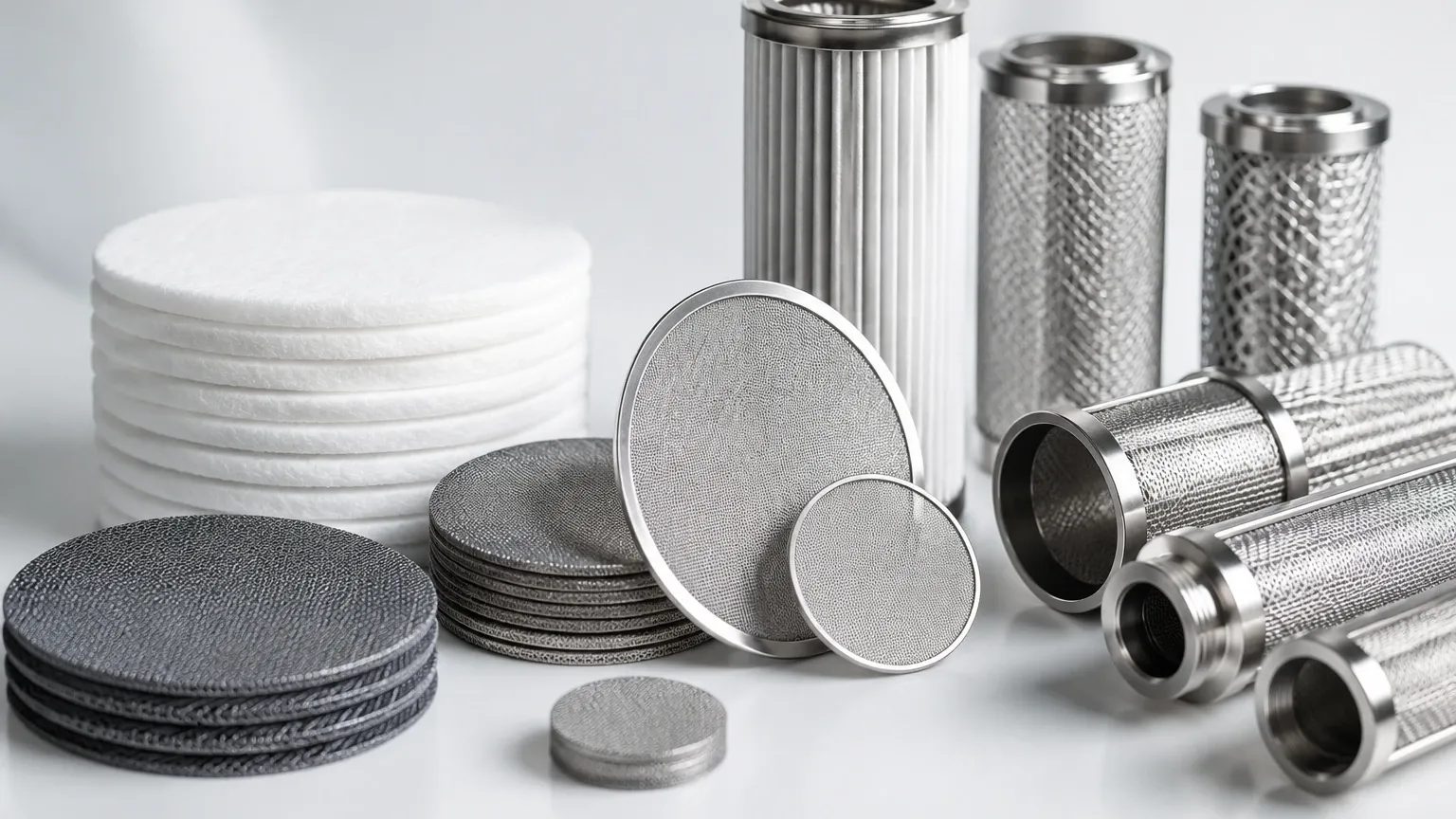
Within a 7 filter water dispenser, specialized metal components like filter discs and multilayer packs serve multiple roles. While the primary media might be carbon or a synthetic membrane, stainless steel mesh components are frequently integrated into the housing or as standalone stages for several reasons:
Media Retention
In stages involving granular media, such as activated carbon or ion-exchange resins, it is vital to prevent "media migration." If carbon fines escape the filter housing, they can clog downstream valves or contaminate the final output. Sintered or welded mesh packs are used at the inlet and outlet of these filter canisters to ensure the media remains contained while allowing for high flow rates.
High-Pressure Support
Multi-stage systems often operate under significant pressure, especially if they include an RO stage. Filter discs provide the necessary structural support for softer filter media, preventing deformation under hydraulic stress. By using a multi-layer pack—combining a fine filtration mesh with a coarser support mesh—engineers can achieve both high filtration accuracy and structural rigidity.
Pre-filtration and Protection
Before water reaches the ultra-fine stages of a 7 filter water dispenser, it must be stripped of sharp or abrasive particles that could puncture delicate membranes. Stainless steel filter discs with precise micron ratings (ranging from 5 to 100 microns) act as a reliable "last line of defense" before the water enters the more sensitive stages of the dispenser.
Material Selection and Engineering Considerations
When specifying components for a 7 filter water dispenser, material compatibility is the first priority. Because these systems are designed for potable water or high-purity industrial water, the materials must be corrosion-resistant and food-grade.
* Stainless Steel 304 vs. 316L: While SS304 is suitable for many water applications, SS316L is preferred for systems where the water may have higher chloride levels or where aggressive cleaning agents are used. 316L offers superior resistance to pitting and crevice corrosion.
* Weave Types: The choice of weave in the wire mesh—such as plain weave, twill weave, or Dutch weave—determines the filtration characteristics. For the fine stages of a water dispenser, Dutch weave mesh is often utilized in filter packs because it offers a higher density of wires, allowing for finer micron ratings without sacrificing strength.
* Micron Rating Accuracy: In a multi-stage system, the micron rating of each stage must be carefully graduated. If a 7-stage system uses a 10-micron disc in stage one and a 5-micron disc in stage four, the load is distributed effectively. If the ratings are mismatched, one stage will clog prematurely, leading to system downtime.
Performance Expectations and Flow Dynamics
One of the most common challenges in designing a 7 filter water dispenser is managing the cumulative pressure drop. Every filter stage introduces resistance to the flow. Engineers must calculate the "Total Pressure Differential" (ΔP) across all seven stages to ensure the pump or supply pressure is sufficient to deliver the required output at the tap.
Using precision-engineered Filter Discs & Packs helps optimize these flow dynamics. Unlike depth filters (such as melt-blown polypropylene), which can have inconsistent pore structures, wire mesh discs provide a uniform open area. This consistency allows for predictable flow calculations and ensures that the dispenser maintains a steady output throughout the service life of the filter elements.
Furthermore, metal filter packs are often cleanable. In industrial water dispensing applications, the ability to backwash or ultrasonically clean a stainless steel disc can significantly reduce the Total Cost of Ownership (TCO) compared to disposable plastic cartridges that must be replaced every few months.
Customization and OEM Requirements
For manufacturers of water dispensing equipment, standard off-the-shelf filters are often insufficient for proprietary system designs. Customization is frequently required in several areas:
1. Geometry: Filter discs can be produced in various shapes—circular, annular, or rectangular—to fit specific housing geometries within the 7-stage assembly.
2. Layering Configuration: A "pack" can consist of anywhere from two to seven layers of mesh. For a 7 filter water dispenser, a three-layer pack (Support Mesh / Filtration Mesh / Protection Mesh) is a common high-performance configuration.
3. Edge Treatment: To prevent bypass and ensure a secure fit within the filter housing, discs can be supplied with spot-welded edges, aluminum or stainless steel rims, or specialized gaskets.
By working with a specialized manufacturer like Kaifil, OEM teams can develop custom filtration components that meet the exact micron and flow requirements of their specific dispenser model, ensuring that the "7-stage" claim is backed by verifiable engineering performance.
Maintenance and Replacement Cycles
The longevity of a 7 filter water dispenser depends heavily on the maintenance of its initial stages. If the pre-filters (Stages 1-3) are neglected, the subsequent stages will fail.
* Monitoring Pressure: Industrial dispensers should ideally include pressure gauges before and after the filter bank. A significant increase in ΔP indicates that the filter discs or packs are loaded with contaminants and require cleaning or replacement.
* Replacement Indicators: While some stages (like UV lamps) have timed replacements, mechanical filters should be replaced based on performance. Stainless steel components offer the advantage of durability; they do not degrade or "shed" fibers over time, which is a common risk with low-quality polymer filters.
* Sanitization: In a 7-stage system, biofilm growth can occur in the middle stages. Stainless steel filter packs are compatible with high-temperature steam or chemical sanitization, allowing for a more thorough cleaning process than plastic-based systems.
Conclusion: Selecting the Right Components for High-Stage Filtration
A 7 filter water dispenser is only as effective as its weakest stage. For engineers and purchasing managers, the focus should be on the technical specifications of the filtration media and the structural integrity of the components holding that media in place. Precision metal Filter Discs & Packs provide the reliability, accuracy, and durability required for high-performance water treatment systems.
When evaluating suppliers for these components, it is essential to confirm material certifications, micron rating precision, and the manufacturer's ability to provide customized designs. By integrating high-quality stainless steel filtration elements, manufacturers can ensure their 7-stage dispensers deliver consistent, high-purity water while minimizing the long-term maintenance burden for the end-user.
