


Brewed Coffee Filter Packs
In the landscape of industrial food and beverage production, the efficiency of extraction processes directly impacts product consistency, flavor profile, and operational costs. For commercial coffee brewing—ranging from large-scale cold brew operations to high-pressure espresso extraction and the production of liquid coffee concentrates—the choice of filtration media is a critical engineering decision. While paper filters are common in consumer settings, industrial applications increasingly rely on stainless steel Filter Discs & Packs to achieve the durability and precision required for continuous high-volume output.
Brewed coffee filter packs made from stainless steel wire mesh offer a permanent, high-performance alternative to disposable media. These components are engineered to withstand the thermal and mechanical stresses of industrial brewing while providing controllable filtration accuracy. This article examines the technical specifications, material considerations, and engineering criteria essential for selecting and implementing metal filter packs in commercial brewing environments.
Understanding Stainless Steel Filter Discs in Industrial Coffee Brewing
Industrial coffee brewing is a complex extraction process where water serves as a solvent to pull soluble solids and oils from roasted ground beans. The role of the filter pack is twofold: it must retain the spent coffee grounds (sediment control) while allowing the desired oils and chemical compounds to pass through at a controlled flow rate.
Unlike paper, which absorbs a significant portion of the coffee’s natural oils and can impart a cellulose-based flavor, stainless steel filter discs are chemically inert. They allow for a fuller-bodied extraction by permitting the passage of micro-oils that define the coffee's mouthfeel and aromatic complexity. From an engineering perspective, these metal packs provide a rigid structure that prevents "channeling"—a common failure in paper filters where water bypasses the coffee bed, leading to uneven extraction.
For large-scale systems, brewed coffee filter packs are often designed as multi-layer assemblies. These assemblies combine fine filtration layers with coarser support meshes to manage the hydraulic pressure exerted during the brewing cycle. This structural integrity is vital in closed-loop systems where pressure differentials can fluctuate significantly.
Material Selection and Food-Grade Compliance
When specifying filter packs for coffee applications, material selection is the primary safeguard for both product quality and equipment longevity. Coffee is naturally acidic, with a pH typically ranging from 4.85 to 5.10. Over time, this acidity, combined with high brewing temperatures, can cause lower-grade metals to corrode or leach metallic ions into the product.
Stainless Steel 304 vs. 316L
* Type 304: This is the standard grade for many food-grade applications. It offers good corrosion resistance and is cost-effective for general brewing tasks. However, in environments with high mineral content in the water or where aggressive cleaning agents are used, it may be susceptible to pitting.
* Type 316L: For industrial coffee extraction, 316L is often the preferred specification. The addition of molybdenum enhances resistance to acetic and phosphoric acids found in coffee. The "L" denotes low carbon content, which improves weldability and prevents intergranular corrosion during the manufacturing of rimmed or spot-welded filter packs.
Kaifil ensures that all materials used in the construction of filter discs meet stringent industrial standards, providing the mechanical strength necessary for repeated cleaning cycles and high-pressure environments.
Mesh Types and Filtration Precision
The performance of brewed coffee filter packs is determined by the weave pattern and the resulting micron rating. In coffee filtration, the goal is to eliminate "fines"—extremely small particles that can lead to over-extraction and bitterness—while maintaining an optimal flow rate.
Plain Square Weave
Plain weave mesh features a simple over-and-under pattern. It provides high transparency and a predictable flow rate. In coffee brewing, plain weave is often used for the outer support layers of a multi-layer pack or as a primary filter for coarse-ground cold brew applications where high flow is prioritized over fine sediment capture.
Dutch Weave (Plain and Twilled)
For precision filtration, Dutch weave patterns are utilized. These weaves use a heavier warp wire and a smaller diameter shute wire, creating a dense, tortuous path for the fluid. This allows for much finer micron ratings (down to 10–20 microns) without sacrificing the physical strength of the mesh. In commercial espresso or concentrate production, a Dutch weave layer within the filter pack ensures that even the smallest sediment is retained, resulting in a clear, sediment-free extract.
Micron Rating Selection
Selecting the correct micron rating depends on the grind size of the coffee and the brewing method:
* Coarse Grinds (Cold Brew): 100 to 150 microns.
* Medium Grinds (Drip/Batch Brew): 60 to 100 microns.
* Fine Grinds (Espresso/Concentrate): 20 to 50 microns.
Structural Integrity: Multi-Layer Filter Packs
In industrial brewing vessels, a single layer of thin wire mesh is often insufficient to withstand the weight of the wet coffee bed or the pressure of the pump. To address this, engineers utilize multi-layer brewed coffee filter packs. These packs consist of several layers of wire cloth bonded together to create a robust filtration unit.
Sintered vs. Bound Packs
* Sintered Mesh: Layers of mesh are fused together through heat and pressure. This creates a monolithic structure that will not delaminate under pressure. It is the gold standard for high-pressure industrial extraction.
* Rimmed/Bound Packs: Multiple layers are stacked and secured with a metal rim (usually aluminum or stainless steel). The rim provides a sealing surface that prevents bypass around the edges of the filter. This design is highly effective for batch brewers and is often more cost-effective for large-diameter filters.
By combining a fine filtration layer with a coarse drainage layer and a heavy-duty support layer, the filter pack maintains its flatness and pore geometry even under heavy mechanical loads. This prevents the mesh from stretching or deforming, which would otherwise alter the filtration accuracy over time.
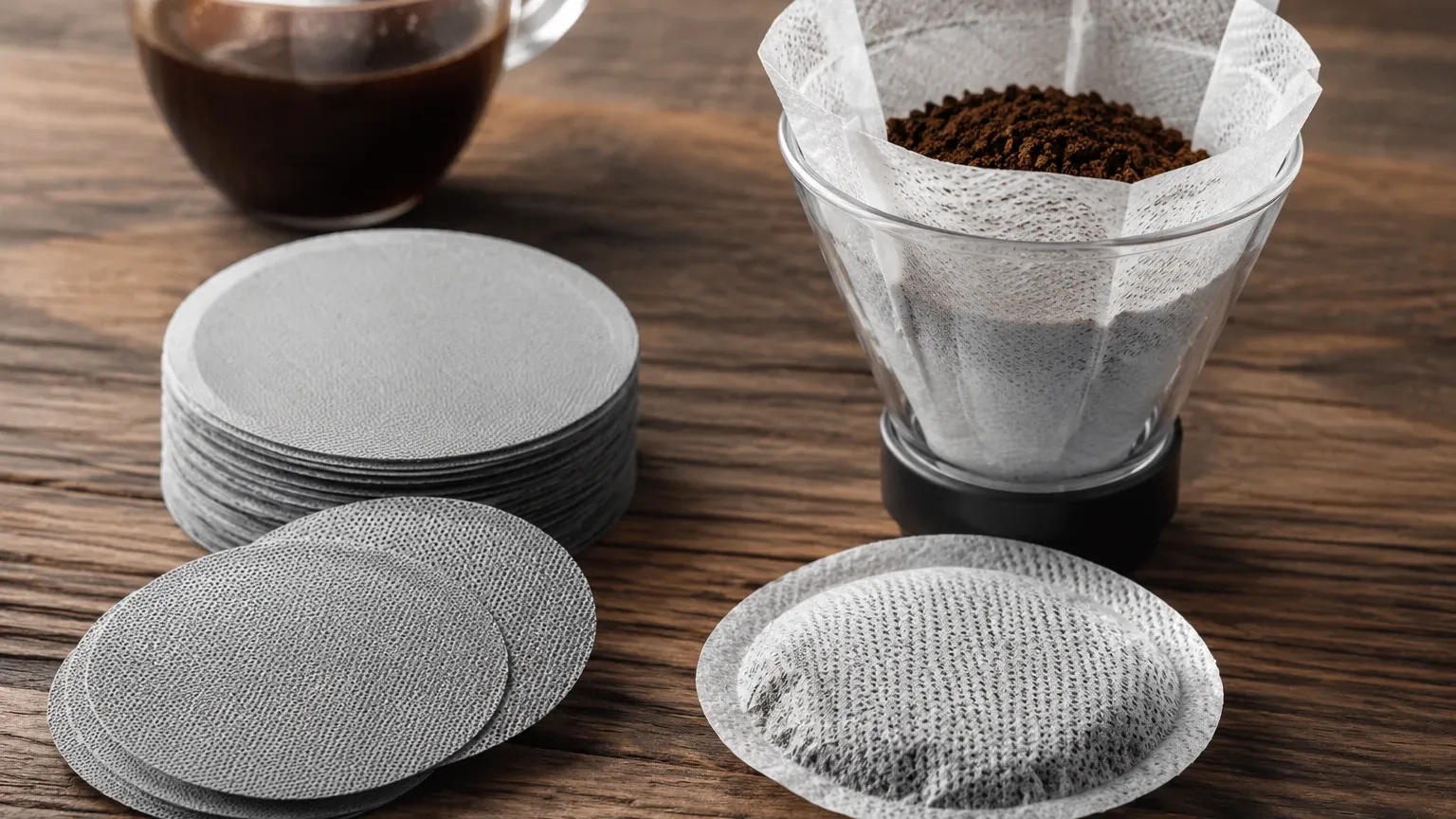
Performance Evaluation: Flow Rate and Sediment Control
In a B2B context, the performance of a filter pack is measured by its impact on the Total Dissolved Solids (TDS) and the extraction yield. Engineers must balance the "Permeability" of the filter with its "Retention Capability."
If the brewed coffee filter packs are too restrictive, the backpressure increases, which can stress the pump and lead to over-extraction (bitterness). Conversely, if the mesh is too open, the flow rate will be too high, leading to under-extraction (sourness) and excessive sediment in the final product.
Key performance indicators for technical teams include:
1. Pressure Drop (ΔP): The difference in pressure before and after the filter. A stable ΔP indicates consistent flow and proper sizing.
2. Cake Release: How easily the spent coffee grounds are removed from the filter surface. Stainless steel packs with smooth weave patterns facilitate faster turnover between batches.
3. Uniformity of Pore Distribution: Ensuring that the mesh is woven to tight tolerances so that the flow is even across the entire surface area of the disc.
Maintenance and Operational Efficiency
One of the primary drivers for switching to stainless steel Filter Discs & Packs is the reduction in long-term operational costs. While the initial investment is higher than paper or cloth, the total cost of ownership (TCO) is significantly lower due to reusability.
Cleaning Protocols
To maintain the flow characteristics of brewed coffee filter packs, a regular cleaning regimen is required. Coffee oils (lipids) can accumulate within the mesh pores, eventually becoming rancid or causing blockages.
* Daily Maintenance: High-pressure hot water rinsing or backwashing.
* Periodic Deep Cleaning: Use of enzyme-based cleaners or mild caustic solutions to dissolve organic buildup.
* Ultrasonic Cleaning: For multi-layer or sintered packs, ultrasonic baths are highly effective at removing trapped particles from deep within the mesh structure.
Because stainless steel is durable, these filters can withstand thousands of cleaning cycles without degrading, provided they are handled correctly and not subjected to mechanical damage from sharp tools.
Customization for OEM Brewing Equipment
Industrial brewing equipment varies widely in design. From circular discs for vertical extraction columns to rectangular or custom-shaped packs for automated brewing systems, customization is often necessary.
When partnering with a manufacturer like Kaifil, engineering teams can specify:
* Exact Dimensions: Tolerances as tight as +/- 0.1mm to ensure a perfect fit in the filter housing.
* Layer Configuration: Custom stacking of mesh layers to meet specific flow and strength requirements.
* Edge Finishing: Options include spot welding, plasma welding, or metal binding to ensure no loose wires contaminate the product.
* Reinforcement: Addition of perforated metal backing for extremely large diameter discs that must support hundreds of kilograms of wet grounds.
Conclusion: Selecting the Right Filtration Partner
For B2B buyers and engineers, the selection of brewed coffee filter packs is an exercise in balancing technical performance with food safety and economic viability. A well-engineered stainless steel filter disc not only improves the sensory quality of the coffee but also streamlines the production process by reducing waste and downtime.
By focusing on high-quality materials like 316L stainless steel, precise weave patterns, and robust structural designs, manufacturers can achieve consistent extraction results batch after batch. Whether you are designing a new commercial brewing system or optimizing an existing production line, understanding the engineering nuances of metal filtration is essential for long-term success in the competitive coffee industry.
