


Disc Filter 2.5 Inch
In industrial filtration, the precision of component dimensions is as critical as the filtration media itself. The disc filter 2.5 inch (approximately 63.5 mm) is a standardized yet highly versatile component used across various high-pressure and high-temperature environments. Whether utilized in polymer extrusion, hydraulic systems, or pharmaceutical processing, these discs must be engineered to withstand rigorous mechanical stresses while maintaining strict particle retention levels.
Selecting the correct disc filter 2.5 inch requires a deep understanding of metallurgy, weave patterns, and structural integrity. For engineers and procurement specialists, the challenge lies in balancing flow rates with filtration efficiency and ensuring that the selected Filter Discs & Packs can integrate seamlessly into existing housings without the risk of bypass or structural failure.
Engineering Specifications and Dimensional Tolerances
The 2.5-inch diameter is a common specification for small-to-medium scale industrial equipment. While "2.5 inch" serves as the nominal size, the actual manufacturing tolerance is critical for ensuring a proper seal within the filter housing. Most industrial applications require a tolerance of ±0.1mm to ±0.5mm, depending on the sealing mechanism used (e.g., O-rings, metal-to-metal contact, or rimmed edges).
When specifying a disc filter 2.5 inch, engineers must consider the thickness of the disc. A single-layer wire mesh disc may only be a few hundred microns thick, whereas a multi-layer sintered or spot-welded pack can exceed several millimeters in thickness. This thickness directly impacts the depth of the filter housing and the compression required to prevent fluid bypass. If the disc is too thin for the housing, it may shift under pressure; if too thick, it may prevent the housing from closing securely, leading to leaks.
Material Science: Stainless Steel Grades and Compatibility
The choice of material for a disc filter 2.5 inch is dictated by the chemical environment and operating temperature of the application. Stainless steel is the industry standard due to its mechanical strength and resistance to corrosion.
Stainless Steel 304
This is the most common grade for general industrial use. It offers good corrosion resistance and is cost-effective for applications involving water, oils, and mild chemicals at moderate temperatures. However, it is susceptible to chloride-induced pitting, making it less suitable for marine environments or highly acidic processes.
Stainless Steel 316 and 316L
For more demanding environments, SS 316 includes molybdenum, which significantly enhances resistance to pitting and crevice corrosion in chloride environments. SS 316L, the low-carbon version, is preferred for applications involving welding, as it minimizes carbide precipitation that can lead to intergranular corrosion. These grades are standard in the pharmaceutical, food and beverage, and chemical processing industries.
Specialty Alloys
In extreme conditions, such as highly corrosive chemical baths or temperatures exceeding 500°C, specialty alloys like Hastelloy, Inconel, or Monel may be required. These materials provide the necessary oxidation resistance and mechanical stability that standard stainless steels cannot offer.
Structural Variations: Single-Layer vs. Multi-Layer Filter Packs
A disc filter 2.5 inch can be manufactured as a single layer of wire mesh or as a complex multi-layer pack. The decision depends on the required filtration fineness and the pressure differential the disc must withstand.
Single-Layer Discs
Single-layer discs are typically used for coarse filtration or as a primary screen to remove large debris. They offer the highest flow rates and lowest pressure drops but lack the structural rigidity for high-pressure applications. They are often used in gravity-fed systems or low-pressure fluid lines.
Multi-Layer Packs
To achieve fine filtration under high pressure, multiple layers of wire mesh are combined. A typical multi-layer pack includes:
1. Filtration Layer: The middle layer(s) with the finest mesh count, responsible for particle retention.
2. Support Layer: Coarser mesh layers on either side that provide mechanical strength and prevent the filtration layer from deforming under pressure.
3. Drainage Layer: Optional layers that help distribute the fluid flow evenly across the surface of the filter.
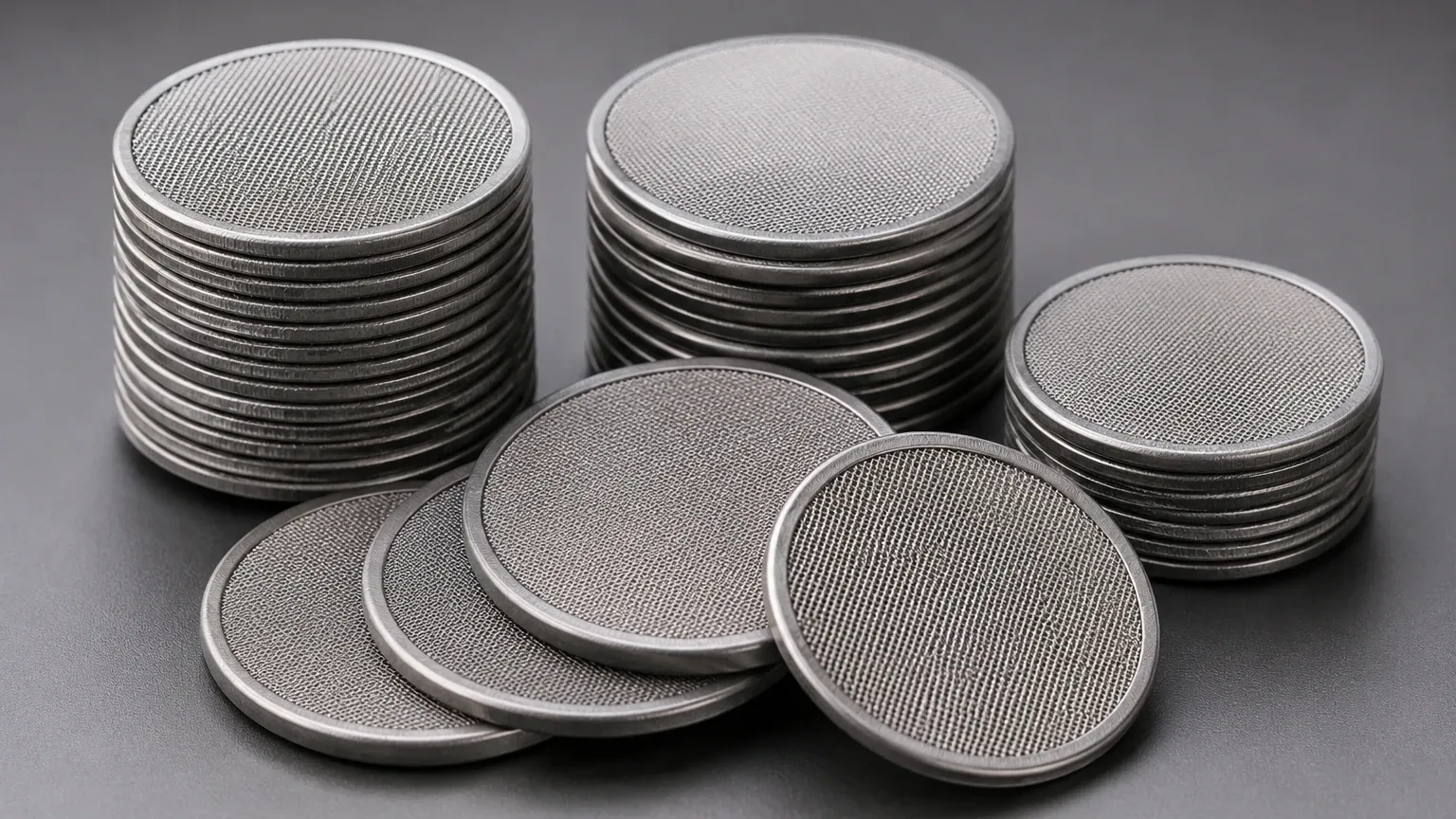
These layers can be joined via spot welding at the perimeter or by using a metal rim. Rimmed Filter Discs & Packs are particularly effective in high-pressure polymer extrusion, as the rim (often made of aluminum or stainless steel) provides a robust sealing surface and prevents the edges of the mesh from fraying or bypassing.
Filtration Precision and Weave Patterns
The performance of a disc filter 2.5 inch is largely determined by the weave pattern of the wire mesh. Different weaves offer varying balances of strength, flow, and micron ratings.
* Plain Weave: The simplest pattern where each warp wire crosses over and under each weft wire. It provides high flow rates and is easy to clean, typically used for filtration ranges from 50 to 500 microns.
* Twill Weave: Each warp wire passes over and under two weft wires. This allows for thicker wires and a heavier mesh, suitable for finer filtration and higher mechanical loads.
* Dutch Weave (Plain or Twill): This weave uses a larger diameter warp wire and a smaller diameter weft wire driven closely together. This creates a "tortuous path" for particles, providing excellent strength and very fine filtration (down to 1-5 microns).
* Sintered Wire Mesh: For the most demanding applications, multiple layers of mesh are sintered together in a vacuum furnace. This fuses the wires at every contact point, creating a rigid, porous structure that cannot shift or fray, even under extreme pressure and backwashing cycles.
Manufacturing Techniques: Edge Treatment and Sealing
The edge of a disc filter 2.5 inch is a critical engineering point. If left untreated, the cut wires of the mesh can fray, potentially introducing metal contaminants into the filtrate or creating gaps that allow bypass.
Spot Welding
In multi-layer packs, spot welding at multiple points around the circumference ensures the layers stay together during handling and installation. This is a cost-effective method for many industrial applications.
Rimming (Framing)
For high-pressure applications, the disc is encased in a metal rim. This rim can be made of aluminum, copper, or stainless steel. The rim serves two purposes: it binds the layers of the pack securely and acts as a gasket to ensure a leak-proof seal within the filter housing. In the plastic recycling and polymer extrusion industry, aluminum-rimmed 2.5-inch discs are standard because the aluminum is soft enough to deform slightly and create a perfect seal under the extreme pressures of the extruder.
Application Environments for 2.5-Inch Filtration
The disc filter 2.5 inch is utilized in diverse sectors where precision and durability are paramount.
Polymer and Fiber Extrusion
In the production of plastics and synthetic fibers, molten polymer is forced through a series of filters before reaching the spinneret or die. The 2.5-inch disc is a common size for these "screen changers." It removes gels, un-melted resin, and foreign contaminants that would otherwise cause fiber breakage or surface defects in the final product.
Hydraulic and Lubrication Systems
Precision hydraulic systems require clean oil to prevent wear on valves and pumps. A disc filter 2.5 inch can be integrated into the fluid line to catch wear particles and environmental contaminants. Stainless steel is preferred here because it does not react with hydraulic fluids and can be cleaned and reused.
Pharmaceutical and Chemical Processing
In these industries, the disc filter 2.5 inch is often used in laboratory-scale production or pilot plants. The ability to use 316L stainless steel ensures that the filter does not leach contaminants into the product and can withstand aggressive cleaning protocols, including steam sterilization (SIP) and clean-in-place (CIP) chemicals.
Factors Affecting Service Life and Replacement Cycles
Determining when to replace or clean a disc filter 2.5 inch is essential for maintaining process efficiency and protecting downstream equipment.
Pressure Drop (ΔP)
As particles accumulate on the surface of the disc, the resistance to flow increases, leading to a rise in the pressure drop across the filter. Engineers typically set a "terminal pressure drop" limit. Once this limit is reached, the disc must be cleaned or replaced to prevent the risk of mesh collapse or pump strain.
Dirt Holding Capacity
The dirt holding capacity is the total amount of contaminant the disc can retain before the pressure drop becomes excessive. This is influenced by the surface area and the pore structure. Sintered or multi-layer packs generally have a higher dirt holding capacity than single-layer discs because they provide more depth for particle entrapment.
Cleaning Methods
One of the primary advantages of stainless steel Filter Discs & Packs is their cleanability. Depending on the contaminant, discs can be cleaned using:
* Ultrasonic Cleaning: High-frequency sound waves create cavitation bubbles that dislodge particles from deep within the mesh.
* Chemical Cleaning: Solvents or acids are used to dissolve organic or mineral deposits.
* Burn-off (Pyrolysis): For polymer extrusion, discs are placed in a controlled furnace to burn off the residual plastic, followed by ultrasonic cleaning to remove the ash.
Procurement and Customization Guidance
When sourcing a disc filter 2.5 inch, providing detailed specifications to the manufacturer is vital to ensure performance. A standard request should include:
1. Exact Diameter and Tolerance: Specify if the 2.5 inch is the outer diameter (OD) or if there is an inner diameter (ID) for donut-shaped discs.
2. Micron Rating: Define whether this is an absolute or nominal rating.
3. Material Grade: Specify SS 304, 316L, or other alloys based on the operating environment.
4. Layer Configuration: Detail the number of layers and the mesh count for each layer (e.g., 20/100/20 mesh).
5. Edge Treatment: Specify if the disc should be spot-welded, rimmed, or plain-cut.
6. Operating Conditions: Provide information on the maximum operating temperature and pressure to ensure the structural design is adequate.
By focusing on these technical parameters, engineering and purchasing teams can ensure that their filtration systems operate at peak efficiency, reducing downtime and maintaining high product quality. Customization allows for the optimization of the disc filter 2.5 inch to specific process nuances, providing a more reliable solution than off-the-shelf alternatives.
