


Disc Filter Micron Size
In industrial filtration, the precision of a separation process is fundamentally defined by the micron rating of the filter media. For engineers and procurement specialists sourcing Filter Discs & Packs, understanding the nuances of disc filter micron size is critical to ensuring system integrity, protecting downstream equipment, and optimizing the total cost of ownership.
Selecting the correct micron size is not merely a matter of choosing the smallest possible aperture; it involves a complex balance of flow dynamics, pressure constraints, and the physical characteristics of the contaminants being removed. This guide examines the technical considerations behind micron selection for stainless steel filtration components, providing the factual framework necessary for informed industrial decision-making.
Understanding the Fundamentals of Micron Ratings
A micron, or micrometer (μm), is one-millionth of a meter. In the context of industrial filtration, the micron rating refers to the ability of a filter medium to remove particles of a specific size from a fluid or gas stream. When discussing disc filter micron size, it is essential to distinguish between the physical opening of the mesh and the actual filtration performance under operating conditions.
Stainless steel wire mesh, the primary material for high-performance filter discs, is manufactured with high precision. The micron rating is determined by the wire diameter and the mesh count (the number of wires per linear inch). As the mesh count increases, the aperture size decreases, leading to a finer micron rating. However, the geometry of the weave—whether plain, twill, or Dutch weave—significantly alters how particles are captured and how fluid flows through the media.
Nominal vs. Absolute Micron Ratings in Industrial Filtration
One of the most frequent points of confusion in filter procurement is the distinction between nominal and absolute micron ratings. This distinction is vital for applications where bypass of even a small percentage of particles could lead to catastrophic equipment failure or product contamination.
Nominal Micron Rating
A nominal rating indicates the filter's ability to retain a majority of particles of a specified size, typically ranging from 60% to 95% efficiency. It is an industrial shorthand that provides a general guideline for filtration capability but does not guarantee that every particle above that size will be captured. Nominal filters are often used in pre-filtration stages where the primary goal is to reduce the overall solids load before the fluid reaches more sensitive components.
Absolute Micron Rating
An absolute rating refers to the diameter of the largest hard spherical particle that will pass through the filter under specified laboratory test conditions. For stainless steel filter discs, an absolute rating implies an efficiency of 99.9% or higher. This is achieved through rigorous manufacturing standards and is often validated via the bubble point test (ISO 4003). In critical applications, such as pharmaceutical processing or high-pressure hydraulic systems, absolute-rated discs are mandatory to ensure consistent performance.
The Relationship Between Mesh Weave and Micron Precision
The physical architecture of the filter disc determines its micron capabilities. Different weave patterns offer varying levels of mechanical strength and filtration accuracy.
1. Plain Weave: The simplest pattern where wires cross over and under each other. These typically offer larger micron sizes and high open areas, making them suitable for coarse filtration and high-flow applications.
2. Twill Weave: Each shute wire passes successively over and under two warp wires. This allows for the use of heavier wires in a fine mesh, providing greater strength for a given disc filter micron size.
3. Dutch Weave (Plain and Twill): These weaves utilize different diameters for warp and shute wires, resulting in a "tortuous path" for the fluid. Dutch weaves provide the finest micron ratings (down to 5–10 microns) and superior mechanical stability, making them the standard for precision industrial filtration.
4. Sintered Mesh: For the most demanding environments, multiple layers of wire mesh are sintered (thermally bonded) together. This process fixes the pore structure permanently, ensuring that the micron rating does not shift under high pressure or during backwashing.
Engineering Trade-offs: Flow Rate and Pressure Drop
Selecting a disc filter micron size requires an understanding of the relationship between filtration fineness and system hydraulics. There is an inverse relationship between filtration efficiency and the "open area" of the filter disc.
Pressure Drop ($ΔP$)
As the micron size decreases, the resistance to flow increases. This results in a higher initial pressure drop across the filter. If an engineer specifies a micron rating that is unnecessarily fine for the application, the system will require more energy to maintain the desired flow rate, and the filter will reach its terminal pressure drop more quickly, necessitating frequent cleaning or replacement.
Flow Velocity and Particle Breakthrough
High flow velocities through a fine micron disc can lead to "particle migration" or breakthrough, where flexible or deformable particles are forced through the mesh apertures. Engineers must calculate the flux (flow per unit area) to ensure that the velocity does not compromise the disc's ability to retain contaminants at the specified micron level.
The Role of Multi-layer Filter Packs in Micron Control
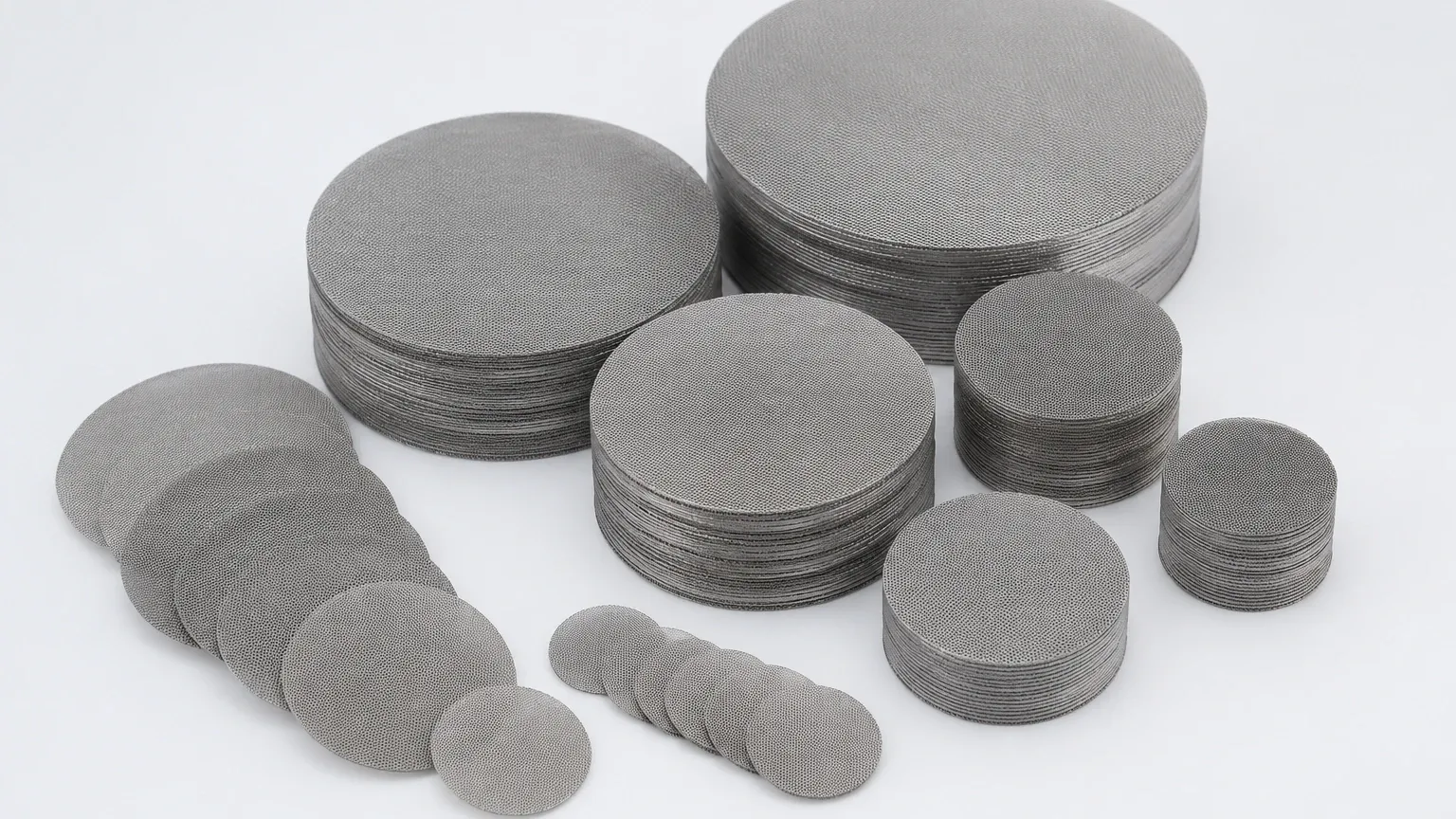
In many industrial processes, a single layer of wire mesh is insufficient. Filter Discs & Packs are often engineered as multi-layer structures to optimize performance. A typical high-performance pack may include:
* The Filtration Layer: The central layer(s) that define the actual micron rating of the pack.
* Support Layers: Coarser mesh layers on either side of the filtration media that provide mechanical rigidity and prevent the fine mesh from deforming under pressure.
* Drainage Layers: These facilitate the even distribution of fluid across the entire surface area of the disc, preventing localized clogging and extending the service life.
By combining different mesh counts, manufacturers can create a gradient filtration effect. This allows larger particles to be trapped by the outer layers while the inner layers focus on the target micron size, significantly increasing the dirt-holding capacity compared to a single-layer disc.
Application-Specific Selection Criteria
The "correct" disc filter micron size is dictated by the requirements of the specific industrial application. Factual boundaries for selection include:
Chemical and Petrochemical Processing
In these environments, filters must withstand corrosive fluids and high temperatures. The micron selection is often driven by the need to protect catalysts or prevent the clogging of fine spray nozzles. Stainless steel 316L is typically preferred for its corrosion resistance, and sintered discs are used to maintain micron integrity in high-viscosity polymer filtration.
Food and Beverage Production
Filtration in this sector focuses on removing spoilage organisms and ensuring product clarity. Micron ratings are strictly controlled to meet food safety standards. The discs must be easy to clean (CIP – Clean-In-Place) and capable of withstanding repeated sterilization cycles without the mesh shifting or the apertures enlarging.
Hydraulic and Lubrication Systems
Hydraulic components, such as servo valves, have extremely tight tolerances. A single particle larger than the clearance of the valve can cause a system failure. Therefore, absolute-rated filter discs with a precise micron size (often 3, 5, or 10 microns) are used to maintain fluid cleanliness levels according to ISO 4406 standards.
Quality Assurance and Performance Validation
When sourcing industrial filter discs, the verification of the micron rating is as important as the specification itself. Professional manufacturers like Kaifil utilize several methods to ensure that the delivered product meets the engineered requirements:
* Bubble Point Testing: This non-destructive test measures the pressure required to force air bubbles through a liquid-saturated filter. The pressure at which the first bubble appears is used to calculate the absolute micron rating.
* Glass Bead Testing: A more rigorous method where calibrated glass spheres are passed through the filter to determine the exact retention characteristics.
* Scanning Electron Microscopy (SEM): Used during the R&D and quality control phases to inspect the uniformity of the weave and measure aperture dimensions at the microscopic level.
Total Cost of Ownership and Replacement Cycles
While a finer micron rating might seem safer, it often leads to higher operational costs. The total cost of ownership (TCO) for a filtration system includes the initial cost of the disc, the energy cost associated with pressure drop, and the labor and downtime costs of replacement.
Engineers should aim for the coarsest micron rating that still provides adequate protection for the process. This approach maximizes the service life of the disc and minimizes the frequency of maintenance. Furthermore, the durability of stainless steel allows for ultrasonic cleaning and reuse, which is a significant advantage over disposable polymer filters, provided the cleaning process does not damage the mesh structure or alter the micron size.
Conclusion
Determining the optimal disc filter micron size requires a technical evaluation of the fluid properties, contaminant profile, and system constraints. By understanding the differences between nominal and absolute ratings, the impact of weave patterns, and the benefits of multi-layer packs, technical professionals can select filtration components that provide reliable performance in demanding industrial environments. For customized solutions and technical consultation on specific filtration challenges, reviewing professional manufacturing capabilities is the recommended next step for engineering teams.
