


Disc Filter Nordic
In the demanding industrial landscapes of the Nordic region—encompassing Sweden, Finland, Norway, and Denmark—precision filtration is a critical component of operational efficiency. From the massive pulp and paper mills of the Finnish interior to the offshore oil and gas platforms in the North Sea, the requirement for robust, corrosion-resistant, and high-performance filtration media is constant. The term "disc filter nordic" refers to the specific application and procurement of disc-shaped filtration components designed to withstand these rigorous environments.
As a specialized manufacturer, Kaifil provides high-quality Filter Discs & Packs that meet the stringent engineering standards required by Northern European industries. Understanding the technical nuances of material selection, weave types, and structural integrity is essential for engineers and purchasing teams looking to optimize their filtration systems.
Understanding the Role of Disc Filters in Nordic Industrial Applications
The Nordic industrial sector is characterized by high levels of automation and a strong focus on environmental sustainability. Filtration systems in these regions must not only be effective but also durable enough to minimize waste and reduce the frequency of replacements. Disc filters are preferred in these contexts due to their ability to provide a large surface area within a compact footprint, making them ideal for integrated machinery.
Pulp and Paper Industry
Finland and Sweden are global leaders in pulp and paper production. In these facilities, water recycling and chemical recovery processes rely heavily on stainless steel filter discs. These components must handle high flow rates and resist the abrasive nature of wood fibers and the corrosive effects of processing chemicals.
Marine and Offshore Engineering
With extensive coastlines and a dominant maritime industry, Nordic companies require filtration solutions that can handle seawater exposure. Disc filters used in ballast water treatment systems or hydraulic power units on offshore rigs must be manufactured from high-grade alloys like 316L stainless steel or Duplex steels to prevent pitting and crevice corrosion.
Food and Beverage Processing
Strict hygiene standards in the Nordic food industry necessitate the use of food-grade stainless steel filter packs. These are used in the filtration of edible oils, beverages, and dairy products, where cleanability and the absence of contaminants are paramount.
Engineering Specifications for Filter Discs & Packs
When specifying a disc filter for a Nordic application, engineers must look beyond simple dimensions. The performance of the filter is dictated by its internal structure and the quality of its construction.
Material Selection
Stainless steel is the primary material for industrial filter discs due to its mechanical strength and thermal resistance. Common grades include:
* AISI 304: Suitable for general industrial use where moderate corrosion resistance is required.
* AISI 316/316L: The standard for marine and chemical environments, offering superior resistance to chlorides.
* 904L and Hastelloy: Reserved for highly aggressive chemical processing where standard stainless steels fail.
Weave Types and Filtration Accuracy
The choice of wire mesh weave determines the filtration rating (micron size) and the flow characteristics.
* Plain Weave: Offers a straightforward aperture and is easy to clean, typically used for coarser filtration.
* Dutch Weave: Provides a much finer filtration rating by using a higher density of weft wires. This is ideal for high-pressure applications where fine particle retention is required.
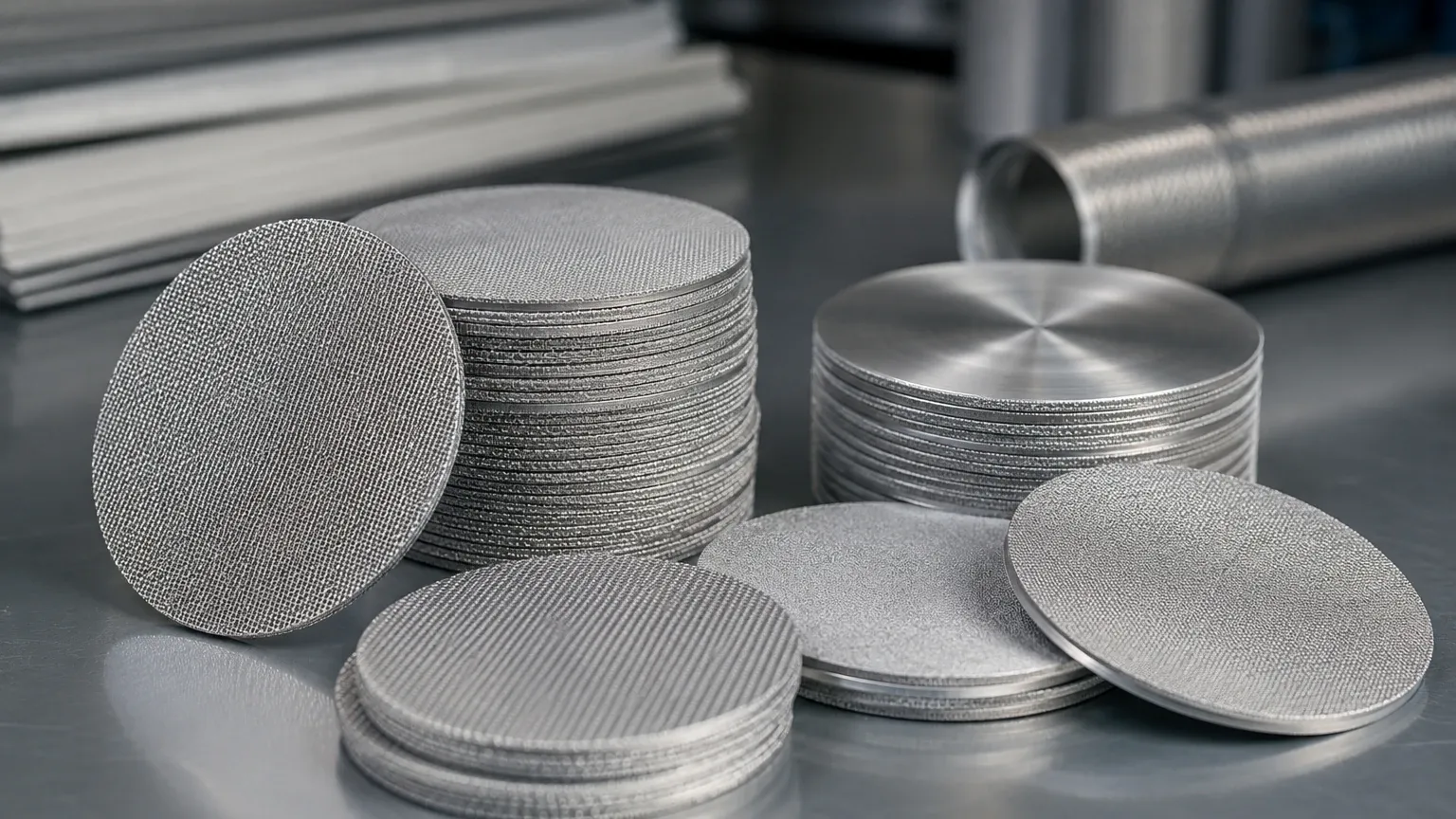
* Sintered Mesh: For the most demanding Nordic applications, multiple layers of mesh are sintered (heat-bonded) together. This creates a porous metal plate that is incredibly strong and maintains its pore structure even under extreme pressure.
Performance Evaluation: Filtration Accuracy and Flow Dynamics
For an engineer, the primary metrics for evaluating a disc filter are its micron rating and its pressure drop (delta P). In many Nordic hydraulic systems, maintaining a low pressure drop is essential to prevent pump cavitation and energy loss.
Micron Rating: Absolute vs. Nominal
It is vital to distinguish between nominal and absolute filtration. A nominal rating refers to the ability of the filter to retain a certain percentage of particles of a specific size. An absolute rating, common in precision Filter Discs & Packs, indicates that no particle larger than the specified micron size can pass through the mesh. In critical pharmaceutical or chemical processes, absolute ratings are often mandatory.
Effective Filtration Area (EFA)
The EFA of a disc filter determines how much fluid can pass through the media before the pressure drop becomes unacceptable. By using multi-layer packs or pleated disc designs, manufacturers can increase the EFA without increasing the outer diameter of the component. This is a key consideration for "disc filter nordic" applications where space within existing machinery is often limited.
Customization for Nordic Environmental and Operational Conditions
Standard off-the-shelf filters often fail to meet the specific needs of specialized Nordic equipment. Customization is where manufacturers like Kaifil provide the most value, ensuring that the filter disc is a perfect fit for the intended housing and operating conditions.
Rim and Border Options
Filter discs can be supplied as plain mesh or with protective borders. Rims made of aluminum, stainless steel, or copper help to provide structural rigidity and ensure a leak-proof seal within the filter housing. For high-temperature extrusion processes, these rims prevent the edges of the mesh from fraying under stress.
Multi-Layer Configurations
In many polymer extrusion or oil filtration processes, a single layer of mesh is insufficient. Multi-layer packs combine different mesh counts—for example, a fine filtration layer sandwiched between two coarser support layers. This configuration provides the necessary filtration fineness while ensuring the disc can withstand high differential pressures without deforming.
Geometric Precision
Nordic engineering is synonymous with precision. Whether the requirement is for a simple circular disc, an oval shape, or a complex multi-segment pack for a large-scale rotary filter, the dimensional tolerances must be exact. Advanced laser cutting and CNC machining ensure that every disc fits perfectly into the assembly, preventing bypass—a common failure point in low-quality filtration components.
Selection Criteria for Engineering and Purchasing Teams
Selecting the right disc filter involves a balance between performance, durability, and cost. When evaluating suppliers for the Nordic market, technical teams should confirm the following:
1. Chemical Compatibility: Does the stainless steel grade match the acidity or alkalinity of the process fluid? In the Nordic chemical industry, this is often the most frequent cause of premature filter failure.
2. Mechanical Strength: Will the disc be subjected to high-pressure pulses? Sintered or reinforced packs are necessary for such environments.
3. Cleaning Protocols: Is the filter intended to be a single-use consumable or a cleanable, reusable component? Stainless steel discs are highly reusable, which aligns with the sustainability goals of many Nordic enterprises.
4. Certification and Traceability: For food, beverage, and pharmaceutical sectors, material traceability is non-negotiable. Ensure the manufacturer can provide mill test reports (MTRs) for the alloys used.
Maintenance, Lifecycle, and Total Cost of Ownership (TCO)
In the Nordic region, where labor costs are high, the total cost of ownership is a more important metric than the initial purchase price. A cheaper, lower-quality filter disc that requires frequent replacement or causes downtime is significantly more expensive in the long run.
Cleaning and Reusability
One of the primary advantages of stainless steel Filter Discs & Packs is their ability to be cleaned. Methods such as ultrasonic cleaning, backwashing, or chemical cleaning can restore the filter's performance. In Nordic industries, establishing a standardized cleaning cycle can extend the life of a filter pack by several years, drastically reducing the TCO.
Preventing Bypass and Failure
Regular inspection of the filter rims and the mesh surface is essential. In high-vibration environments, such as those found in marine engines or heavy mining equipment, the spot welds on multi-layer packs can sometimes fail. Specifying high-quality welding or sintered edges can mitigate these risks, ensuring continuous operation.
Conclusion
Navigating the requirements for a "disc filter nordic" application requires a deep understanding of both the environmental challenges of the region and the technical capabilities of modern filtration media. By focusing on high-grade materials, precision manufacturing, and customized designs, engineers can ensure their systems operate at peak efficiency with minimal maintenance.
Kaifil remains committed to supporting these industrial needs by offering a comprehensive range of stainless steel filtration solutions. Whether for a specialized chemical plant in Sweden or a water treatment facility in Norway, the right choice of filter disc is a fundamental step toward operational excellence. For more detailed specifications and to explore customization options, technical teams are encouraged to review the available Filter Discs & Packs and consult with engineering experts to match products to their specific application requirements.
