


Filter Disc Screen
In industrial filtration, the precision and reliability of a filter disc screen are paramount to maintaining process integrity and protecting downstream equipment. These components, often used in polymer extrusion, chemical processing, and hydraulic systems, serve as the primary barrier against contaminants. As a specialized manufacturer, Kaifil provides high-performance Filter Discs & Packs designed to meet the rigorous demands of modern engineering applications. Understanding the technical nuances of material selection, weave patterns, and structural configurations is essential for engineers tasked with optimizing filtration efficiency and minimizing operational downtime.
Engineering Fundamentals of Filter Disc Screen Production
The performance of a filter disc screen begins with the selection of the base material. In most industrial environments, stainless steel is the preferred medium due to its mechanical strength and resistance to corrosion.
Material Selection: SS304 vs. SS316L
Engineers must choose between different grades of stainless steel based on the chemical composition of the fluid and the operating temperature.
- AISI 304: This is the standard grade for general industrial use. It offers excellent strength and good corrosion resistance for non-acidic environments.
- AISI 316L: Containing molybdenum, 316L provides superior resistance to pitting and crevice corrosion, particularly in chloride-rich or highly acidic environments. It is the preferred choice for pharmaceutical and marine applications where hygiene and material stability are critical.
- Specialty Alloys: For extreme conditions, materials like Monel, Inconel, or Hastelloy may be utilized to withstand high temperatures or highly aggressive chemical reagents.
Wire Mesh Weave Patterns
The weave pattern of the filter disc screen determines its filtration accuracy (micron rating) and its structural integrity.
- Plain Weave: The most common pattern where wires cross over and under each other. It provides a consistent pore size and is ideal for standard filtration tasks.
- Twill Weave: Each warp wire passes over and under two successive weft wires. This allows for thicker wires and is used for heavier filtration loads.
- Dutch Weave (Plain and Twill): These weaves utilize different wire diameters for the warp and weft. This creates a dense, strong mesh with very fine filtration capabilities, often used in high-pressure applications like hydraulic systems and fuel filtration.
Structural Configurations: Single Layer vs. Multi-layer Filter Discs & Packs
Depending on the pressure requirements and the nature of the contaminants, a filter disc screen can be configured as a single layer or as part of a multi-layer assembly.
Single-Layer Filter Discs
Single-layer discs are typically used in low-pressure applications or as a secondary filtration stage. They are cost-effective and easy to replace. However, they lack the mechanical support required for high-viscosity fluids or high-pressure differentials.
Multi-layer Filter Discs & Packs
For more demanding processes, such as plastic and fiber extrusion, multi-layer Filter Discs & Packs are the standard. These packs are engineered by layering different mesh counts to achieve a specific filtration profile.
- Support Layers: Coarse mesh layers provide structural rigidity to prevent the finer filtration mesh from deforming under pressure.
- Filtration Layers: The middle layers consist of the fine mesh that dictates the micron rating of the pack.
- Protection Layers: These prevent the filtration media from being damaged by mechanical friction or large debris.
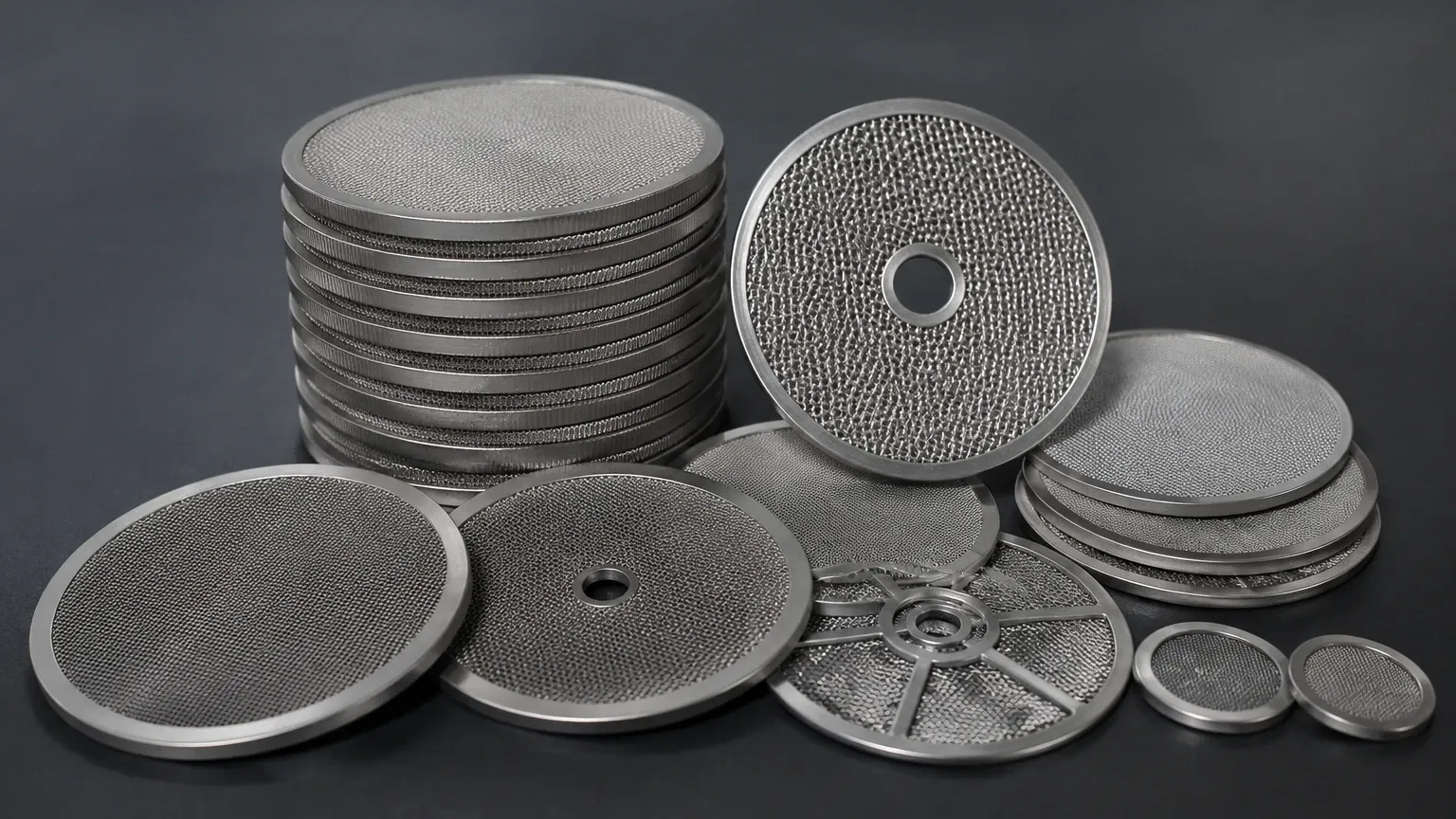
These layers are often joined using spot welding or are bound by a metal rim (edging) made of aluminum, stainless steel, or copper. Rimming ensures that the edges of the mesh do not fray and provides a better seal within the filter housing.
Key Performance Evaluation Criteria
When specifying a filter disc screen for an industrial project, engineers must evaluate several performance metrics to ensure the component will function reliably throughout its service life.
Filtration Accuracy and Micron Rating
The micron rating defines the size of the smallest particle the screen can effectively retain. It is important to distinguish between "nominal" and "absolute" ratings. A nominal rating indicates the ability to retain a percentage of particles, while an absolute rating refers to the diameter of the largest spherical particle that can pass through the mesh under laboratory conditions.
Flow Rate and Pressure Drop (Delta P)
The "open area" of the mesh significantly impacts the flow rate. A filter disc screen with a high open area allows for higher throughput but may sacrifice some mechanical strength. Engineers must calculate the initial pressure drop across the filter to ensure the system pump can handle the resistance without exceeding its operational limits.
Mechanical Strength and Burst Pressure
In high-viscosity applications, such as polymer melt filtration, the filter disc screen is subjected to immense pressure. The assembly must be able to withstand the differential pressure without rupturing. Multi-layer packs with reinforced support meshes are specifically designed to address this requirement.
Customization and Design Considerations for Engineers
Industrial filtration is rarely a one-size-fits-all solution. Customization is often necessary to integrate the filter disc screen into existing machinery or to meet specific process requirements. Kaifil specializes in OEM solutions that allow for precise tailoring of filter components.
Shape and Dimensional Tolerances
While circular discs are the most common, filter screens can be manufactured in oval, rectangular, or ring shapes. Precision in dimensional tolerances is critical to ensure a leak-proof fit. Even a millimeter of deviation can lead to "bypass," where unfiltered fluid escapes around the edges of the disc.
Edge Processing and Assembly
For automated systems, the way the disc is finished matters.
- Spot Welded Packs: Ideal for maintaining the sequence of layers without adding bulk.
- Framed/Rimmed Discs: Provide a rigid edge that simplifies installation and removal, and enhances the sealing capabilities of the filter.
- Ultrasonic Cleaning: To meet the cleanliness standards of the pharmaceutical and food industries, discs should undergo ultrasonic cleaning to remove any residual manufacturing oils or metal fines.
Industry Applications of Filter Disc Screens
The versatility of the filter disc screen makes it a staple in various sectors. Each industry presents unique challenges that dictate the design of the filtration media.
1. Plastic and Rubber Extrusion: Used in screen changers to remove impurities from molten polymers, ensuring the quality of the final product and preventing nozzle clogs.
2. Chemical Processing: Employed in the filtration of aggressive chemicals, where the corrosion resistance of SS316L or specialty alloys is vital.
3. Food and Beverage: Used for straining liquids and gases, requiring materials that are FDA-compliant and easy to sterilize.
4. Pharmaceuticals: High-precision discs are used in drug manufacturing to ensure purity and consistency, often requiring absolute micron ratings.
5. Oil and Gas: Utilized in sand control and fluid purification, where the ability to withstand high pressure and abrasive particles is necessary.
Selection and Maintenance: Optimizing Total Cost of Ownership
Choosing the right filter disc screen involves balancing performance with the total cost of ownership (TCO). While a high-quality stainless steel disc may have a higher initial cost than lower-grade alternatives, its durability and ability to be cleaned and reused often result in lower long-term expenses.
Replacement Cycles and Monitoring
Engineers should monitor the pressure differential across the filter. A steady increase in Delta P indicates that the screen is becoming loaded with contaminants. Establishing a scheduled replacement or cleaning cycle based on pressure readings prevents sudden system failures and protects expensive downstream components like extrusion dies or high-pressure pumps.
Cleaning and Reusability
Unlike disposable synthetic filters, stainless steel filter disc screens can often be cleaned. Methods such as backwashing, ultrasonic cleaning, or chemical cleaning can restore the mesh to near-original performance levels. However, repeated cleaning cycles can eventually fatigue the wire, so it is important to inspect the mesh for signs of thinning or breakage during each maintenance interval.
Sourcing and Quality Assurance
When purchasing Filter Discs & Packs, it is essential to partner with a manufacturer that provides material certifications and adheres to strict quality control standards. Inconsistent wire diameters or poor welding can lead to premature failure and costly production halts.
Conclusion
The filter disc screen is a critical component in the industrial filtration landscape. By carefully considering material properties, weave structures, and customization options, engineering teams can significantly improve process efficiency and product quality. Whether for simple liquid straining or complex high-pressure polymer extrusion, the selection of high-quality filtration media is an investment in the reliability and longevity of the entire industrial system. Kaifil continues to support global industries by delivering precision-engineered filtration solutions that meet the most demanding technical specifications.
