


Filter Disc Stainless Steel
In industrial filtration, the reliability of a process often hinges on the performance of a single component. The filter disc stainless steel is a critical element used across various sectors to ensure the purity of fluids, the consistency of polymer melts, and the protection of downstream equipment. As a specialized manufacturer, Kaifil provides engineered Filter Discs & Packs designed to withstand high pressures, corrosive environments, and extreme temperatures while maintaining precise filtration accuracy.
Selecting the right filter disc requires more than just knowing the diameter and the micron rating. Engineers must consider the mechanical properties of the mesh, the chemical compatibility of the alloy, and the structural integrity of the disc assembly. This guide provides a technical overview of stainless steel filter discs to assist procurement teams and engineers in making informed decisions for their specific industrial applications.
Understanding the Construction of Stainless Steel Filter Discs
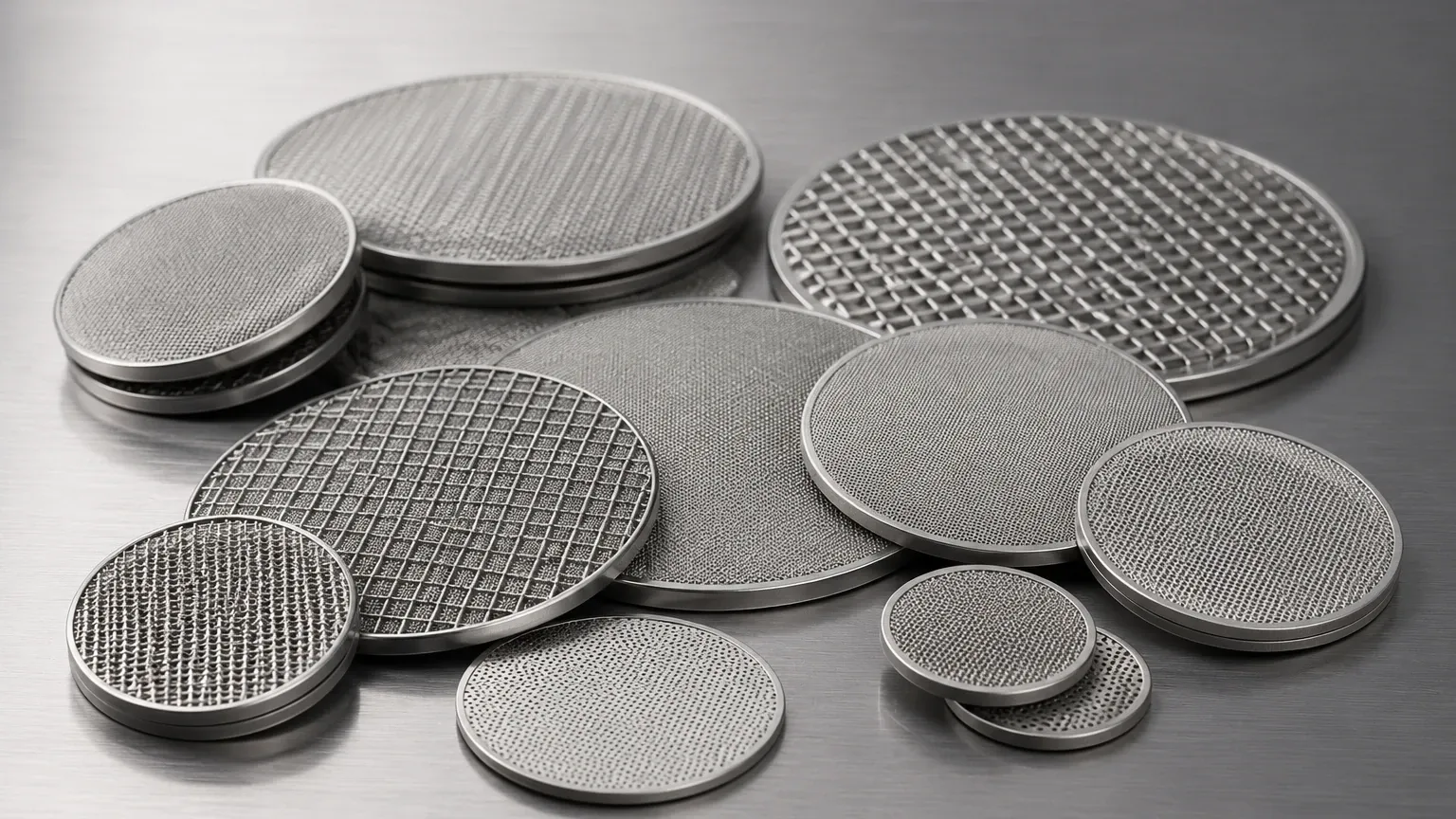
A filter disc stainless steel is typically fabricated from high-quality wire mesh, which can be configured as a single layer or combined into multi-layer packs. The performance of these discs is dictated by the weaving method and the wire diameter used in the mesh.
Weave Types and Their Impact
1. Plain Weave: This is the most common weave where each warp wire crosses over and under each shute wire. It provides a consistent aperture size and is ideal for general-purpose filtration where flow rate is a priority over high-pressure resistance.
2. Twill Weave: In this configuration, each warp wire passes over and under two shute wires. This allows for the use of heavier wires in a given mesh count, providing greater strength and the ability to achieve finer filtration ratings than plain weave.
3. Dutch Weave (Plain and Twill): These weaves use a larger diameter warp wire and a smaller diameter shute wire. The result is a dense, strong mesh with very small, curved openings. Dutch weaves are preferred for high-pressure applications such as hydraulic systems and polymer extrusion because they offer superior mechanical stability.
Single Layer vs. Multi-Layer Packs
Single-layer discs are often used in low-pressure environments or as pre-filters. However, many industrial processes require multi-layer Filter Discs & Packs. These packs often feature a fine filtration layer sandwiched between coarser support layers. The support layers prevent the fine mesh from deforming under pressure and help distribute the flow evenly across the entire surface area of the disc.
Material Selection: Beyond Standard 304
While 304 stainless steel is the industry standard for many general applications, specialized environments require alloys with enhanced properties. The choice of material directly impacts the service life and the total cost of ownership of the filtration system.
* Stainless Steel 304: Offers good corrosion resistance and is suitable for most food processing and general industrial water filtration. It is cost-effective but may struggle in high-chloride environments.
* Stainless Steel 316/316L: The addition of molybdenum provides significantly better resistance to pitting and crevice corrosion, particularly in chloride-rich environments. 316L (low carbon) is preferred for components that require welding, as it prevents carbide precipitation that can lead to corrosion at the weld sites.
* 904L and Specialty Alloys: For highly acidic or aggressive chemical processing, alloys like 904L or even Hastelloy may be used. These materials ensure that the filter disc stainless steel does not degrade and contaminate the process fluid.
When selecting a material, engineers should evaluate the pH levels of the fluid, the presence of oxidizing agents, and the operating temperature. Stainless steel remains the material of choice because it maintains its mechanical strength at temperatures where synthetic filters would fail.
Technical Specifications and Performance Criteria
To ensure a filter disc meets the requirements of a specific system, several technical parameters must be defined during the design and procurement phase.
Micron Rating: Nominal vs. Absolute
The micron rating defines the size of particles the filter is intended to remove. It is important to distinguish between "nominal" and "absolute" ratings. A nominal rating indicates the ability of the mesh to retain a majority of particles of a certain size, whereas an absolute rating refers to the diameter of the largest hard spherical particle that will pass through the filter under specified test conditions. For high-precision applications like pharmaceutical manufacturing, absolute ratings are usually required.
Pressure Drop and Permeability
The pressure drop (delta P) is the difference in pressure between the upstream and downstream sides of the filter. A high initial pressure drop can reduce the efficiency of the pump and shorten the time between filter cleanings or replacements. Permeability is influenced by the open area percentage of the mesh. A well-designed filter disc stainless steel balances fine filtration with a high open area to minimize energy consumption and maximize flow rates.
Mechanical Strength and Burst Pressure
In applications like plastic extrusion or high-pressure hydraulic lines, the filter disc must withstand significant mechanical stress. Multi-layer packs are often spot-welded or bound with a metal rim (aluminum, copper, or stainless steel) to provide structural rigidity. The rim not only holds the layers together but also acts as a gasket to prevent bypass—where unfiltered fluid escapes around the edges of the disc.
Customization and Edge Treatments
Standard circular discs are common, but many industrial housings require custom shapes and edge finishes. Kaifil specializes in providing customized solutions that integrate seamlessly into existing hardware.
Edge Binding Options
* Spot Welded Edges: Ideal for multi-layer packs where a low profile is required. The layers are fused at specific points to maintain alignment without adding significant thickness.
* Aluminum/Copper Rims: These soft metal rims provide an excellent seal when compressed within a filter housing. They are often used in the polymer industry where high-temperature seals are necessary.
* Stainless Steel Rims: Used for the most demanding applications where chemical compatibility must be maintained across the entire component, including the binding.
Shape Variations
Beyond simple circles, Filter Discs & Packs can be manufactured in oval, rectangular, or ring shapes (with a center hole). Precision die-cutting ensures that the dimensions remain within tight tolerances, which is essential for preventing fluid bypass in high-precision equipment.
Key Applications for Stainless Steel Filter Discs
The versatility of the filter disc stainless steel makes it a staple in numerous high-stakes industries.
Polymer and Fiber Extrusion
In the production of plastics, resins, and synthetic fibers, melt filtration is necessary to remove gels and contaminants that could cause breakage in the fiber or defects in the final plastic product. Filter packs are used in screen changers to handle the high viscosity and high pressure of the molten polymer.
Chemical and Petrochemical Processing
Stainless steel filters are used to recover catalysts, remove impurities from fuel, and protect sensitive instrumentation. Their ability to be cleaned and reused (through ultrasonic cleaning or chemical baths) makes them a sustainable choice compared to disposable cartridges.
Food and Beverage Industry
Hygiene is paramount in food processing. Stainless steel is non-reactive and easy to sterilize. Filter discs are used in the filtration of cooking oils, beverages, and dairy products to ensure consumer safety and product clarity.
Pharmaceutical and Biotechnology
Precision filtration is required for the production of active pharmaceutical ingredients (APIs). The use of 316L stainless steel ensures that there is no metallic leaching into the product, and the precise micron ratings allow for the removal of specific particulates or microorganisms.
Selection Guide: Questions for Engineering and Purchasing Teams
Before ordering a filter disc stainless steel, engineers should confirm the following details to ensure the component is fit for purpose:
1. What is the exact fluid composition? (To determine the required stainless steel grade).
2. What is the maximum operating temperature and pressure? (To determine if a multi-layer pack or reinforced rim is necessary).
3. What is the target particle size for removal? (To select the appropriate weave and micron rating).
4. What are the dimensional tolerances of the filter housing? (To ensure a proper fit and prevent bypass).
5. Is the filter intended to be disposable or cleanable? (To evaluate the long-term cost and material durability).
The Total Cost of Ownership
While the initial purchase price of a filter disc stainless steel may be higher than that of a synthetic or paper alternative, the total cost of ownership is often lower in industrial settings. Stainless steel filters offer:
* Durability: Resistance to mechanical damage and pressure surges reduces the frequency of unplanned downtime.
* Cleanability: Many stainless steel discs can be backflushed or cleaned ultrasonically, extending their service life significantly.
* Consistency: Unlike depth filters that can shed fibers or deform over time, a high-quality wire mesh disc provides consistent filtration performance throughout its life cycle.
Conclusion
The filter disc stainless steel is a deceptively simple component that carries immense responsibility in industrial operations. By understanding the nuances of weave types, material grades, and structural reinforcements, engineers can optimize their filtration processes for better product quality and lower operational costs.
As a dedicated manufacturer, Kaifil provides the technical expertise and manufacturing precision required to produce high-performance Filter Discs & Packs. Whether you require standard sizes for water treatment or custom-engineered packs for polymer extrusion, focusing on material integrity and precise construction is the key to reliable filtration. For technical consultation or to review specific product options, selecting a partner with deep manufacturing experience in stainless steel filtration is the most effective way to ensure your application's success.
