


Odor Trap Packs vs Carbon Filter
In industrial filtration and air quality management, selecting the appropriate media for gas-phase contaminant removal is a critical engineering decision. The debate between odor trap packs vs carbon filter often arises when designing systems for chemical processing, pharmaceutical manufacturing, or food and beverage production. While both technologies aim to mitigate volatile organic compounds (VOCs) and unpleasant odors, their mechanical structures, material properties, and operational efficiencies differ significantly.
For engineers and procurement professionals, understanding these differences is essential to ensuring system longevity, maintaining compliance with environmental standards, and optimizing the total cost of ownership. This guide evaluates the technical nuances of odor trap packs and carbon filters, focusing on their application in demanding industrial environments.
Understanding the Fundamentals: Odor Trap Packs vs Carbon Filter
To effectively compare odor trap packs vs carbon filter, one must first define the scope of each technology. A carbon filter typically refers to a housing or substrate impregnated with activated carbon. Activated carbon is processed to have small, low-volume pores that increase the surface area available for adsorption or chemical reactions. It is the gold standard for removing a wide variety of gaseous pollutants.
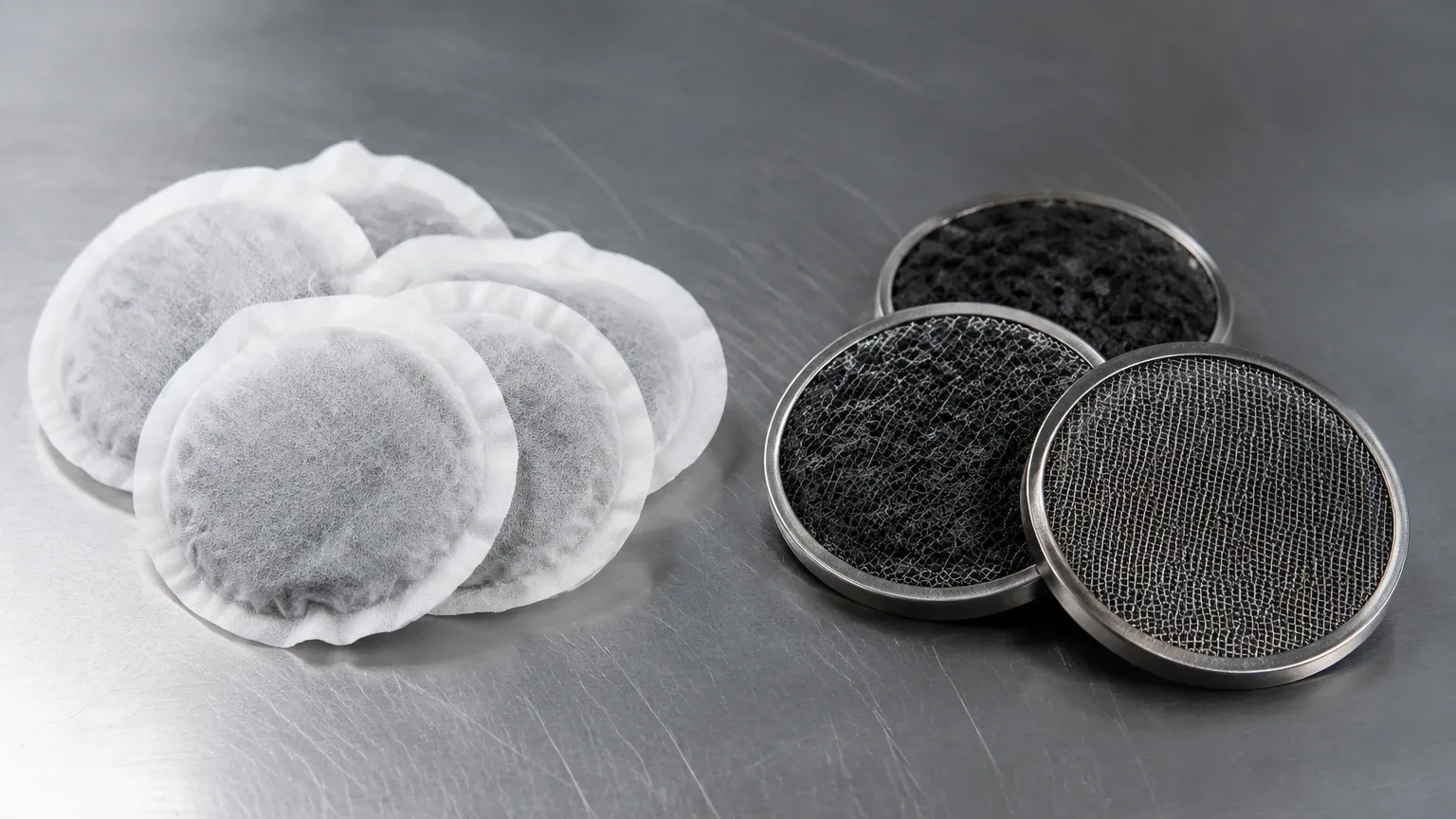
Conversely, "odor trap packs" in an industrial context often refer to multi-layered filtration components that may combine various media, including specialized metal meshes, desiccant layers, or proprietary neutralizing agents. In many high-pressure or high-temperature industrial settings, these packs are constructed using stainless steel Filter Discs & Packs to provide the structural integrity required to hold loose media or to act as a primary barrier against particulate matter that could blind more sensitive chemical adsorbents.
Mechanical Design and Material Composition
The physical construction of a filtration component dictates its durability and suitability for specific environments.
Carbon Filter Construction
Carbon filters are generally available in granular (GAC), powdered (PAC), or extruded block forms. In industrial HVAC or process gas systems, they are often housed in plastic or galvanized steel frames. The primary limitation of standard carbon filters is their structural fragility. Under high-velocity airflow or pulsating pressure, granular carbon can undergo attrition, leading to "carbon fines"—small particles of carbon dust—leaking into the downstream flow. This is unacceptable in cleanroom or pharmaceutical applications.
Filter Pack Engineering
Industrial odor trap packs, particularly those utilizing stainless steel wire mesh, offer a robust alternative. These packs are often composed of multiple layers of wire cloth, ranging from coarse support meshes to fine filtration weaves. When comparing odor trap packs vs carbon filter, the metal-based pack excels in mechanical strength. These components can be sintered or spot-welded to ensure that the layers do not shift under pressure. This design allows for the containment of specialized odor-neutralizing pellets or the integration of catalytic materials that operate at temperatures where traditional carbon would ignite or degrade.
Filtration Mechanisms: Adsorption vs. Physical Capture
The efficacy of any filtration system depends on the underlying physics of how it interacts with contaminants.
1. Adsorption in Carbon Filters: Activated carbon works primarily through physical adsorption (Van der Waals forces). The vast internal surface area traps gas molecules within the pore structure. Some carbon filters are "chemically impregnated" with substances like potassium permanganate to enhance the capture of specific gases like hydrogen sulfide or formaldehyde through chemisorption.
2. Multi-Stage Capture in Trap Packs: Odor trap packs often employ a hybrid approach. The outer layers of a stainless steel pack provide physical filtration, removing aerosols and particulates that might otherwise coat the surface of an adsorbent. The internal layers or the media contained within the pack then address the gaseous odors. By using precision-engineered Filter Discs & Packs, engineers can create a gradient filtration effect, extending the life of the internal chemical media by protecting it from mechanical fouling.
Performance Metrics: Pressure Drop and Throughput
In B2B industrial applications, the energy cost associated with moving air or fluid through a filter is a major consideration. This is where the comparison of odor trap packs vs carbon filter becomes highly technical.
* Pressure Drop ($ΔP$): Carbon blocks and densely packed granular beds often exhibit high resistance to flow. As the carbon pores fill with contaminants, the pressure drop increases, requiring higher fan or pump power.
* Flow Optimization: Custom-designed filter packs can be engineered with specific mesh counts to balance filtration efficiency with permeability. Because stainless steel mesh has a predictable and uniform pore size, engineers can calculate the exact pressure drop across the pack. This predictability is vital for maintaining consistent process conditions in chemical reactors or aeration systems.
Industrial Application Suitability
Choosing between these two technologies requires an analysis of the operating environment.
When to Choose Carbon Filters
Carbon filters are ideal for general VOC removal in ambient temperature environments where the gas concentration is relatively low and the air is dry. They are commonly used in office building air handlers, light manufacturing, and water treatment polishing stages. However, they struggle in high-humidity environments, as water vapor can occupy the adsorption sites, rendering the carbon ineffective.
When to Choose Specialized Filter Packs
Industrial odor trap packs, especially those utilizing stainless steel components, are the preferred choice for:
* High-Temperature Processes: Where gas streams exceed 150°C, standard carbon filters may fail. Stainless steel packs remain structurally sound at much higher temperatures.
* Corrosive Environments: In chemical processing plants where acidic or alkaline vapors are present, 316L stainless steel packs provide the necessary corrosion resistance that plastic or aluminum-framed carbon filters lack.
* High-Purity Requirements: In pharmaceutical and food processing, the risk of media migration (carbon fines) must be eliminated. Sintered mesh packs provide a secure, non-shedding barrier.
Customization and Integration in Industrial Systems
One of the primary advantages of working with a manufacturer like Kaifil is the ability to customize the geometry and filtration characteristics of Filter Discs & Packs. Unlike off-the-shelf carbon filters that come in standard sizes, industrial packs can be tailored to fit existing hardware.
Engineers can specify the number of layers, the wire diameter, and the alloy type (e.g., 304, 316, or Hastelloy) to meet specific chemical compatibility requirements. This level of customization is essential when dealing with complex odor profiles that require a combination of physical impingement, moisture separation, and gas-phase adsorption. For instance, a pack might be designed with a hydrophobic outer mesh to repel water droplets followed by a dense mesh layer to hold a specific odor-neutralizing compound.
Maintenance, Replacement Cycles, and Total Cost
The long-term value of odor trap packs vs carbon filter is often found in maintenance requirements.
Carbon filters are generally considered consumables. Once the adsorption sites are saturated, the media must be replaced. In many cases, the entire filter housing is discarded, leading to significant waste.
In contrast, many industrial filter packs are designed for longevity. Stainless steel mesh components can often be cleaned using ultrasonic baths, backwashing, or chemical cleaning, depending on the nature of the contaminants. Even if the internal odor-neutralizing media is consumable, the robust stainless steel housing and support discs can be reused for multiple cycles. This reduces the frequency of component replacement and lowers the long-term environmental impact and procurement costs.
Technical Considerations for Engineers
Before finalizing a specification for odor trap packs vs carbon filter, engineers should confirm the following technical parameters:
1. Gas Composition: Identify the specific molecules causing the odor. Carbon is excellent for organic vapors but poor for small, highly polar molecules unless specifically treated.
2. Face Velocity: Ensure the velocity of the gas stream allows for sufficient "dwell time" within the filter media for adsorption to occur.
3. Temperature and Humidity: High humidity can reduce carbon efficiency by up to 50%. In such cases, a multi-stage pack with a pre-filter mesh to coalesce moisture is necessary.
4. Mechanical Constraints: Determine if the system is subject to vibration or high-pressure spikes that could compromise the integrity of a standard carbon filter.
By evaluating these factors, technical teams can determine whether a standard carbon solution suffices or if a more durable, customized solution involving precision-engineered Filter Discs & Packs is required to ensure process stability and odor control. In the demanding landscapes of modern industry, the robustness and versatility of metal filtration components often provide the reliability that standard carbon filters cannot match.
