


Well Filter Pack Sand
In industrial well completion and large-scale process filtration, the selection of well filter pack sand is a critical engineering decision that dictates the long-term efficiency, sand-free production, and structural integrity of the well. Often referred to as a "gravel pack" in the context of water and oil and gas industries, this specialized granular media acts as a secondary filter, stabilizing the borehole and preventing the migration of fine formation materials into the wellbore.
For engineers and procurement teams, understanding the technical nuances of filter sand—and how it interfaces with mechanical components like Filter Discs & Packs—is essential for optimizing flow rates and minimizing maintenance costs. This article explores the engineering principles, material specifications, and selection criteria for well filter pack sand within industrial filtration systems.
Understanding the Role of Well Filter Pack Sand in Industrial Filtration
The primary function of well filter pack sand is to create a permeable envelope around the well screen. In industrial applications, such as high-volume groundwater extraction, chemical processing intake, or remediation wells, the natural formation often contains a mix of grain sizes. Without a properly engineered filter pack, the finer particles from the formation would bypass the well screen, leading to several operational issues:
1. Pump Abrasion: Fine sand particles are highly abrasive. When they enter the fluid stream, they cause rapid wear on pump impellers, seals, and valves.
2. Well Clogging: If the formation collapses against the screen or if fines bridge across the screen openings, the specific capacity of the well decreases, requiring higher energy input for the same yield.
3. Subsidence: The continuous removal of sand from the formation can create voids, potentially leading to the structural failure of the well or surrounding ground.
By installing a filter pack with a controlled grain size distribution, engineers create a zone of high hydraulic conductivity that filters out formation fines while maintaining a low-velocity flow path. This mechanical stabilization is supported by precision metal components that ensure the sand remains in its designated annular space.
Engineering Specifications for Filter Media Selection
Selecting the correct well filter pack sand is not a matter of choosing a generic aggregate. It requires a detailed sieve analysis of the formation material and a calculation of the appropriate filter-to-formation ratio. The following technical parameters are the industry standards for evaluating filter sand quality.
Grain Size Distribution (GSD)
The most critical factor is the size of the sand grains. This is typically defined by the D10 and D60 values, which represent the sieve sizes that allow 10% and 60% of the material to pass by weight, respectively.
* D10 (Effective Size): This value is used to estimate the permeability of the sand pack. A larger D10 indicates a more permeable pack but may offer less retention of very fine formation particles.
* Uniformity Coefficient (UC): Calculated as the ratio of D60 to D10 (UC = D60/D10). For a filter pack to be effective, it must be highly uniform. A UC of less than 2.5 is generally required for industrial wells, as it ensures that the pore spaces between grains are consistent, preventing the segregation of sizes during installation.
Sphericity and Roundness
Industrial filter sand must be well-rounded and spherical. Angular grains, such as those found in crushed stone, tend to bridge and pack tightly, significantly reducing the porosity and hydraulic conductivity of the filter. High sphericity (typically measured on the Krumbein scale) ensures that the sand settles into a stable, high-porosity matrix that allows for maximum fluid flow with minimal pressure drop.
Chemical Purity and Acid Solubility
In chemical processing or water treatment applications, the chemical composition of the sand is paramount. Most industrial filter packs utilize high-purity silica sand (SiO2 > 98%). The material must have low acid solubility (typically < 5%) to ensure that it does not degrade during well rehabilitation processes, such as acid washing to remove mineral scaling. For highly specialized applications, ceramic proppants or synthetic beads may be used, though silica sand remains the standard due to its cost-effectiveness and durability.
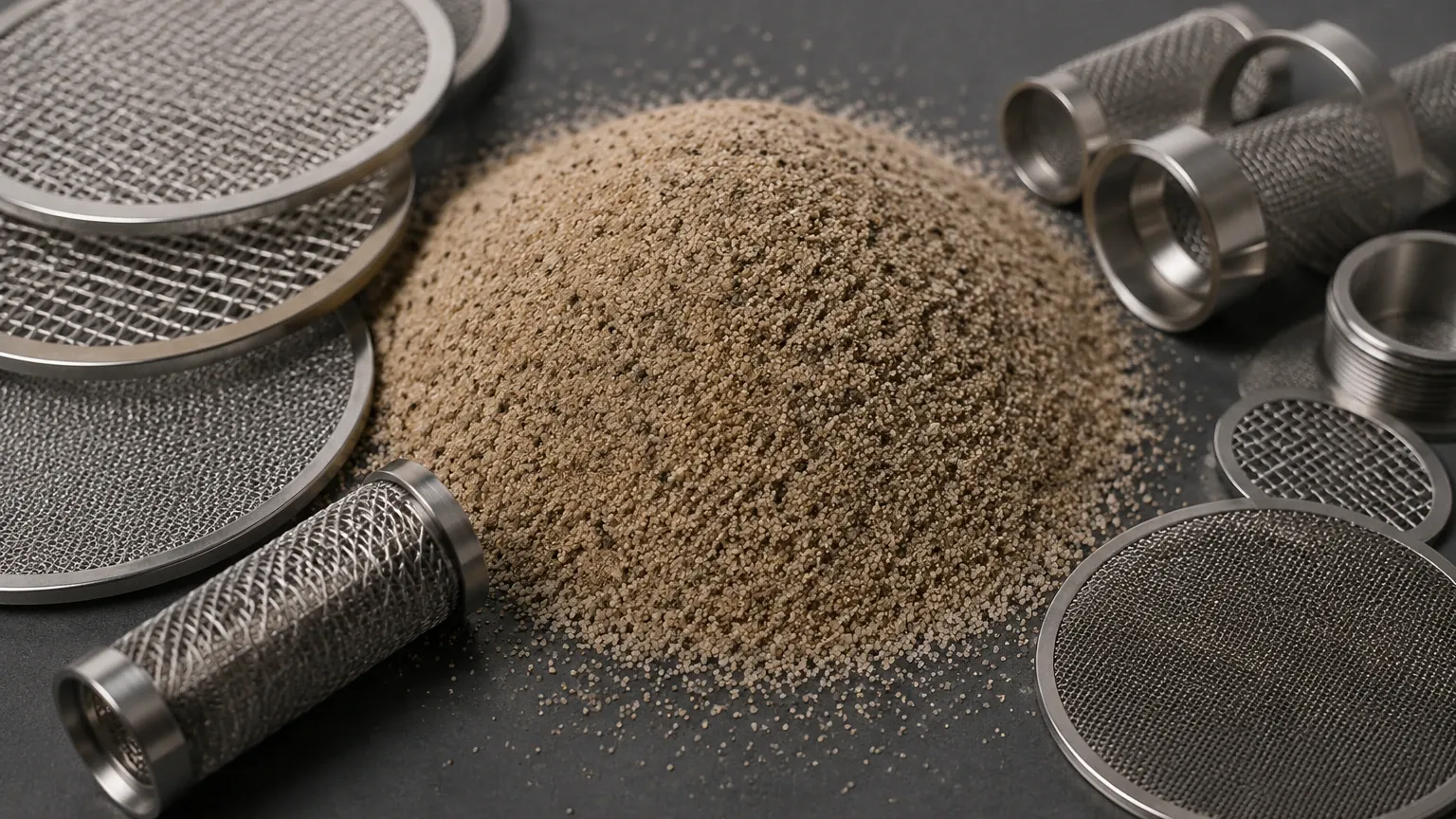
The Interface Between Sand Packs and Stainless Steel Filter Discs & Packs
While the sand provides the primary filtration barrier against the formation, it must be held in place by a mechanical structure. This is where the synergy between granular media and precision metal filtration components becomes vital. In many industrial filtration housings and well screen assemblies, Filter Discs & Packs are utilized as the final containment layer.
Retention of the Filter Media
The mesh size of the stainless steel filter discs must be carefully selected to be smaller than the smallest grain size in the filter pack (the D10 value). If the mesh is too large, the filter sand will migrate into the process stream; if it is too small, it may become a site for premature blinding.
Structural Support in High-Pressure Environments
In deep wells or high-pressure chemical reactors, the filter pack is subjected to significant compressive forces. Stainless steel filter packs, often consisting of multiple layers of sintered wire mesh, provide the necessary mechanical strength to support the weight of the sand column and the hydraulic pressure of the fluid. These metal components are engineered to resist corrosion and erosion, ensuring that the integrity of the filter bed is maintained over decades of operation.
Performance Evaluation and Permeability Calculations
Engineers must predict the performance of the well filter pack sand before installation. This is primarily done through the application of Darcy’s Law, which relates flow rate to the hydraulic gradient and the permeability of the media.
Porosity and Hydraulic Conductivity
The porosity of a well-rounded silica sand pack typically ranges from 30% to 40%. The hydraulic conductivity ($K$) is influenced by the square of the effective grain size ($D_{10}$). A common approximation is the Hazen formula:
$$K = C \cdot (D_{10})^2$$
Where $C$ is a coefficient based on the uniformity and packing of the sand. In industrial settings, maximizing $K$ while maintaining sand retention is the primary goal. If the calculated conductivity is too low, the well will experience excessive "drawdown," leading to increased pumping costs and potential cavitation issues in the pump assembly.
Head Loss Considerations
Every layer of filtration—from the sand pack to the internal stainless steel mesh—contributes to the total head loss of the system. By using high-quality, uniform sand and precision-engineered metal filter packs, engineers can minimize the "skin effect" (the pressure drop specifically occurring at the interface of the wellbore and the filter pack).
Common Failure Modes in Well Filtration Systems
Even with high-quality well filter pack sand, systems can fail if engineering boundaries are not respected. Understanding these failure modes is essential for developing a robust maintenance strategy.
1. Sand Segregation: If the sand is poured too quickly or from too great a height without a tremie pipe, the larger grains may settle faster than the smaller ones. This creates layers of varying permeability, which can lead to localized high-velocity zones and sand breakthrough.
2. Biofouling and Scaling: In water wells, bacteria or mineral precipitates (like calcium carbonate) can grow within the pore spaces of the sand pack. This reduces permeability and requires chemical treatment. The filter sand must be chemically compatible with these treatments.
3. Mechanical Erosion: If the fluid velocity is too high, the constant movement of fluid can erode the sand grains over time, especially if they are not sufficiently hard. This is why Mohs hardness (typically 7 for silica sand) is a key specification.
4. Mesh Failure: If the supporting stainless steel filter discs are not specified for the correct corrosion environment (e.g., using 304 stainless steel in a high-chloride environment instead of 316L), the mesh may fail, leading to a catastrophic loss of the sand pack into the process stream.
Customization and OEM Solutions for Demanding Environments
No two industrial wells are identical. Geological variations and process requirements often necessitate customized filtration solutions.
Tailored Grain Sizes
For unique formations, such as those with very fine silts or highly non-uniform distributions, custom-blended filter packs may be required. These blends are engineered to match the specific sieve analysis of the site, ensuring that the filter-to-formation ratio (typically between 4 and 6) is maintained for optimal stability.
Integrated Filter Assemblies
In modern industrial filtration, there is a move toward integrated OEM components. Manufacturers like Kaifil provide customized stainless steel filtration components that are designed to work in tandem with specific grades of filter sand. This includes:
* Sintered Mesh Packs: Providing high-strength retention for high-pressure applications.
* Pleated Filter Elements: Increasing the surface area of the mechanical filter to reduce velocity at the sand-mesh interface.
* Custom Disc Geometries: Ensuring a perfect fit within the well screen or filter housing to prevent bypass.
Procurement and Quality Control: What to Confirm
When purchasing well filter pack sand and the associated mechanical filter components, purchasing teams should verify the following documentation to ensure performance expectations are met:
* Sieve Analysis Report: A recent test showing the D10, D60, and UC of the sand batch.
* Material Safety Data Sheet (MSDS): Confirming the silica content and the absence of hazardous contaminants.
* Crush Resistance Test: Especially important for deep wells where lithostatic pressure is high.
* Mesh Micron Rating: For the stainless steel components, confirm that the absolute or nominal micron rating is compatible with the sand's D10 value.
Conclusion
Well filter pack sand is a foundational element of industrial well design, serving as the primary defense against formation instability and equipment wear. However, its effectiveness is entirely dependent on precise engineering—specifically the grain size distribution, uniformity, and the quality of the mechanical retention system.
By integrating high-purity sand with professional-grade Filter Discs & Packs, industrial operators can achieve a filtration system that offers both high permeability and long-term durability. Whether for water treatment, chemical processing, or resource extraction, the synergy between granular media and stainless steel filtration technology remains the gold standard for reliable, sand-free production.
