


Y Filter Irrigation
In industrial and large-scale agricultural operations, the reliability of an irrigation system is directly proportional to the quality of its filtration. Y filter irrigation systems serve as a primary defense mechanism, protecting sensitive components such as solenoid valves, drip emitters, and micro-sprinklers from particulate matter. Named for its physical shape, the Y-strainer or Y-filter is an indispensable component that allows for the removal of solids from a flowing fluid by means of a perforated or mesh straining element.
For engineers and procurement professionals, selecting the right filtration solution involves more than just choosing a housing size. It requires a deep understanding of fluid dynamics, material compatibility, and the specific filtration media required to maintain system pressure while ensuring water purity. This guide examines the technical nuances of Y filter irrigation, focusing on engineering considerations, material science, and the role of precision components in optimizing performance.
Engineering Principles of Y Filter Irrigation
The fundamental design of a Y-filter allows it to be installed in either a horizontal or vertical position, provided the "leg" of the Y points downward. This orientation is critical because it utilizes gravity to help collect trapped debris in the cooling leg, preventing it from re-entering the main flow during periods of low pressure or system shutdown.
From a fluid dynamics perspective, the Y-filter creates a slight diversion in the flow path. As water enters the inlet, it is forced through a cylindrical filter element. The solids are captured on the interior or exterior of the mesh (depending on the design), and the cleaned water exits through the outlet. The efficiency of this process is governed by the "Effective Filtration Area" (EFA). A larger EFA reduces the velocity of the fluid passing through the mesh, which in turn minimizes the pressure drop ($ΔP$) across the filter and extends the time between cleaning cycles.
In industrial irrigation, where water sources may include reclaimed process water or surface water from ponds, the particulate load can fluctuate significantly. Engineers must calculate the maximum allowable pressure drop to ensure that the downstream emitters receive the required operating pressure. If the filter is undersized, the resulting turbulence and high-pressure differential can cause "debris breakthrough," where flexible organic matter is forced through the mesh openings, leading to system-wide clogging.
Material Selection for Durability and Chemical Resistance
While plastic Y-filters are common in residential applications, industrial-grade Y filter irrigation systems often demand more robust materials. The choice of material impacts the system's longevity, especially when dealing with fertigation (the injection of fertilizers into the irrigation stream) or chemically treated water.
1. Stainless Steel (304 and 316L): For high-pressure environments and systems exposed to corrosive chemicals, stainless steel is the gold standard. 316L stainless steel, in particular, offers superior resistance to chlorides and acidic fertilizers. Unlike plastic, metal housings and elements do not degrade under UV exposure and can withstand significant hydraulic shocks (water hammer) without fracturing.
2. Chemical Compatibility: In many B2B irrigation contexts, such as greenhouse climate control or chemical processing wash-downs, the water may contain additives. It is essential to verify that the gaskets (typically EPDM, Viton, or NBR) and the filter media are compatible with these substances to prevent seal failure.
3. Structural Integrity: Industrial Y-filters must maintain their shape under high differential pressure. Plastic elements may bow or collapse if the filter becomes heavily loaded with debris, whereas reinforced metal elements provide the mechanical strength necessary to withstand these forces until a cleaning cycle is initiated.
The Role of Filter Discs & Packs in Precision Irrigation
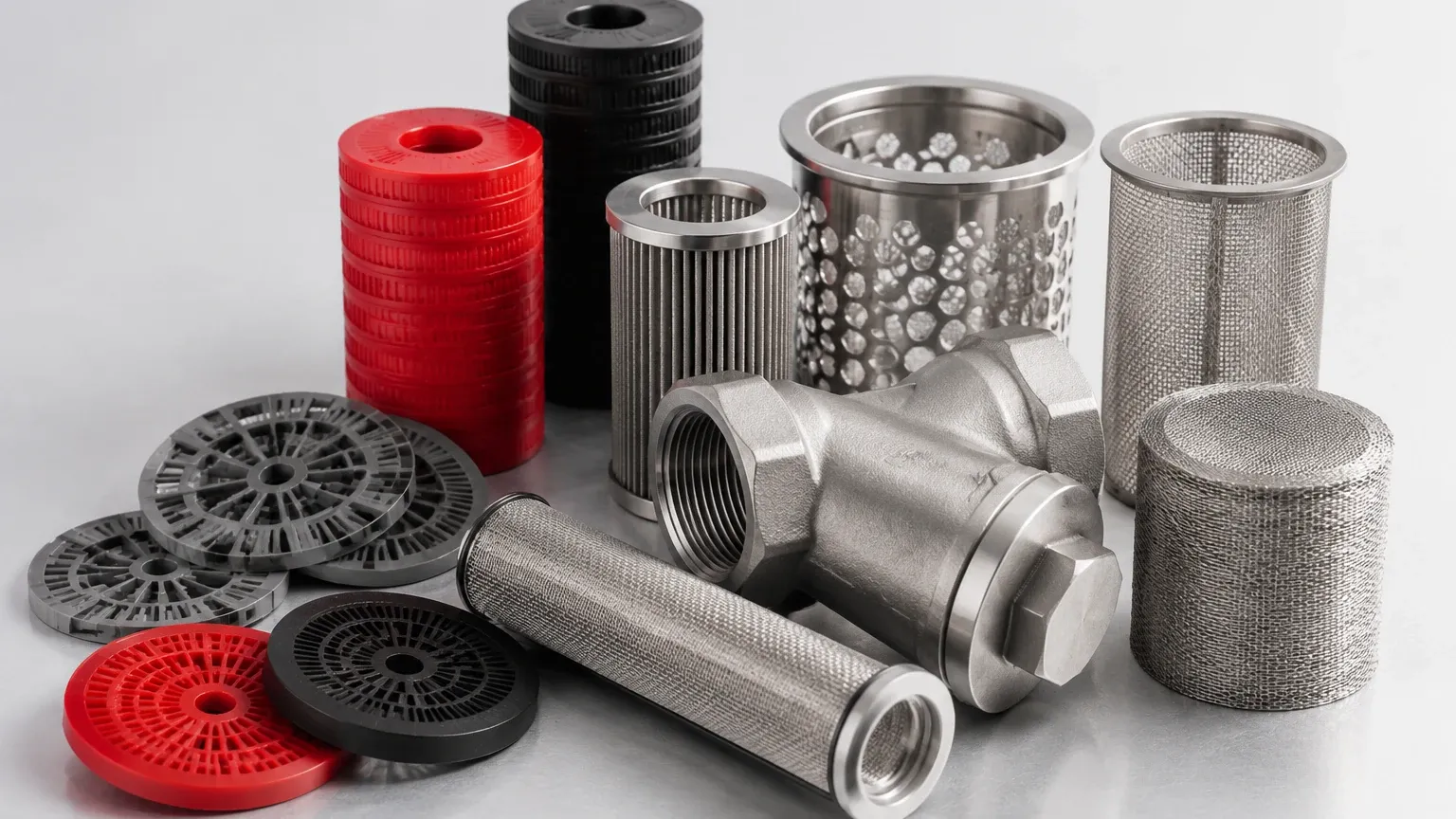
The heart of any Y-filter is the media itself. While standard perforated screens are sufficient for removing large pebbles or bark, precision irrigation requires a much finer degree of control. This is where high-performance Filter Discs & Packs become essential.
In many advanced Y-filter configurations, the traditional single-layer mesh screen is replaced or supplemented by multi-layer packs. These components offer several technical advantages:
* Depth Filtration: By layering different mesh counts, a filter pack can provide depth filtration. Larger particles are trapped on the outer layers, while finer silt is captured deeper within the media. This prevents the surface blinding that often occurs with single-layer screens.
* Enhanced Support: In high-pressure irrigation, the fine mesh required for drip protection is often fragile. Integrating the mesh into a robust pack assembly provides the necessary structural support to prevent tearing.
* Customizable Micron Ratings: Industrial applications often require specific micron ratings that standard off-the-shelf screens cannot provide. Custom-engineered discs allow for precise calibration of the filtration level, ensuring that even the smallest emitters remain clear without unnecessarily restricting flow.
Using high-quality metal filter packs ensures that the filtration element can be cleaned and reused multiple times, providing a much lower total cost of ownership compared to disposable plastic cartridges.
Technical Specifications: Micron Ratings and Flow Rates
When specifying a Y filter irrigation system, two primary metrics dictate performance: the micron rating and the flow capacity.
Micron Rating vs. Mesh Count
In the filtration industry, mesh count refers to the number of openings per linear inch. However, for engineering specifications, the micron rating (the size of the smallest particle the filter will reliably trap) is more accurate. For example, a 150-mesh screen typically correlates to approximately 100 microns. In drip irrigation, it is a general rule of thumb to filter to at least 1/10th the diameter of the smallest emitter orifice. If a drip tape has an orifice of 1.0mm, the filtration should be at 100 microns or finer.
Flow Rate and Pressure Drop
Every Y-filter has a flow coefficient ($Cv$), which represents the flow of water in gallons per minute (GPM) that will pass through the filter with a 1 PSI pressure drop. Engineers must ensure that the selected Y-filter can handle the peak flow of the irrigation zone without exceeding a 2-3 PSI drop when clean. If the initial pressure drop is too high, the system will reach its "terminal pressure drop" (the point where cleaning is required) almost immediately, leading to excessive maintenance and potential pump strain.
Maintenance Protocols and Operational Longevity
A Y filter irrigation system is only as effective as its maintenance regimen. Because these filters are "passive" devices, they continue to collect debris until the flow is restricted or the element fails.
Blow-down Valves
Most industrial Y-filters are equipped with a blow-down port on the leg of the Y. By installing a ball valve on this port, operators can perform a "flush" without dismantling the filter. This uses the system's own pressure to eject accumulated sediment. However, a blow-down is not a substitute for a full manual cleaning, as it may not remove organic biofilms or wedged particulates from the mesh.
Cleaning Cycles
In automated systems, differential pressure sensors are installed upstream and downstream of the filter. When the $ΔP$ reaches a pre-set limit (typically 5-7 PSI over the clean pressure), an alert is triggered. For manual systems, a regular inspection schedule is required. Stainless steel elements should be cleaned using a soft brush or high-pressure water spray, taking care not to deform the mesh.
Indicators for Replacement
While stainless steel filter elements are highly durable, they are not infinite. Signs that an element needs replacement include:
* Permanent Pressure Drop: If the $ΔP$ remains high even after thorough cleaning, it indicates that particles have become permanently embedded in the mesh (blinding).
* Mechanical Deformation: Any signs of crushing or "telescoping" of the element suggest the system has exceeded its design pressure limits.
* Bypass Leaks: If debris is found downstream despite the filter being in place, the seals or the element itself may be compromised.
Customization for OEM and Specialized Irrigation
For manufacturers of irrigation equipment (OEMs), standard Y-filters may not meet the spatial or performance requirements of a proprietary system. Customization allows for the optimization of the filtration process for specific environments, such as high-salinity coastal irrigation or high-temperature industrial cooling loops.
Customization options often include:
* Variable Housing Geometry: Modifying the angle of the Y-leg to fit into compact skid-mounted systems.
* Specialized Mesh Alloys: Using Monel or Inconel for extreme chemical resistance in specialized fertigation applications.
* Integrated Filter Packs: Designing the internal chamber to house high-capacity Filter Discs & Packs that provide greater surface area than a standard cylinder.
By working with a manufacturer capable of precision metal fabrication, engineering teams can ensure that the filtration component is a value-add to their system rather than a bottleneck. This collaborative approach leads to more resilient irrigation infrastructure and reduced long-term maintenance costs for the end-user.
Conclusion
Y filter irrigation is a critical discipline within industrial water management. By selecting the appropriate materials, understanding the fluid dynamics of pressure drop, and utilizing high-precision filtration media like stainless steel mesh and filter packs, organizations can protect their capital investments in irrigation technology. Whether the application is a simple landscape project or a complex industrial fertigation system, the principles of robust engineering and quality component selection remain the foundation of efficient, uninterrupted operation.
