


10 Micron Hydraulic Filter
In the realm of industrial fluid power, the cleanliness of hydraulic oil is the single most critical factor determining the longevity and reliability of system components. A 10 micron hydraulic filter serves as a primary line of defense, specifically engineered to capture particulate matter that is invisible to the naked eye but large enough to cause catastrophic wear in precision components like servo valves, piston pumps, and high-pressure cylinders. Selecting the correct filtration solution requires a deep understanding of micron ratings, material compatibility, and the mechanical stresses inherent in high-pressure hydraulic circuits.
As a specialized manufacturer of stainless steel filtration solutions, Kaifil provides engineering-grade components designed to meet the rigorous demands of industrial hydraulic systems. Understanding the technical nuances of a 10 micron hydraulic filter is essential for engineers and procurement teams tasked with maintaining system integrity and reducing total cost of ownership.
Understanding the 10 Micron Rating: Absolute vs. Nominal
One of the most common points of confusion in filter specification is the distinction between nominal and absolute micron ratings. A "10 micron" label can mean significantly different things depending on the testing methodology used by the manufacturer.
Nominal Filtration
A nominal rating is an arbitrary micrometer value indicated by the filter manufacturer. It typically implies that the filter can trap a large percentage of particles of that size (often between 50% and 95%). However, nominal filters do not guarantee the capture of all particles at the rated size. In hydraulic systems where tolerances are tight, a nominal 10 micron hydraulic filter might allow enough oversized particles through to cause "stiction" in valves or abrasive wear on pump vanes.
Absolute Filtration
An absolute rating is determined through the Multi-Pass Test (ISO 16889). For a filter to be considered "absolute" at 10 microns, it must achieve a high Beta Ratio ($β$). For instance, a $β_{10} ≥ 200$ means the filter is 99.5% efficient at capturing particles 10 microns and larger. In critical industrial applications, engineers almost exclusively specify absolute-rated filters to ensure predictable fluid cleanliness levels.
Material Selection for 10 Micron Hydraulic Filters
The environment in which a hydraulic filter operates dictates the materials used in its construction. While disposable cellulose or glass fiber media are common in standard applications, demanding industrial environments often require the durability of stainless steel.
Stainless Steel Wire Mesh
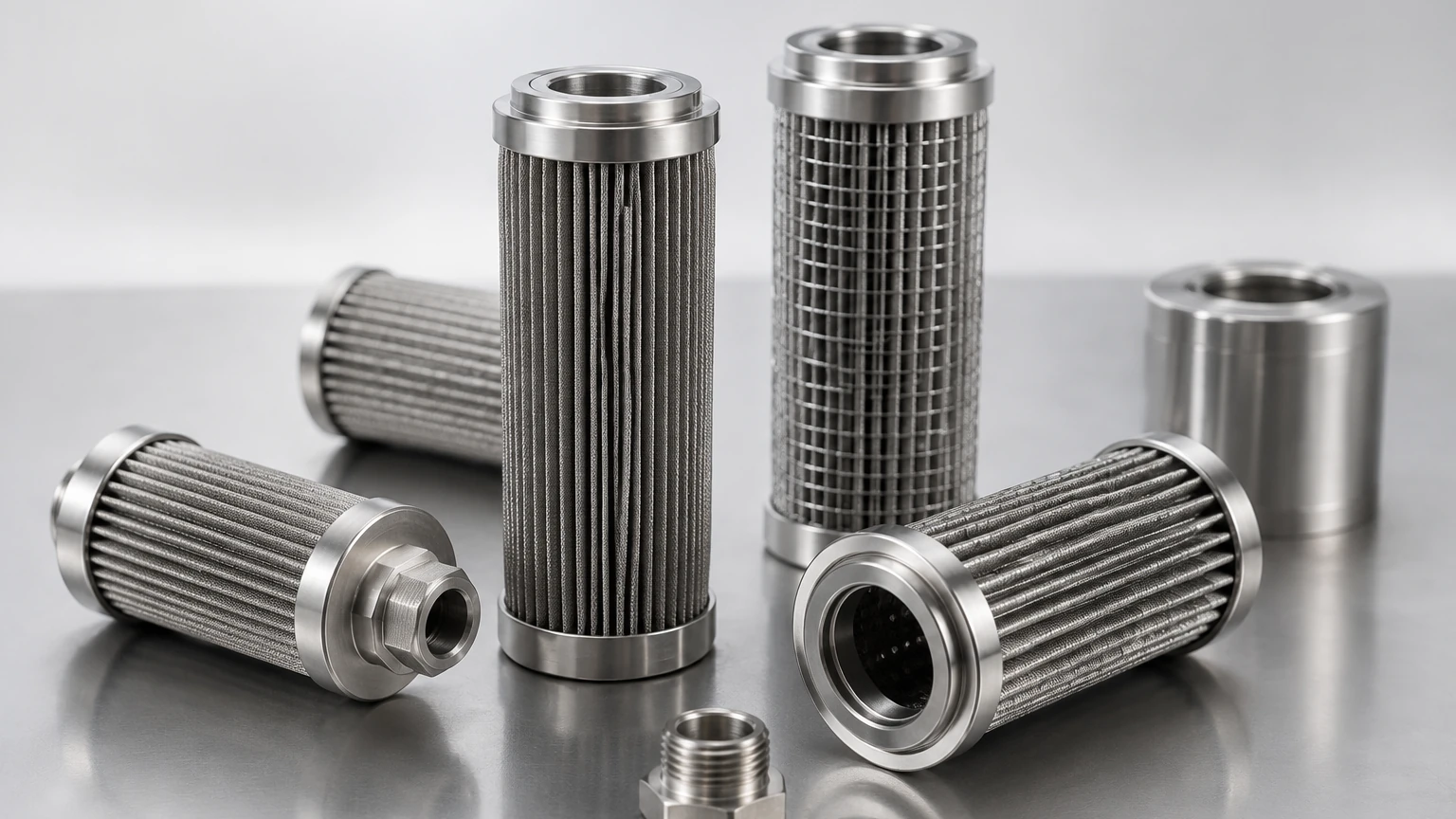
For applications involving high temperatures, aggressive chemical fluids, or the need for cleanability, stainless steel wire mesh is the preferred media. Kaifil specializes in weaving precision stainless steel mesh (typically SUS 304 or 316L) that provides fixed pore structures. Unlike fiber-based media, stainless steel mesh does not suffer from "media migration," where bits of the filter material itself break off and enter the downstream flow.
Glass Fiber (Synthetic Media)
Inert glass fiber is frequently used for 10 micron hydraulic filters due to its high dirt-holding capacity and deep-bed filtration characteristics. It is excellent for capturing fine silt. However, it is a single-use material. When the pressure drop across the filter reaches a critical point, the element must be replaced and discarded.
Structural Components
Beyond the media, the structural integrity of the filter element is paramount. This includes:
- Center Tubes: Usually made of perforated stainless steel or carbon steel to prevent element collapse under high differential pressure.
- End Caps: Precision-machined or stamped components that ensure a leak-proof seal within the filter housing.
- Support Layers: Coarse wire mesh layers that protect the fine 10-micron media from the mechanical stresses of flow surges.
Key Performance Metrics in Hydraulic Filtration
When evaluating a 10 micron hydraulic filter, engineers must look beyond the micron rating and consider how the filter will perform under real-world operating conditions.
Beta Ratio and Efficiency
The Beta Ratio ($β$) is the industry standard for measuring filter efficiency. It is calculated by dividing the number of particles upstream of the filter by the number of particles downstream. For a 10 micron filter, a $β_{10} = 1000$ indicates 99.9% efficiency. High-performance hydraulic systems often target an ISO 4406 cleanliness code of 16/14/11 or better, which necessitates high Beta-rated 10-micron filtration.
Dirt Holding Capacity (DHC)
DHC refers to the total amount of contaminant a filter can trap before the pressure drop reaches the bypass valve setting. A filter with a high DHC will have a longer service life, reducing maintenance intervals and downtime. Factors affecting DHC include the total surface area of the media (often increased through pleating) and the depth of the media.
Clean Pressure Drop (ΔP)
Every filter introduces a restriction to flow. The "clean pressure drop" is the resistance measured when the filter is new and the fluid is at operating temperature. If the initial ΔP is too high, the system may prematurely enter "bypass mode," allowing unfiltered oil to circulate. Engineers must balance filtration fineness with the required flow rate to ensure the system remains efficient.
Application Scenarios for 10 Micron Filtration
Where exactly is a 10 micron hydraulic filter utilized? While suction strainers may be 100 microns and return line filters might be 25 microns, the 10-micron threshold is typically found in the following areas:
1. Pressure Line Filtration: Located immediately downstream of the pump, these filters protect expensive components like servo valves and actuators from pump-generated wear debris.
2. Off-line (Kidney Loop) Filtration: A dedicated motor and pump circulate oil through a high-efficiency 10 micron hydraulic filter to maintain a constant baseline of cleanliness, independent of the main system's operation.
3. Pilot Line Filtration: Small, high-pressure filters used to protect the sensitive pilot stages of large directional control valves.
4. Hydrostatic Transmissions: Closed-loop systems found in mobile equipment require extremely clean oil to prevent the rapid failure of high-speed piston motors.
Engineering Considerations for Custom Filter Design
At Kaifil, we recognize that off-the-shelf solutions do not always meet the specific needs of specialized industrial machinery. When designing or specifying a custom 10 micron hydraulic filter, several engineering variables must be confirmed:
Fluid Compatibility
Not all hydraulic fluids are mineral-based. Phosphate esters, water-glycols, and high-water-content fluids can degrade standard adhesives and seals. For these applications, stainless steel filters with Viton (FKM) or EPR seals are often required to ensure chemical resistance.
Temperature Extremes
Standard hydraulic filters are rated for temperatures up to approximately 250°F (120°C). In applications such as steel mills or glass manufacturing, temperatures can exceed these limits. Stainless steel pleated elements, joined via TIG welding or plasma welding rather than adhesives, allow for continuous operation in extreme heat.
Flow Fatigue and Pulse Resistance
Hydraulic systems are rarely steady-state. Rapid valve cycling creates pressure ripples and flow surges that can fatigue filter media. A robust 10 micron hydraulic filter must be designed with adequate support mesh to prevent the pleats from flexing and eventually cracking, which would lead to a total loss of filtration efficiency.
Maintenance and Replacement Cycles
The effectiveness of a filtration system is only as good as its maintenance schedule. Relying solely on a calendar-based replacement strategy often leads to either premature disposal of viable filters or, worse, running a filter in bypass mode for weeks.
Differential Pressure Monitoring
The most reliable way to determine when a 10 micron hydraulic filter needs replacement is by monitoring the differential pressure (ΔP). Visual indicators or electrical pressure switches can alert operators when the filter is reaching its capacity. Typically, if a bypass valve is set to 50 PSI (3.5 bar), the filter should be changed when the ΔP reaches 35-40 PSI.
Fluid Analysis
Regular oil analysis provides a window into the health of both the fluid and the filter. If a 10 micron filter is performing correctly, the particle count (ISO 4406) should remain stable. A sudden spike in particle counts indicates either a filter bypass, a ruptured element, or a mechanical failure elsewhere in the system that is overwhelming the filtration capacity.
Why Choose Kaifil for Industrial Filtration?
Kaifil is a professional manufacturer specializing in custom stainless steel filtration solutions. We combine advanced manufacturing capabilities with deep engineering expertise to provide reliable OEM and customized filtration components. Our focus is on delivering high-performance products that meet the specific accuracy and durability requirements of demanding industrial environments.
From the initial material selection to the final quality control checks, we work closely with global customers to ensure our filters provide the precise performance needed for chemical processing, pharmaceutical production, and heavy-duty hydraulic applications. For more detailed technical specifications and to explore our full range of capabilities, please visit our Main Page.
Conclusion
Selecting a 10 micron hydraulic filter involves more than just matching a part number. It requires an analysis of the system's cleanliness targets, the physical properties of the hydraulic fluid, and the mechanical stresses of the application. By choosing high-quality, absolute-rated filtration components—particularly those constructed from durable materials like stainless steel—engineers can significantly extend the life of their hydraulic machinery and minimize the risk of unplanned downtime. Whether you are designing a new system or optimizing an existing one, prioritizing high-efficiency filtration is an investment that pays dividends in system reliability and performance.
