


5 Micron Stainless Steel Mesh Filter
In industrial filtration, the transition from coarse straining to precision separation often centers around the 5-micron threshold. A 5 micron stainless steel mesh filter represents a critical component for protecting sensitive downstream equipment, ensuring product purity, and maintaining the integrity of fluid systems. Unlike disposable polymer filters, these stainless steel components offer a combination of mechanical strength, thermal stability, and chemical resistance that is essential for demanding B2B applications in chemical processing, pharmaceuticals, and high-pressure hydraulics.
Selecting the right filtration media at the 5-micron level requires a deep understanding of mesh geometry, material science, and fluid dynamics. This guide examines the technical specifications, engineering considerations, and performance expectations that technical professionals must evaluate when integrating these filters into industrial processes.
Understanding the Engineering of 5 Micron Filtration
Filtration at the 5-micrometer (µm) scale is significantly more complex than standard debris removal. For perspective, a human red blood cell is approximately 6–8 microns in diameter. To consistently capture particles smaller than a blood cell, the filter mesh must be engineered with extreme precision.
Standard plain square weaves, where the warp and shute wires pass over and under each other, are generally limited in their ability to reach a stable 5-micron rating while maintaining structural integrity. At this level of fineness, the wires become so thin that the mesh lacks the mechanical strength to withstand industrial flow rates and pressure spikes.
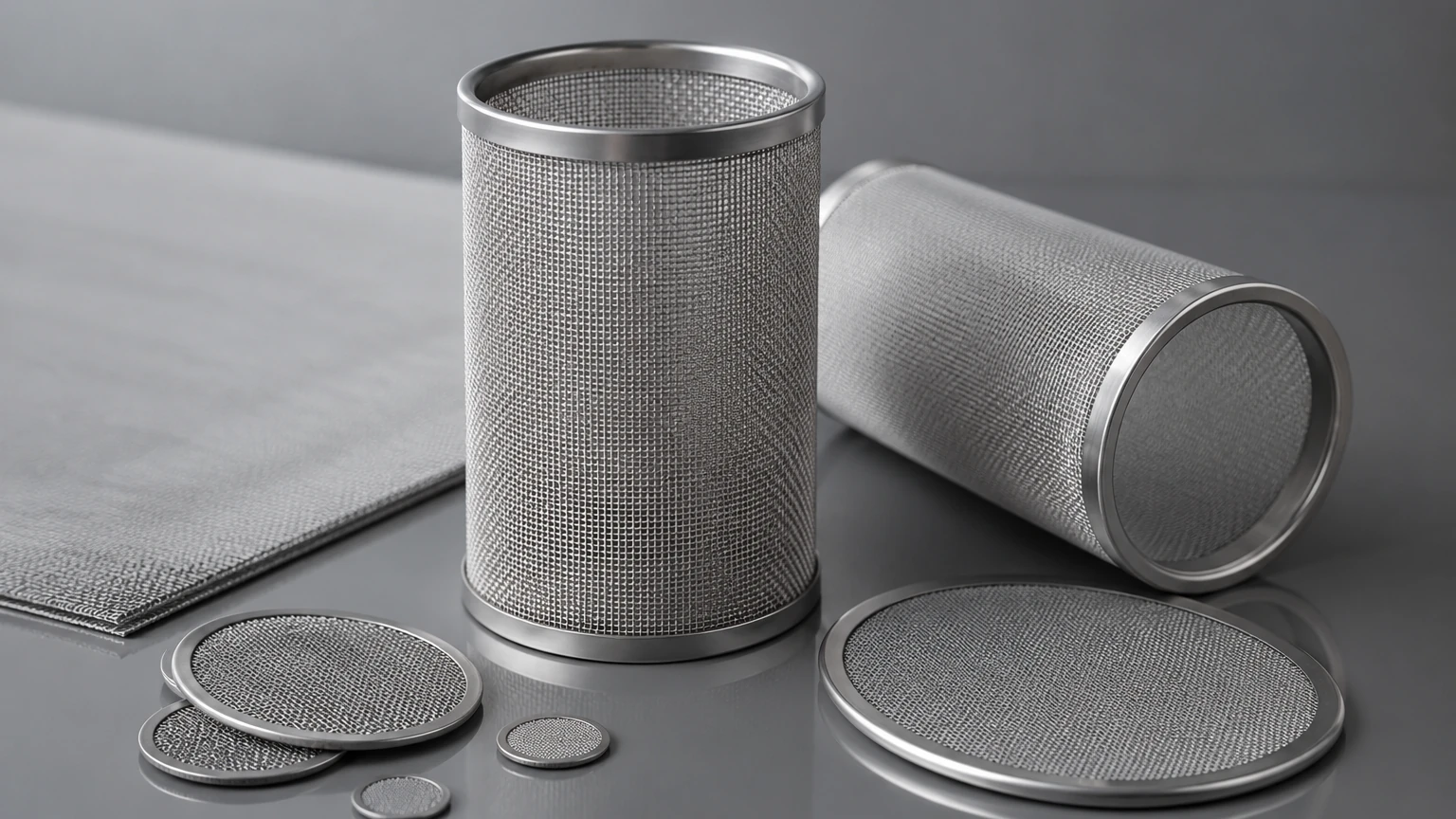
To achieve a reliable 5 micron stainless steel mesh filter, manufacturers typically utilize specialized weaving patterns such as Twilled Dutch Weave (TDW). In this configuration, the warp and shute wires are woven in a way that creates a dense, three-dimensional structure. This provides a tortuous path for the fluid, ensuring that particles as small as 5 microns are trapped within the depth of the mesh or on its surface, depending on the specific design. This structure not only provides the necessary filtration fineness but also offers the thickness required to resist deformation under load.
Material Selection: 304 vs. 316L Stainless Steel
The performance of a 5-micron filter is only as reliable as the alloy from which it is constructed. In the industrial sector, the choice usually alternates between Grade 304 and Grade 316L stainless steel.
* Grade 304: This is the standard industrial grade, providing excellent strength and basic corrosion resistance. It is suitable for many water treatment applications and general hydraulic systems where the fluid is non-corrosive.
* Grade 316L: For applications involving chlorides, acids, or high-purity requirements (such as food and beverage or pharmaceuticals), 316L is the preferred choice. The addition of molybdenum enhances its resistance to pitting and crevice corrosion. The "L" denotes low carbon content, which is vital for components that require welding, as it prevents carbide precipitation that could lead to intergranular corrosion at the weld points.
Engineers must also consider the operating temperature. Stainless steel mesh maintains its structural properties at temperatures far exceeding the limits of synthetic fibers, often operating effectively from cryogenic levels up to 500°C (932°F), depending on the housing and seal materials used.
Key Performance Metrics: Efficiency and Pressure Drop
When specifying a 5 micron stainless steel mesh filter, it is essential to distinguish between "nominal" and "absolute" filtration ratings.
1. Nominal Rating: This refers to the filter's ability to retain a major weight percentage (usually 60% to 90%) of particles of a specific size. A nominal 5-micron filter may allow some larger particles to pass through during pressure surges.
2. Absolute Rating: This indicates that the filter will retain 99.9% or more of particles at the specified micron size. For critical applications like protecting high-pressure fuel injectors or pharmaceutical batch processing, an absolute rating is often required.
Another critical engineering factor is the Clean Pressure Drop (ΔP). Because a 5-micron mesh is very dense, it naturally offers more resistance to flow than a 40 or 100-micron mesh. If the filter area is too small for the required flow rate, the initial pressure drop will be high, shortening the functional life of the filter before it reaches its terminal pressure drop (the point at which it must be cleaned or replaced). Engineers should calculate the effective filtration area (EFA) to ensure that the fluid velocity through the mesh remains within the recommended limits for the specific viscosity of the media.
Structural Integrity: Sintered vs. Multi-Layer Mesh
A single layer of 5-micron mesh is fragile. In industrial environments characterized by vibration, high pressure, or back-pulsing, the mesh requires support. There are two primary ways to achieve this:
Multi-Layer Laminated Mesh
In this design, the 5-micron filtration layer is sandwiched between coarser support layers and drainage layers. These layers are mechanically held together, often within a perforated metal core or an outer cage. This provides the necessary physical protection while allowing for high flow rates.
Sintered Metal Mesh
Sintering is a process where multiple layers of stainless steel wire cloth are bonded together using heat and pressure in a vacuum furnace. This creates a monolithic structure where the wires are fused at every contact point. Sintered 5 micron stainless steel mesh filters are exceptionally robust. They do not suffer from wire migration (where individual wires shift and change the pore size) and can withstand extreme differential pressures. This makes them the gold standard for high-pressure hydraulic systems and heavy-duty chemical filtration.
Industrial Applications and Critical Use Cases
The 5-micron filtration level is a staple in several high-stakes industries:
* Hydraulic and Lubrication Systems: Modern hydraulic valves and pumps have extremely tight tolerances. Particles larger than 5 microns can cause abrasive wear, leading to component failure. A 5-micron mesh filter in the return line or off-line loop ensures fluid cleanliness levels (ISO 4406) are maintained.
* Pharmaceutical and Biotech: In the production of active pharmaceutical ingredients (APIs), 5-micron filters are used for pre-filtration before final sterilization. They remove bulk particulates and precipitates that would otherwise clog expensive membrane filters.
* Food and Beverage: These filters are used to clarify liquids, remove fine carbon fines after decolorization processes, and protect bottling equipment from micro-particulates.
* Chemical Processing: 5-micron filters are essential for catalyst recovery and the filtration of fine chemicals where purity directly impacts the chemical reaction's yield and quality.
Maintenance, Cleaning, and Replacement Cycles
One of the primary B2B advantages of stainless steel mesh is that it is a permanent or semi-permanent media. Unlike polypropylene or glass fiber cartridges that are disposed of after a single use, stainless steel filters can be cleaned and returned to service.
Cleaning Methods
* Ultrasonic Cleaning: This is the most effective method for 5-micron mesh. High-frequency sound waves create cavitation bubbles that dislodge deeply embedded particles within the dense weave structure.
* Backwashing/Back-pulsing: In automated systems, the flow is momentarily reversed to flush contaminants off the surface of the mesh. This is highly effective for surface-loading contaminants but may be less effective for depth-loading particles in a Dutch weave.
* Chemical Cleaning: If the contaminant is organic or a specific mineral scale, compatible chemical solvents or acids can be used to dissolve the blockage without damaging the stainless steel.
Determining Replacement
While cleanable, these filters do have a finite lifespan. Repeated cleaning cycles and mechanical stress can eventually lead to work hardening of the metal or fatigue cracks. Regular bubble-point testing is recommended to ensure the integrity of the 5-micron rating over time. If the bubble point pressure drops significantly, it indicates that the pores have enlarged or the mesh has been breached, and the element must be replaced.
Pre-Purchase Evaluation: What Engineers Must Confirm
Before selecting a 5 micron stainless steel mesh filter, purchasing and engineering teams should collaborate to confirm several technical variables. Failure to account for these can lead to premature filter failure or system downtime.
* Fluid Compatibility: Confirm that the alloy (304 vs 316L) and the seal materials (Viton, EPDM, PTFE) are fully compatible with the process fluid at operating temperatures.
* Flow Rate vs. Viscosity: Ensure the filter housing and element are sized for the fluid's viscosity. Thicker fluids require more surface area to maintain a low pressure drop at 5 microns.
* Connection Type: Specify the required end-fittings (e.g., 222/226 O-rings, NPT threads, or DOE – Double Open End) to ensure a bypass-free seal within the existing housing.
* Customization Requirements: Many industrial systems require non-standard lengths or diameters. Working with a manufacturer that offers OEM and customized filtration solutions is often necessary for legacy equipment or specialized new builds.
For technical professionals looking to optimize their filtration systems, reviewing specific product performance data and engineering support is the next logical step. You can Review product options and application support by visiting the Kaifil Main Page to explore how custom stainless steel solutions can meet your specific industrial requirements.
Conclusion
The 5 micron stainless steel mesh filter is a high-performance tool designed for precision and durability. By selecting the appropriate weave type, material grade, and structural configuration, industrial operators can achieve reliable particulate removal while benefiting from the long-term cost savings of a cleanable, robust filtration medium. Whether protecting a high-pressure hydraulic circuit or ensuring the purity of a chemical batch, the technical integrity of the 5-micron filter remains a cornerstone of modern industrial processing.
