


Recessed Plate Filter Press
In the landscape of industrial solid-liquid separation, the recessed plate filter press—often referred to as a chamber filter press—stands as one of the most efficient and versatile tools for dewatering slurry. For engineers and procurement specialists in the chemical, pharmaceutical, and food processing sectors, selecting the right filtration equipment is not merely a matter of capacity, but a complex calculation of material compatibility, pressure ratings, and filtration precision. As a manufacturer specialized in high-performance filtration components, Kaifil understands that the efficacy of any filter press is fundamentally tied to the quality of its internal filtration media and the engineering of its pressure-bearing components. To explore our full range of industrial filtration solutions, visit our Main Page.
The Engineering Logic of the Recessed Plate Design
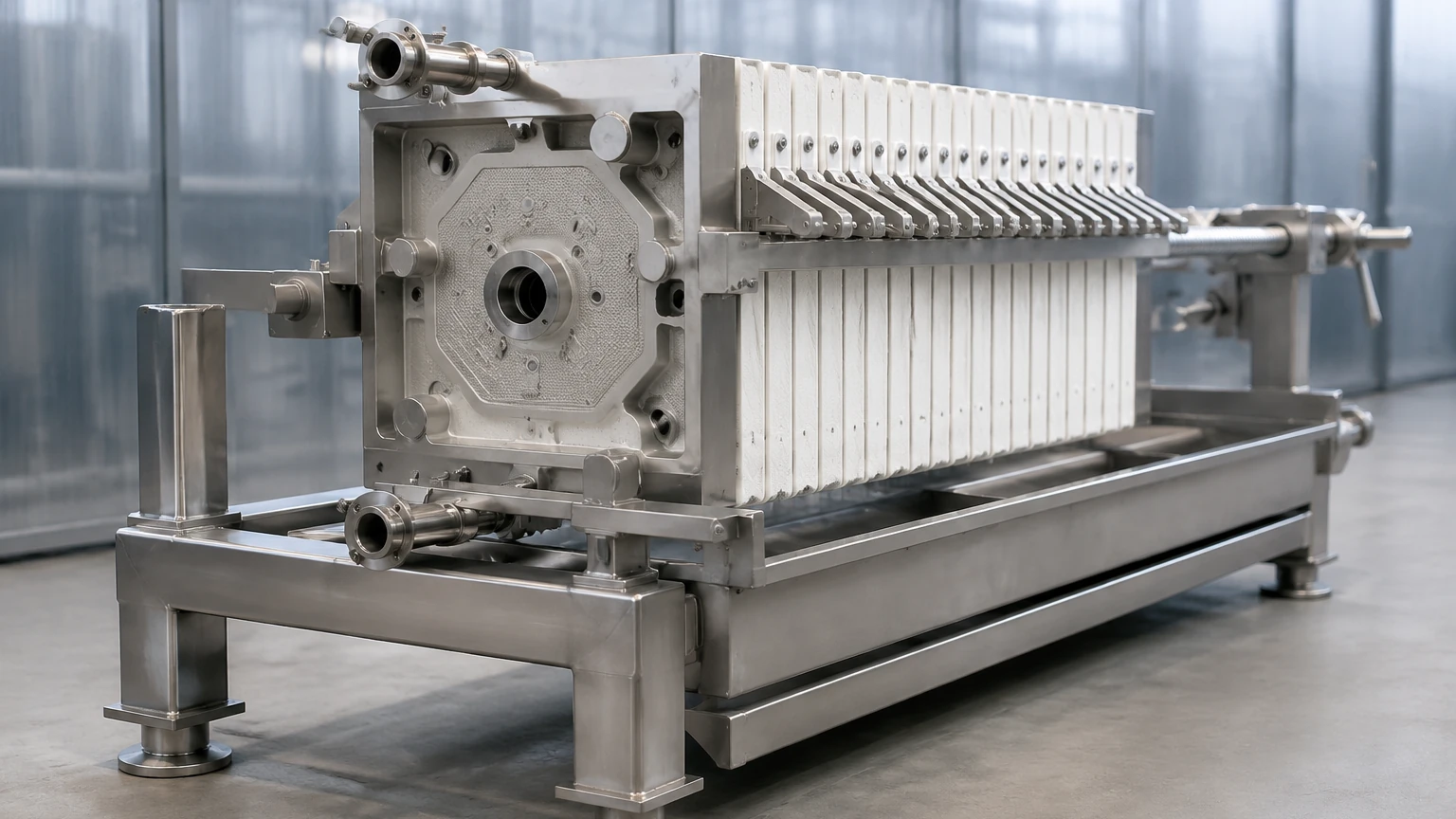
The recessed plate filter press is distinguished by its plate geometry. Unlike traditional plate-and-frame filters, which utilize separate plates and frames to create a chamber, the recessed plate design integrates the chamber space directly into the plate itself. Each plate has a concave center on both sides; when two plates are clamped together by hydraulic force, they form a hollow chamber where the filter cake accumulates.
Structural Integrity and Pressure Handling
One of the primary engineering advantages of the recessed plate filter press is its structural stability. Because the chambers are formed by the plates themselves, the assembly is more rigid than the plate-and-frame alternative. This allows for higher feed pressures, often ranging from 7 bar (100 psi) to as high as 20 bar (300 psi) in specialized high-pressure models. Higher pressure translates directly to drier filter cakes and shorter cycle times, which are critical metrics for total cost of ownership (TCO) in industrial environments.
Chamber Volume and Cake Thickness
In a recessed plate filter press, the depth of the recess determines the thickness of the filter cake. Standard recess depths typically range from 15mm to 50mm. Engineers must select the recess depth based on the solids concentration of the slurry and the filtration characteristics of the material. A recess that is too deep for a slow-filtering slurry can lead to incomplete cake formation and uneven moisture distribution, while a recess that is too shallow may result in frequent cycling and increased mechanical wear on the hydraulic system.
The Filtration Cycle: A Technical Breakdown
Understanding the operational phases of a recessed plate filter press is essential for optimizing performance and specifying the correct filtration media, such as stainless steel wire mesh or specialized filter cloths.
1. Closing Phase: The hydraulic cylinder moves the follower plate, compressing the stack of filter plates together. A high clamping force is required to overcome the internal pressure generated during the feed cycle and to ensure a leak-proof seal at the plate boundaries.
2. Filling and Filtration: The slurry is pumped into the central feed manifold. It enters each chamber simultaneously. The liquid (filtrate) passes through the filter medium and exits through drainage ports in the plate corners, while the solids are trapped in the recessed chamber.
3. Cake Washing (Optional): In applications where the solid cake must be purified or where valuable chemicals must be recovered from the cake, a wash liquid is pumped through the press. The recessed design allows for efficient "cross-washing," where the wash liquid is forced through the entire thickness of the cake.
4. Air Blowing (Optional): To further reduce moisture content, compressed air may be blown through the cake. This step is particularly common in the chemical and mining industries where cake dryness impacts downstream processing costs.
5. Cake Discharge: The hydraulic ram retracts, and the plates are separated—either manually or via an automatic plate shifter. The solid cakes drop from the chambers into a collection hopper.
Material Selection for Demanding Applications
While many standard recessed plate filter presses utilize polypropylene plates, demanding industrial environments often require more robust materials. This is where the integration of precision metal components becomes vital.
Stainless Steel Components in Filtration
In the pharmaceutical and food and beverage industries, hygiene and chemical resistance are non-negotiable. Stainless steel (typically 304 or 316L) is often employed for the feed manifolds, filtrate collection pipes, and, in some high-temperature or high-pressure cases, the filter plates themselves. Kaifil specializes in providing the custom stainless steel filtration solutions that ensure these systems operate without contamination or structural failure.
For processes involving volatile organic compounds (VOCs) or extreme pH levels, stainless steel wire mesh is often preferred over synthetic cloths. Wire mesh offers superior thermal stability, precise pore size control, and the ability to be cleaned in place (CIP) without degradation. When designing a recessed plate filter press system, engineers must confirm that the filtration medium is compatible with both the chemical nature of the slurry and the mechanical stresses of the discharge cycle.
Key Evaluation Criteria for Engineers
When specifying a recessed plate filter press, technical teams should focus on several critical performance indicators to ensure long-term reliability.
Filtration Area vs. Chamber Volume
The relationship between the total filtration area and the total chamber volume dictates the cycle time. A high surface-area-to-volume ratio is generally preferred for slurries with low solids concentration, as it allows for faster liquid removal. Conversely, for high-solids slurries, chamber volume is the limiting factor.
Feed Pump Selection
The performance of the filter press is inextricably linked to the feed pump. Positive displacement pumps (like diaphragm or screw pumps) are typically used because they can maintain a consistent flow as the pressure inside the press increases. Centrifugal pumps are generally avoided for the final stages of the cycle because their flow rate drops significantly as back-pressure builds.
Drainage Configuration
Plates can be designed with "open" or "closed" filtrate discharge. Open discharge allows the filtrate to flow into a trough on the side of the press, providing a visual check of the filtrate quality from each individual chamber. Closed discharge keeps the filtrate within a manifold system, which is essential for handling hazardous, toxic, or oxygen-sensitive materials.
Common Operational Risks and Mitigation
Even a well-designed recessed plate filter press can face operational challenges if not managed correctly.
* Plate Wicking: If the filter cloth or mesh extends through the sealing surface of the plate, capillary action can cause "wicking," where liquid leaks out of the press. Proper gasket design or the use of "CGR" (caulked, gasketed, recessed) plates can mitigate this.
* Core Blowing: If the central feed hole is not properly cleared before the plates are opened, wet slurry can spill during discharge. Implementing a "core blow" cycle with compressed air ensures the feed path is empty.
* Blinding of the Medium: Over time, fine particles can become trapped within the pores of the filter cloth or wire mesh. This "blinding" increases resistance and cycle times. Selecting a precision-engineered wire mesh with an optimized weave pattern from a specialist like Kaifil can significantly reduce blinding and extend the interval between cleaning cycles.
The Importance of Customization in Industrial Filtration
No two industrial slurries are identical. Variations in particle size distribution, viscosity, and temperature mean that a "one-size-fits-all" approach rarely yields the best ROI. Customization is the cornerstone of efficient filtration. This includes selecting the specific alloy for metal components, tailoring the micron rating of the filter mesh, and adjusting the mechanical design of the filter plates to suit the specific rheology of the waste or product stream.
At Kaifil, we work closely with engineering teams to develop filtration components that meet these specific demands. Whether it is a custom stainless steel filter cartridge for a hydraulic system or a precision-woven wire mesh for a large-scale filter press, the focus remains on durability and filtration accuracy.
Conclusion: Preparing for Procurement
Before moving forward with a recessed plate filter press investment, purchasing and engineering teams should confirm several data points:
1. Slurry Analysis: What is the solids percentage, particle size, and chemical composition?
2. Required Cake Dryness: What is the target moisture content for the final cake?
3. Cycle Time Expectations: How many cycles per day are required to meet production targets?
4. Material Compatibility: Are the plates, gaskets, and filter media resistant to the process temperature and chemistry?
By addressing these technical considerations early in the design phase, companies can ensure they select a system that provides reliable, cost-effective performance for years to come. For more information on high-performance filtration components and custom engineering support, please visit our Main Page.
