


8 Duplex Basket Strainer
In high-capacity industrial fluid systems, maintaining continuous operation while protecting downstream equipment from particulate contamination is a primary engineering challenge. The 8 duplex basket strainer serves as a critical solution for piping systems with an 8-inch nominal pipe size (NPS), where process downtime for filter cleaning is unacceptable. Unlike simplex strainers that require a system shutdown to remove and clean the basket, a duplex configuration utilizes two separate chambers and a diversion valve to ensure uninterrupted flow.
For engineers and procurement teams, selecting an 8-inch duplex system involves more than matching pipe diameters. It requires a deep understanding of flow dynamics, material compatibility, and the specific filtration requirements of the application. As a specialized manufacturer, Kaifil provides precision-engineered filtration components designed to meet these rigorous industrial standards. To explore specific configurations, you can visit the Main Page for detailed product data.
Understanding the 8-Inch Duplex Configuration
The "8-inch" designation refers to the inlet and outlet flange sizes, typically following ASME B16.5 standards. At this scale, the strainer is handling significant fluid volumes, often ranging from 800 to over 2,000 gallons per minute (GPM), depending on the allowable pressure drop and fluid viscosity.
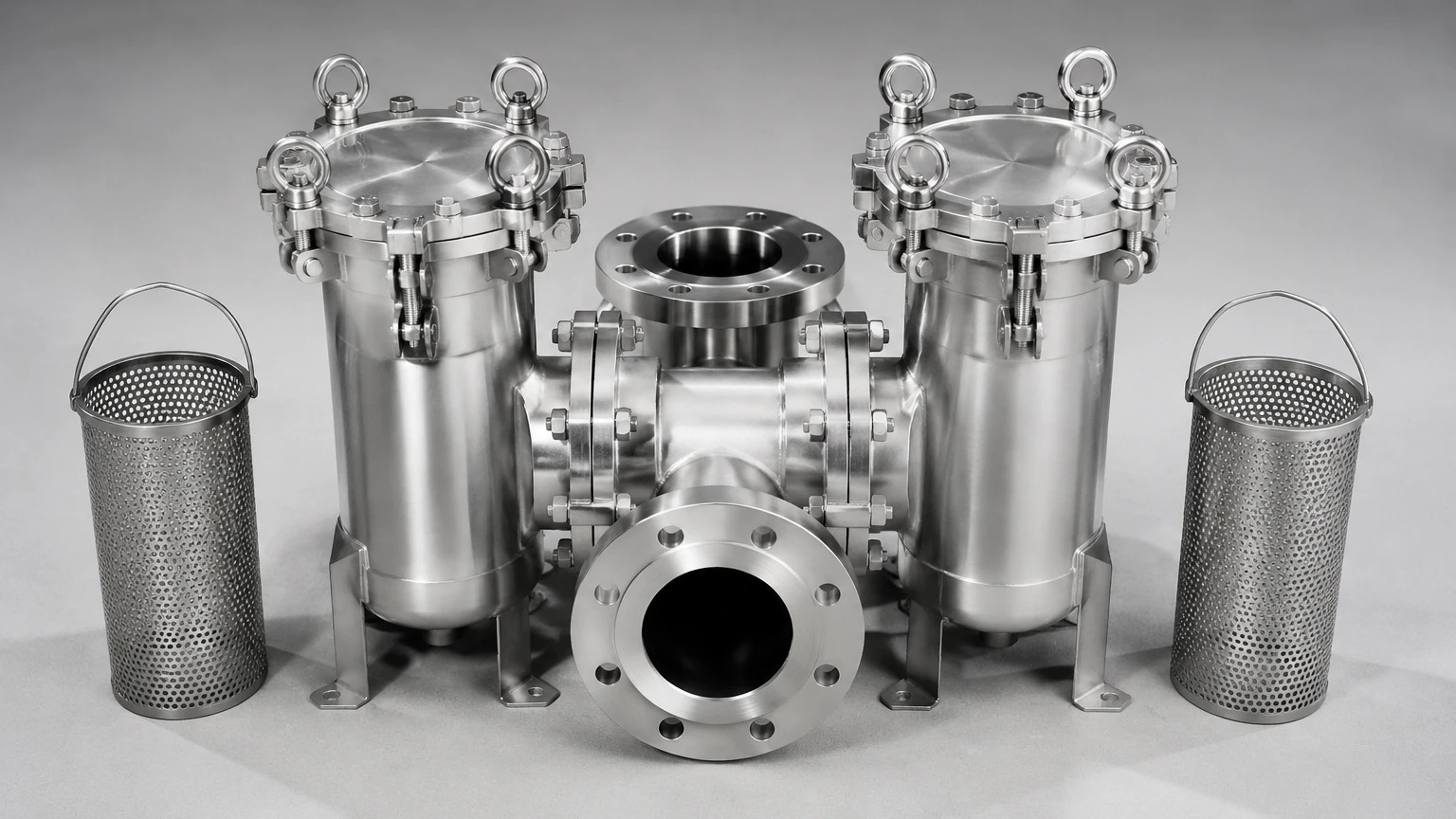
The "duplex" design incorporates two identical strainer baskets housed in separate chambers, connected by a common manifold. A diversion valve—usually a plug, ball, or sliding gate mechanism—directs the flow into one chamber while isolating the other. This allows the operator to remove, clean, and replace the basket in the inactive chamber without stopping the main process pump or depressurizing the entire line.
Key Components of an 8-Inch System
1. Strainer Housing: Typically cast or fabricated from stainless steel (304 or 316) or carbon steel, designed to withstand specific pressure ratings (e.g., Class 150 or Class 300).
2. Diversion Valve: A robust handle or gear-operated mechanism that ensures a bubble-tight seal to prevent bypass during cleaning.
3. Filtration Baskets: The heart of the unit, usually constructed from perforated plate or stainless steel wire mesh. For an 8-inch unit, these baskets are substantial in size and require high structural integrity to resist collapsing under differential pressure.
4. Cover Seals: O-rings or gaskets made from EPDM, Viton, or PTFE, selected based on chemical compatibility and temperature.
5. Pressure Equalization Line: A small bypass line used to equalize pressure between the chambers before switching the flow, preventing hydraulic shock.
Engineering Design: Flow Rates and Pressure Drop
One of the most critical factors in specifying an 8 duplex basket strainer is the clean pressure drop (ΔP). In an 8-inch system, the internal geometry of the housing and the open area of the basket significantly influence energy efficiency. Engineers must calculate the "Open Area Ratio" (OAR), which is the ratio of the total open area of the strainer basket to the internal cross-sectional area of the inlet pipe.
A common industry standard is an OAR of at least 6:1. This ensures that even as the basket begins to collect debris, the pressure drop remains within acceptable limits for a longer period. If the OAR is too low, the frequency of cleaning cycles increases, and the risk of pump cavitation or system fatigue rises.
Factors Influencing Delta P:
* Fluid Viscosity: Heavier fluids (like oils or resins) create higher resistance than water-like fluids.
* Specific Gravity: The density of the fluid affects the velocity and subsequent pressure loss.
* Mesh Micron Rating: Finer mesh (higher mesh count) reduces the open area, leading to a higher initial pressure drop.
* Debris Loading: The nature of the contaminants (fibrous vs. granular) determines how quickly the basket blinds.
Material Selection for Industrial Environments
The longevity of an 8 duplex basket strainer depends heavily on material selection. Industrial environments often involve corrosive chemicals, high temperatures, or abrasive slurries.
Stainless Steel (304 and 316L)
Stainless steel is the preferred choice for many B2B applications due to its excellent corrosion resistance and durability. 316L stainless steel, with its addition of molybdenum, offers superior protection against chlorides and pitting, making it ideal for marine, chemical processing, and pharmaceutical applications. Kaifil specializes in custom stainless steel filtration solutions that ensure these materials are utilized to their maximum potential in high-stress environments.
Specialized Alloys
In extreme cases, such as highly acidic environments or high-temperature steam applications, alloys like Monel, Hastelloy, or Duplex Stainless Steel may be required. These materials provide the necessary mechanical strength and chemical inertness to prevent premature housing failure.
Customization of Filtration Elements
Standard baskets may not suffice for specialized industrial processes. Customization allows engineers to tailor the filtration performance to the exact needs of the system.
Perforated Plate vs. Wire Mesh
* Perforated Plates: These serve as the primary support or as a coarse filter. Hole sizes typically range from 1/32" to 1/2". They offer high structural strength.
* Wire Mesh Liners: For finer filtration (down to 5 microns), a stainless steel wire mesh is lined inside the perforated basket. The weave type—such as plain weave, twilled weave, or Dutch weave—affects both the filtration accuracy and the ease of cleaning.
Magnetic Inserts
For systems where fine metallic particles (such as iron filings or pipe scale) are a concern, magnetic inserts can be added to the center of the basket. These magnets capture sub-micron ferrous particles that might otherwise pass through the mesh, providing an extra layer of protection for precision downstream valves and pumps.
Pleated Elements
In some 8-inch configurations, pleated stainless steel elements are used instead of traditional cylindrical baskets. Pleating increases the surface area significantly within the same footprint, allowing for higher dirt-holding capacity and longer intervals between cleaning cycles.
Operational Maintenance and Safety Protocols
Maintaining an 8 duplex basket strainer requires adherence to safety protocols, especially given the size and weight of the components. An 8-inch basket, when full of debris and fluid, can be quite heavy, often requiring mechanical lifting aids or handles designed for two-person operation.
The Cleaning Cycle
1. Monitor Differential Pressure: Most systems are equipped with a DP gauge. When the pressure drop reaches a predetermined limit (usually 5-10 psi above clean DP), it is time to switch chambers.
2. Switching Flow: Open the pressure equalization valve, then rotate the diversion valve handle to direct flow to the clean chamber.
3. Venting and Draining: Before opening the inactive chamber, the vent valve must be opened to release internal pressure, and the drain plug used to remove the remaining fluid.
4. Basket Inspection: Once removed, the basket should be inspected for signs of mesh tearing or structural deformation. Cleaning is typically done via back-flushing, ultrasonic cleaning, or chemical soaking, depending on the contaminant.
Preventing Bypass
One of the biggest risks in duplex strainer operation is bypass—where fluid leaks past the seals or the diversion valve into the chamber being cleaned. Ensuring that the diversion valve is properly maintained and that the basket seats are flush is essential for operator safety and process integrity.
Total Cost of Ownership (TCO) Considerations
When evaluating an 8 duplex basket strainer, purchasing teams should look beyond the initial capital expenditure. The Total Cost of Ownership (TCO) includes:
* Maintenance Labor: How easy is it to access the baskets? Quick-opening covers (like swing-bolt or clamp styles) can significantly reduce labor time compared to bolted-flange covers.
* Replacement Parts: The availability and cost of replacement baskets and seals. Standardizing on common sizes and materials can reduce inventory costs.
* Energy Costs: A strainer with a poorly designed internal flow path can cause a permanent pressure drop that forces pumps to work harder, increasing electricity consumption over the life of the equipment.
* Downtime Prevention: The primary value of a duplex system is the avoidance of downtime. The reliability of the diversion valve is paramount to ensuring the system actually delivers on this promise.
Conclusion
The 8 duplex basket strainer is a workhorse of industrial filtration, providing a robust and reliable method for protecting large-scale piping systems. By focusing on technical specifications—such as the Open Area Ratio, material compatibility, and ease of maintenance—engineers can ensure they select a unit that optimizes process uptime and protects expensive downstream assets.
For organizations requiring tailored solutions, working with a manufacturer that understands the nuances of custom stainless steel fabrication is essential. Kaifil offers the engineering expertise and manufacturing precision needed to develop filtration components that stand up to the most demanding industrial environments. For more information on our capabilities and product range, please refer to our Main Page.
