

Aerospace Bellows
In the demanding landscape of aerospace engineering, the integrity of fluid and gas conveyance systems is paramount. Components must withstand extreme pressure differentials, rapid thermal cycling, and intense structural vibrations without failure. Among these critical components, aerospace bellows serve as essential flexible connectors, designed to compensate for thermal expansion, misalignment, and mechanical movement while maintaining a hermetic seal. As precision-engineered metal components, they are often integrated into complex filtration and hydraulic assemblies where performance reliability is non-negotiable.
For technical professionals and procurement teams, understanding the engineering nuances of aerospace bellows is vital for ensuring system longevity. This guide examines the design principles, material considerations, and selection criteria necessary for implementing these components in high-stakes industrial and aerospace environments.
The Role of Aerospace Bellows in Complex Systems
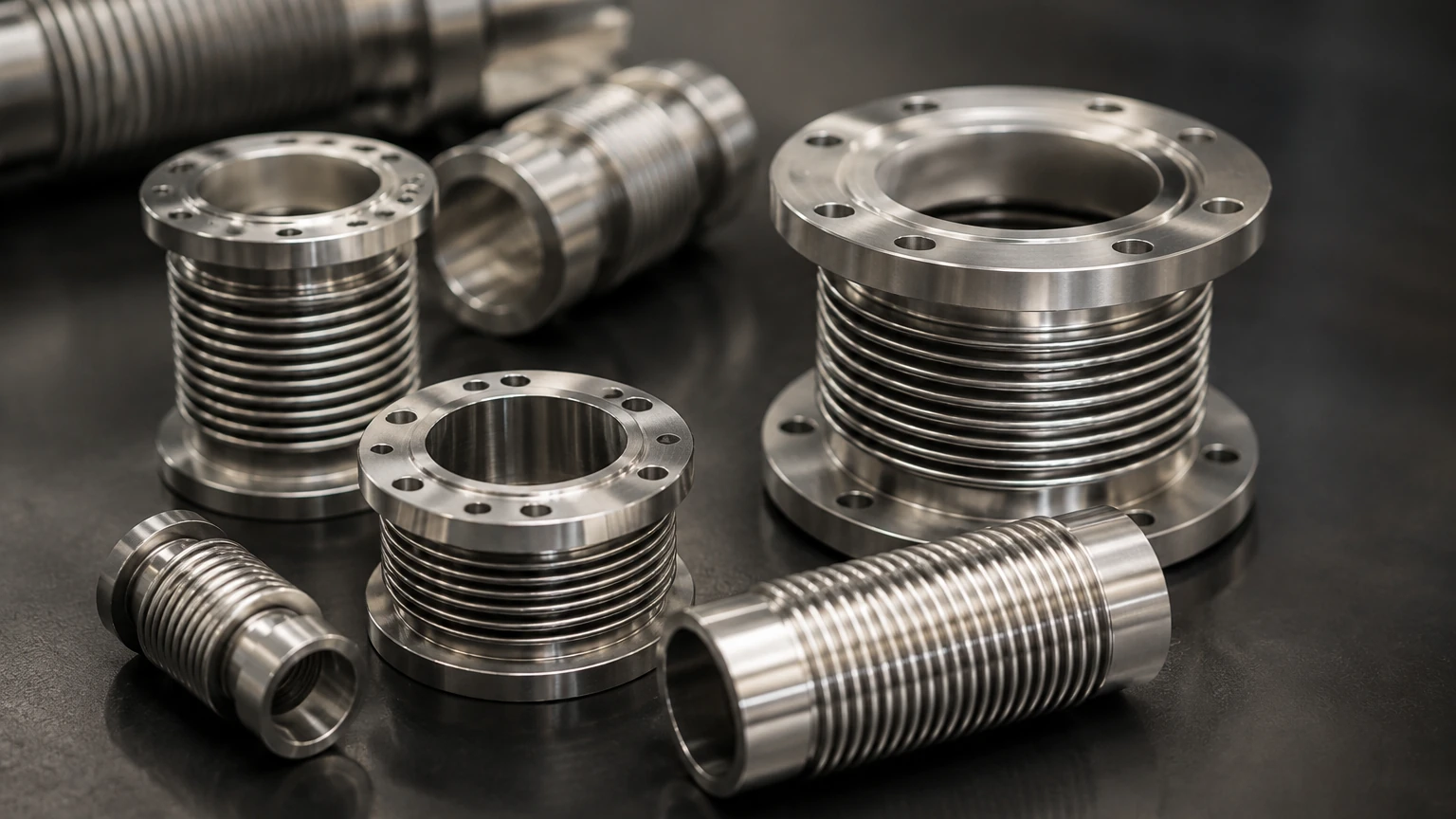
Aerospace bellows are thin-walled, flexible tubes characterized by a series of deep, parallel convolutions. These convolutions allow the component to expand, contract, or bend under pressure and temperature changes. In aerospace applications, they are primarily utilized in exhaust systems, fuel lines, bleed air ducting, and hydraulic circuits.
Beyond simple movement, these bellows act as a safeguard for sensitive downstream equipment, such as stainless steel filter cartridges and precision sensors. By absorbing the stresses of thermal growth—which can be significant in jet engines or high-altitude environments—bellows prevent the transfer of mechanical loads to rigid piping and filtration housings. This isolation is critical for maintaining the accuracy of filtration systems, as excessive stress on filter manifolds can lead to bypass leaks or structural fatigue.
Engineering and Design Fundamentals
The performance of aerospace bellows is dictated by their geometry and manufacturing method. Engineers typically choose between two primary types based on the specific requirements of the application: formed bellows and edge-welded bellows.
Formed Bellows
Formed bellows are manufactured by mechanically or hydraulically stretching a metal tube into the desired convolution shape. These are generally preferred for high-pressure applications due to their seamless construction and robust wall thickness. In aerospace hydraulic systems, where pressures can exceed several thousand PSI, formed bellows provide the necessary hoop strength to prevent rupture while allowing for axial movement.
Edge-Welded Bellows
Edge-welded bellows are created by welding individual metal diaphragms together at their inner and outer diameters. This design offers a significantly higher stroke-to-length ratio, meaning they can compress or extend much further than a formed bellows of the same size. They are often found in vacuum systems or applications requiring precise volumetric compensation. However, the numerous weld points require stringent quality control to ensure leak-free operation in aerospace environments.
Material Selection for Extreme Environments
Material science is the cornerstone of aerospace bellows reliability. The chosen alloy must provide a balance of high fatigue life, corrosion resistance, and structural stability at both cryogenic and elevated temperatures.
1. Stainless Steel (300 Series): Specifically 316L and 321 grades. These are standard for many industrial filtration and bellows applications due to their excellent corrosion resistance and weldability. Type 321 is often preferred for higher temperature aerospace applications because it is stabilized with titanium to prevent intergranular corrosion.
2. Inconel (Alloy 625 and 718): For engine exhaust or high-heat zones, nickel-based superalloys like Inconel are mandatory. They maintain high tensile strength at temperatures where stainless steel would soften and fail.
3. Titanium: Used when weight reduction is the primary engineering driver. Titanium bellows offer an exceptional strength-to-weight ratio but require specialized vacuum welding techniques and are more susceptible to certain types of chemical embrittlement.
When selecting materials, engineers must also consider the compatibility with the fluid being transported. In aerospace filtration systems, compatibility with hydraulic fluids (such as Skydrol) or aviation fuels is a primary concern to prevent elastomer degradation or metal pitting.
Integration with Industrial Filtration Solutions
In many industrial and aerospace setups, bellows and filtration components work in tandem. For instance, in a chemical processing plant or an aircraft fuel system, the filter housing must remain stationary while the connected piping expands due to heat. If the connection is rigid, the resulting force can warp the filter element or damage the seals of the stainless steel filter cartridges.
Integrating precision bellows into the filtration manifold ensures that the filter remains perfectly aligned. This is particularly important for high-precision metal filter components that rely on micron-level tolerances. By visiting the Main Page of a specialized manufacturer like Kaifil, engineers can explore how custom-designed metal components and filtration solutions are engineered to work together in these demanding scenarios.
Key Evaluation Criteria for Procurement
When sourcing aerospace bellows, purchasing teams and engineers should confirm several technical parameters to ensure the component is fit for purpose. Relying on generic specifications is often insufficient for aerospace-grade requirements.
Spring Rate and Effective Area
The spring rate determines how much force is required to compress or extend the bellows. In sensitive aerospace valves, a high spring rate might interfere with the valve's actuation. Additionally, the "effective area" of the bellows is critical for calculating the pressure-thrust forces that will be exerted on the system's anchors and supports.
Cycle Life and Fatigue
Aerospace components are rated by their cycle life—the number of times they can expand and contract before metal fatigue sets in. Procurement specifications must clearly state the expected operating cycles, including the amplitude of movement and the frequency of vibration. A bellows designed for 10,000 cycles will have significantly different wall thicknesses and convolution depths than one designed for 1,000,000 cycles.
Leak Rate and Testing
For aerospace applications, "bubble tight" is often not enough. Mass spectrometer helium leak testing is the standard for ensuring hermetic integrity. Engineers should request documentation on leak rates, typically measured in standard cubic centimeters per second (sccs).
Common Risks and Mitigation Strategies
The most common failure mode for aerospace bellows is fatigue cracking, often accelerated by vibration or corrosion.
* Vibration-Induced Failure: High-frequency vibrations from engines can cause the convolutions to resonate, leading to rapid work-hardening and cracking. This is mitigated by using multi-ply bellows (where two or more thin layers of metal are used instead of one thick layer) to provide natural damping.
* Squirm: At high internal pressures, a bellows can become unstable and buckle sideways, a phenomenon known as "squirm." This is prevented by limiting the number of convolutions or using internal liners and external shrouds to guide the movement.
* Corrosion: Even stainless steel can succumb to stress corrosion cracking (SCC) if chlorides are present in the environment. Proper material selection and post-weld heat treatment are essential mitigation steps.
Customization and OEM Capabilities
Standard off-the-shelf bellows rarely meet the exacting needs of modern aerospace or high-end industrial projects. Customization is often required to match specific flange configurations, envelope constraints, and filtration requirements.
Manufacturers specializing in precision metal components, such as Kaifil, provide the engineering support necessary to move from a conceptual design to a flight-ready component. This process involves rigorous Finite Element Analysis (FEA) to predict stress concentrations and optimize the convolution profile for the specific pressure-temperature-movement envelope of the application.
Whether the requirement is for a single prototype or high-volume OEM production, the focus remains on the precision of the weld and the consistency of the material. For organizations looking to integrate these components into larger filtration assemblies, reviewing the technical capabilities on the Main Page is a necessary step in the vendor qualification process.
Maintenance and Replacement Cycles
Aerospace bellows are considered "wear items" in many maintenance programs. Unlike a rigid pipe, a bellows has a finite life determined by its cumulative stress cycles.
1. Visual Inspection: Maintenance crews should look for signs of "stacking" (uneven convolution spacing), nicks, or discoloration that might indicate overheating.
2. Pressure Testing: Periodic hydrostatic or pneumatic testing helps identify pinhole leaks before they lead to systemic failure.
3. Scheduled Replacement: In critical flight systems, bellows are often replaced based on flight hours or cycles, regardless of their apparent condition, to prevent in-service fatigue failure.
Conclusion
Aerospace bellows are more than just flexible pipes; they are highly engineered components that enable the safe and efficient operation of fluid systems under the most grueling conditions. By understanding the interplay between material science, convolution geometry, and system integration, engineers can select bellows that not only compensate for movement but also protect the integrity of the entire filtration and hydraulic network.
For those tasked with designing or maintaining these systems, the choice of a manufacturing partner is critical. Precision, durability, and technical expertise are the benchmarks of a reliable supplier. To learn more about customized metal filtration and precision component manufacturing, visit the Main Page to access detailed product specifications and engineering support for your next project.
