


Air Cleaner Material
In industrial environments, the selection of air cleaner material is a critical engineering decision that directly impacts the longevity of machinery, the purity of processed goods, and the overall efficiency of ventilation systems. Unlike residential air filtration, which often prioritizes cost and simple particulate capture, industrial air cleaner material must withstand extreme temperatures, corrosive atmospheres, and high-pressure differentials. For engineers and procurement teams, understanding the technical nuances of these materials is essential for optimizing system performance and minimizing downtime.
Industrial filtration often requires a transition from disposable, fiber-based media to robust, permanent solutions. Stainless steel and other high-performance alloys have become the standard for demanding applications where reliability is non-negotiable. This guide explores the engineering considerations, material types, and performance metrics necessary for selecting the appropriate air cleaner material for industrial use.
The Role of Material Science in Industrial Air Filtration
The fundamental purpose of any air cleaner material is to provide a barrier that captures contaminants while allowing air to pass through with minimal resistance. However, in a B2B context, the "air" being filtered is rarely just ambient atmosphere. It may contain chemical vapors, abrasive dust, moisture, or extreme heat.
Material science plays a pivotal role here. The choice of material dictates the filter's mechanical strength, its ability to be cleaned and reused, and its chemical compatibility. For instance, in chemical processing or offshore applications, standard carbon steel or synthetic fibers may degrade rapidly. In these scenarios, stainless steel wire mesh or sintered metal components are preferred due to their inherent resistance to oxidation and structural stability under thermal stress.
Primary Types of Metallic Air Cleaner Material
When precision and durability are required, metallic materials offer significant advantages over synthetic alternatives. These materials are typically categorized by their manufacturing process and the resulting pore structure.
Stainless Steel Wire Mesh
Stainless steel wire mesh is perhaps the most versatile air cleaner material. It is produced by weaving individual wires into various patterns, such as plain, twill, or dutch weave.
- Plain Weave: Offers high flow rates and is suitable for coarse filtration.
- Dutch Weave: Provides a denser structure with higher filtration accuracy, making it ideal for capturing fine particulates in high-pressure air streams.
The primary benefit of wire mesh is its predictable pore size and high open area, which ensures a low initial pressure drop across the filter element.
Sintered Metal Felt and Mesh
Sintering involves bonding layers of wire mesh or metal fibers together using heat and pressure without melting the base material. This process creates a porous, monolithic structure that is incredibly strong. Sintered air cleaner material is used when the application involves high-velocity air flows or where the filter must maintain its shape under intense mechanical vibration. Sintered felt, in particular, offers a three-depth filtration effect, which increases the dust-holding capacity compared to single-layer mesh.
Perforated and Expanded Metal
While rarely used as the primary filtration stage for fine particles, perforated or expanded metal serves as a crucial support material. It provides the structural skeleton for finer mesh layers, preventing the air cleaner material from collapsing under high differential pressure. It also acts as a pre-filter for large debris in heavy-duty industrial air intakes.
Technical Specifications: Mesh Count, Wire Diameter, and Micron Rating
To specify an air cleaner material accurately, engineers must look beyond general descriptions and focus on quantifiable technical data. The performance of a filter is defined by three primary metrics:
1. Mesh Count: This refers to the number of wires per linear inch. A higher mesh count generally indicates a finer filtration capability but may also result in a higher pressure drop.
2. Wire Diameter: The thickness of the wire affects both the strength of the mesh and the percentage of open area. Thicker wires increase durability but reduce the total flow capacity.
3. Micron Rating: This is the most critical metric for filtration efficiency. It defines the size of the particles the material can effectively trap. For industrial air filtration, ratings can range from coarse (100+ microns) for intake screens to ultra-fine (sub-5 microns) for high-purity process air.
When evaluating these specifications, it is important to distinguish between "absolute" and "nominal" micron ratings. An absolute rating implies that 99.9% of particles of that size will be captured, whereas a nominal rating is an average estimate of efficiency.
Evaluating Environmental Compatibility and Corrosion Resistance
The operational environment is the most common cause of filter failure. If the air cleaner material is not compatible with the surrounding chemistry, it will suffer from pitting, stress corrosion cracking, or general thinning.
- Type 304 Stainless Steel: The standard choice for general industrial use. It offers good corrosion resistance and is cost-effective for most dry air applications.
- Type 316L Stainless Steel: Contains molybdenum, which provides superior resistance to chlorides and acids. This is the preferred material for pharmaceutical, food and beverage, and marine environments.
- Specialty Alloys: In extreme cases involving high-temperature flue gases or highly acidic vapors, alloys like Inconel or Monel may be required to ensure the integrity of the filtration system.
Selecting the wrong grade of metal can lead to catastrophic system failure, emphasizing the need for technical consultation during the design phase. For more information on material grades and their specific applications, you can visit the Main Page to review technical data sheets.
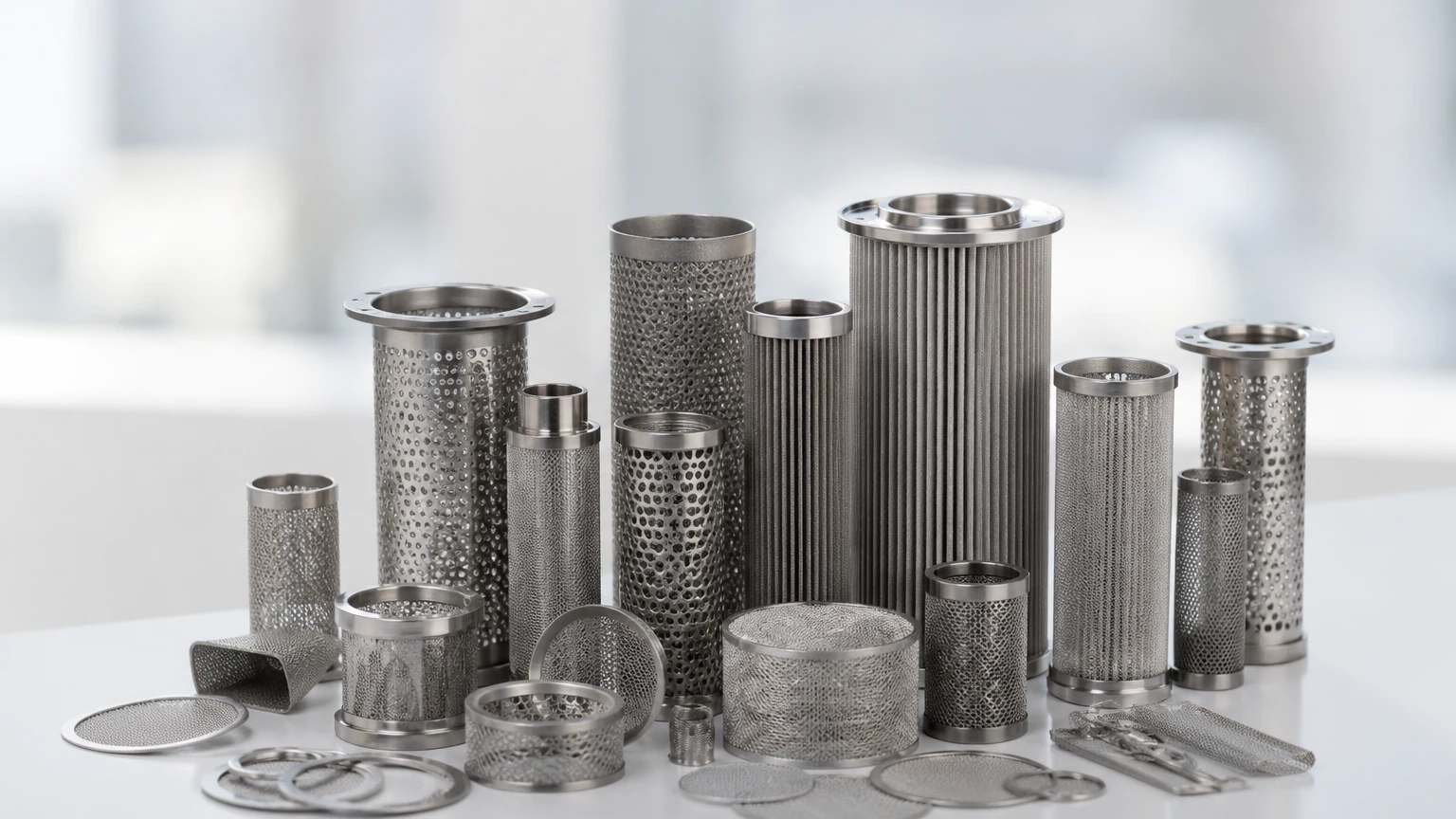
Structural Integrity: Pleating and Support Layers
In many industrial air cleaners, the surface area of the material is just as important as its pore size. To maximize the filtration area within a compact housing, the air cleaner material is often pleated. Pleating increases the effective surface area by several times, which significantly extends the service life of the filter and reduces the frequency of cleaning.
However, pleating introduces mechanical stress at the folds. To counteract this, a multi-layer construction is often employed. A typical high-performance air filter might consist of:
- An inner support tube (perforated metal).
- A coarse support mesh.
- The primary filtration media (fine wire mesh or sintered felt).
- An outer protective wrap.
This composite structure ensures that the air cleaner material remains functional even when subjected to rapid pressure fluctuations or reverse-flow cleaning cycles.
Total Cost of Ownership: Reusability vs. Disposable Media
While the initial cost of stainless steel air cleaner material is higher than that of paper or synthetic alternatives, the Total Cost of Ownership (TCO) is often significantly lower in industrial settings.
Disposable filters require constant purchasing, inventory management, and disposal costs—especially if the captured dust is considered hazardous waste. In contrast, metallic air cleaner materials are designed for long-term use. They can be cleaned using various methods, such as:
- Backwashing/Back-pulsing: Using a reverse flow of air or liquid to dislodge particles.
- Ultrasonic Cleaning: Using high-frequency sound waves in a cleaning solution to remove fine contaminants from deep within the mesh.
- Chemical Cleaning: Using mild acids or solvents to dissolve accumulated residues.
The ability to regenerate the filter media hundreds of times makes metal filters a sustainable and economically sound choice for high-volume industrial processes.
Selecting the Right Solution for Specific Industrial Applications
Different industries have unique requirements for their air cleaner material. For example:
- Chemical Processing: Requires materials that can handle aggressive solvent vapors and high temperatures without losing structural integrity.
- Food and Beverage: Demands materials that are easy to sanitize and compliant with safety regulations (such as FDA standards), typically requiring 316L stainless steel with high-quality surface finishes.
- Hydraulic Systems: Uses air breathers to prevent atmospheric contaminants from entering oil reservoirs; these require fine micron ratings and moisture resistance.
- Pharmaceuticals: Often requires high-precision sintered materials to ensure sterile air environments for drug manufacturing.
By matching the specific properties of the air cleaner material to the demands of the application, engineers can ensure optimal protection for their equipment and end products.
Engineering Support and Customization
Because no two industrial applications are identical, off-the-shelf filtration products often fall short of performance expectations. Custom-engineered solutions allow for the optimization of every variable, from the specific alloy used to the exact dimensions of the filter element.
When working with a manufacturer like Kaifil, engineers can specify custom pleat depths, specialized end-cap designs, and reinforced structures tailored to their unique operating conditions. This collaborative approach ensures that the air cleaner material performs reliably under the specific stresses of the target environment.
In conclusion, selecting the right air cleaner material is a multi-faceted process that requires a deep understanding of filtration physics, material science, and operational requirements. By prioritizing durability, cleanability, and technical precision, industrial facilities can achieve superior filtration performance and long-term cost savings. For those seeking expert guidance on custom filtration components or detailed product specifications, visiting the Main Page provides access to a wealth of technical resources and engineering support.
