


Pool Filter Cartridge Size Chart
In industrial and commercial water treatment, the precision of filtration components is a critical factor in maintaining system integrity and operational efficiency. For engineers and facility managers overseeing large-scale aquatic systems, chemical processing plants, or water reclamation units, the "pool filter cartridge size chart" serves as more than just a reference—it is a technical blueprint for ensuring hydraulic balance and contaminant removal. Selecting the correct cartridge size involves understanding the intersection of physical dimensions, surface area, and flow dynamics.
While standard residential charts focus on simple replacements, industrial applications require a deeper analysis of how dimensions impact the total cost of ownership (TCO) and system longevity. This guide examines the technical parameters of cartridge sizing, the engineering considerations behind material selection, and how to utilize sizing data to optimize filtration performance.
Technical Dimensions and Measurement Standards
To effectively use a pool filter cartridge size chart, one must first master the three primary physical measurements that define a cartridge's fit within a housing. Inaccurate measurements are the leading cause of bypass—a condition where unfiltered fluid escapes around the filter element rather than passing through the media.
Outside Diameter (OD)
The outside diameter is measured across the widest part of the cartridge end cap. In commercial systems, even a 1/16-inch variance can prevent a proper seal or cause the cartridge to rattle within the housing, leading to mechanical wear. When consulting a size chart, ensure the OD aligns with the internal guides of the filter vessel.
Inside Diameter (ID)
This measurement refers to the center hole of the cartridge. The ID must match the standpipe or collector manifold within the filter tank. A hole that is too large allows debris to bypass the filter, while a hole that is too small will not seat properly on the pipe. Some charts list two IDs if the top and bottom of the cartridge differ (e.g., a "stepped" or "conical" design).
Overall Length
The length is measured from end cap to end cap, excluding any handles, threads, or specialized fittings. In high-pressure industrial environments, the length must be precise to ensure the compression spring or top manifold applies the correct amount of downward force to seal the gaskets.
Interpreting the Pool Filter Cartridge Size Chart
A comprehensive pool filter cartridge size chart typically categorizes elements by manufacturer, square footage, and physical dimensions. For technical professionals, the most important column is often the "Filtration Area" (measured in square feet), which directly correlates to the system's flow capacity and dirt-holding potential.
| Square Footage (sq. ft.) | Outside Diameter (in.) | Length (in.) | Inside Diameter (in.) | Typical Flow Rate (GPM) |
| :— | :— | :— | :— | :— |
| 50 | 7 | 14 11/16 | 3 | 50 |
| 100 | 7 | 23 5/8 | 3 | 100 |
| 150 | 8 15/16 | 23 1/4 | 4 | 120 |
| 200 | 8 15/16 | 28 3/16 | 4 | 150 |
*Note: These values are representative of standard commercial configurations. Always verify specific tolerances with the OEM specifications available on the Main Page.*
Engineering Considerations: Surface Area vs. Flow Velocity
The relationship between the size of a cartridge and its performance is governed by the principles of fluid dynamics. A pool filter cartridge size chart allows an engineer to calculate the "flux rate"—the volume of fluid passing through a specific area of filter media over time.
The Importance of Effective Filtration Area
Increasing the surface area (square footage) of a cartridge reduces the velocity at which fluid passes through the media. Lower velocities result in higher filtration efficiency, as smaller particles are less likely to be forced through the pores by hydraulic pressure. Furthermore, a larger surface area extends the time between cleaning cycles, reducing labor costs and downtime.
Pressure Drop (Delta P)
As a filter accumulates debris, the resistance to flow increases, causing a pressure drop across the element. By selecting a cartridge with the maximum possible surface area for a given housing size, engineers can maintain a lower initial Delta P, which reduces the energy consumption of the circulation pumps.
End Cap Configurations and Sealing Mechanisms
Beyond the primary dimensions, the configuration of the end caps determines how the cartridge integrates with the industrial housing. A size chart will often use codes to describe these interfaces:
* Open w/ Gasket: A flat end cap with a rubber or silicone gasket designed to seal against a flat plate.
* Threaded (MPT/FPT): Male or female pipe threads that screw directly into the manifold, common in high-pressure or specialized chemical applications.
* Keyed/Notched: Specific cutouts that ensure the cartridge is oriented correctly within the vessel.
* Closed with Handle: One end is completely sealed, often featuring a handle for easier extraction during maintenance.
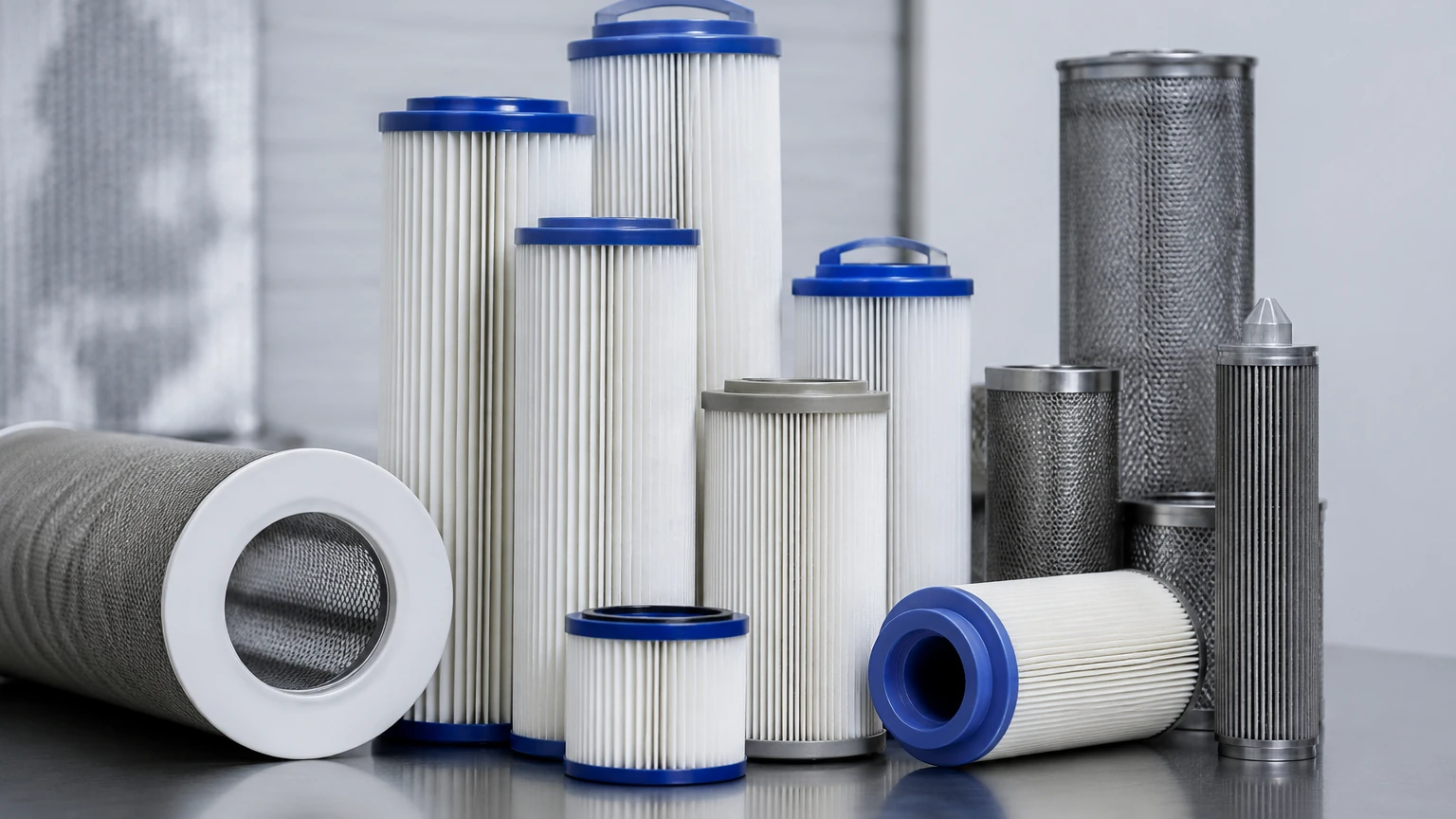
In aggressive industrial environments, the material of the end cap is as important as its shape. While standard commercial cartridges use molded polyurethane, industrial-grade solutions often utilize stainless steel end caps to withstand high temperatures and chemical exposure.
Material Selection: Beyond Synthetic Media
While most standard pool filter cartridge size charts assume the use of pleated polyester (Reemay) or similar synthetic fibers, industrial applications often require more robust materials. When a standard cartridge fails due to chemical incompatibility, high temperature, or excessive pressure, engineers often turn to custom stainless steel filtration solutions.
Stainless Steel Wire Mesh vs. Synthetic Pleats
Stainless steel wire mesh filters offer several advantages over traditional cartridges:
1. Durability: They can withstand significant pressure differentials without collapsing.
2. Cleanability: Unlike synthetic media, which must be discarded once the pores are deeply embedded with oils and fine particulates, stainless steel elements can be backwashed or ultrasonically cleaned.
3. Chemical Resistance: Stainless steel (304 or 316L) is compatible with a wide range of industrial chemicals and high-temperature fluids that would degrade standard pool cartridges.
When transitioning from a standard synthetic cartridge to a custom metal element, the dimensions listed on a pool filter cartridge size chart remain the primary reference point for ensuring a perfect fit in existing housings.
Maintenance and Replacement Indicators
Understanding the sizing and capacity of a cartridge is essential for establishing a predictive maintenance schedule. In a B2B context, waiting for a system to fail is not an option. Engineers monitor the following to determine when a cartridge—regardless of its size—requires attention:
* Terminal Pressure Drop: Most systems are designed for a specific maximum pressure drop (typically 10-15 PSI over the clean start-up pressure). Once this limit is reached, the cartridge must be cleaned or replaced.
* Flow Reduction: If the pump is running at full speed but the output GPM has dropped below the required threshold, the filter media is likely blinded.
* Turbidity Spikes: A sudden increase in downstream particulates may indicate that the cartridge has bypassed or that the media has been breached due to excessive pressure.
Custom Filtration Solutions for Demanding Applications
Standard size charts cover approximately 90% of the market, but specialized industrial processes often require non-standard dimensions or unique performance characteristics. This is where OEM manufacturing and custom design become necessary. Whether you are dealing with high-viscosity fluids in a chemical plant or high-flow requirements in a large-scale desalination pre-treatment system, the ability to customize the filter element is vital.
Customization options often include:
* Variable Micron Ratings: Tailoring the weave of a wire mesh to capture specific particle sizes.
* Reinforced Cores: Adding internal support structures to prevent collapse in high-vacuum or high-pressure systems.
* Specialized Gaskets: Utilizing Viton, EPDM, or PTFE gaskets for specific chemical compatibility.
For those seeking technical support or customized filtration components that go beyond the standard pool filter cartridge size chart, it is recommended to Review product options and application support to find a solution that meets specific engineering requirements.
Conclusion: Making Informed Purchasing Decisions
Selecting the right filtration element requires a balance of physical accuracy and performance expectations. By utilizing a pool filter cartridge size chart as a foundational tool, engineers can ensure that their replacement elements will fit correctly and perform reliably. However, the physical dimensions are only the beginning. To achieve the lowest total cost of ownership and the highest filtration efficiency, one must also consider media material, end cap design, and the specific demands of the industrial environment.
Whether you are maintaining a commercial aquatic facility or an industrial process loop, precision in sizing and quality in manufacturing are the keys to a successful filtration strategy.
