


Basket Strainers Industrial
In industrial fluid handling systems, the presence of particulate matter, scale, and debris can lead to significant mechanical failure, downtime, and product contamination. Basket strainers industrial components serve as the primary line of defense for downstream equipment such as pumps, control valves, flow meters, and heat exchangers. Unlike Y-strainers, which are typically used for smaller amounts of debris in high-pressure steam or gas lines, basket strainers are designed for liquid applications where high flow rates and high dirt-holding capacities are required.
Selecting the correct industrial basket strainer involves more than matching pipe sizes. It requires a deep understanding of fluid dynamics, material compatibility, and the specific filtration requirements of the process. As a specialized manufacturer of stainless steel filtration solutions, Kaifil emphasizes the importance of precision-engineered components to ensure system longevity and operational efficiency.
Engineering Principles of Industrial Basket Strainers
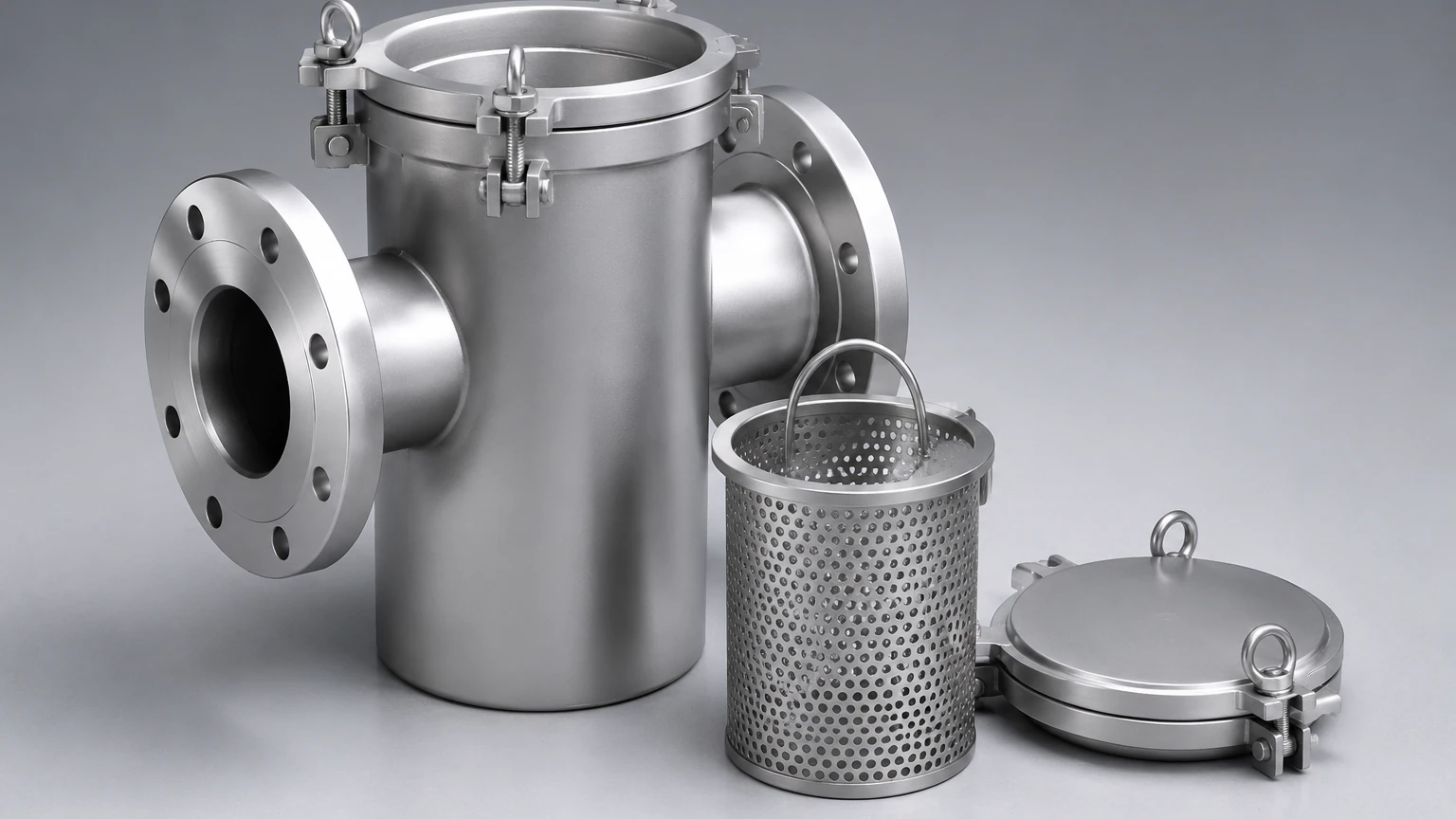
The fundamental purpose of an industrial basket strainer is to remove solids from a flowing liquid by passing it through a removable screen or basket. The fluid enters the strainer housing, passes through the basket media, and exits through the outlet. The debris is trapped within the basket, preventing it from bypassing the filter and entering sensitive downstream components.
One of the most critical engineering considerations in basket strainer design is the "Open Area Ratio" (OAR). The OAR is the relationship between the internal cross-sectional area of the inlet pipe and the total net open area of the strainer basket. A high OAR—typically 6:1 or 8:1 in industrial applications—ensures that the strainer can accumulate a significant amount of debris before the pressure drop becomes excessive. This ratio directly impacts the frequency of maintenance and the overall energy efficiency of the pumping system.
Pressure drop ($ΔP$) is another vital metric. As debris accumulates, the available flow area decreases, causing the pressure drop to rise. Engineers must calculate the clean pressure drop and establish a maximum allowable pressure drop limit. Exceeding this limit can lead to basket collapse or cavitation in downstream pumps. For comprehensive technical data on pressure ratings and flow characteristics, engineers can consult the Main Page of Kaifil’s technical resource center.
Material Selection and Structural Integrity
Industrial environments often involve corrosive fluids, high temperatures, and fluctuating pressures. Consequently, the material of construction for both the housing and the internal basket is paramount. Stainless steel is the industry standard for high-performance applications due to its mechanical strength and chemical resistance.
304 vs. 316L Stainless Steel
Type 304 stainless steel is suitable for general industrial use, including water treatment and mild chemical processing. However, for environments involving chlorides, acids, or pharmaceutical-grade requirements, Type 316L is preferred. The addition of molybdenum in 316L provides superior resistance to pitting and crevice corrosion. In the food and beverage industry, 316L is often mandatory to meet sanitary standards and withstand rigorous Clean-in-Place (CIP) cycles.
Basket Construction
The internal basket usually consists of a perforated metal sheet that provides structural support, often lined with a fine wire mesh to achieve the desired filtration accuracy. For heavy-duty industrial applications, the basket must be designed to withstand the full system pressure in the event of a total blockage. Reinforcement bands and heavy-gauge handles are common features in high-capacity industrial designs to ensure the basket can be safely removed for cleaning without deformation.
Simplex vs. Duplex Configurations
When specifying basket strainers industrial systems, engineers must choose between Simplex and Duplex configurations based on the process requirements for continuity.
Simplex Strainers
Simplex strainers consist of a single housing and basket. They are ideal for batch processes or systems where the flow can be temporarily halted for maintenance. When the pressure drop reaches the cleaning threshold, the system is shut down, the strainer is depressurized, and the basket is removed and cleaned. They offer a cost-effective solution for non-critical lines.
Duplex Strainers
In continuous-flow applications—such as oil refineries, power plants, and large-scale chemical processing—shutting down the system for filter maintenance is not feasible. Duplex strainers consist of two separate strainer housings connected by a diverter valve. When one basket becomes clogged, the valve is turned to redirect the flow to the clean chamber, allowing the dirty basket to be serviced without interrupting the process. This redundancy is essential for protecting critical infrastructure where downtime costs are prohibitive.
Sizing and Selection Methodology
Properly sizing an industrial basket strainer requires a detailed analysis of several variables. Oversizing a strainer leads to unnecessary capital expenditure and space requirements, while undersizing leads to frequent maintenance and high operational costs.
1. Fluid Viscosity: High-viscosity fluids (such as heavy oils or syrups) experience a much higher pressure drop than water. When dealing with viscous liquids, a larger strainer body and a basket with a higher OAR are necessary to maintain acceptable flow rates.
2. Particle Size and Load: The "Micron Rating" or "Mesh Count" must be selected based on the smallest particle that needs to be removed. However, specifying a filter that is too fine for the application will result in rapid clogging. The goal is to balance protection with throughput.
3. Temperature and Pressure: The housing must be rated for the maximum operating temperature and pressure of the system. Thermal expansion and the potential for water hammer should also be considered during the design phase.
4. Connection Types: Industrial strainers are available with flanged, threaded (NPT), or socket-weld connections. Flanged connections are standard for larger pipe sizes (2" and above) as they facilitate easier installation and removal.
Filtration Media: Mesh and Perforation Specifications
The performance of a basket strainer is fundamentally tied to the media used within the basket. Kaifil specializes in custom wire mesh and perforated metal components that meet specific industrial tolerances.
* Perforated Plates: These are used for coarse filtration (typically 1/32" to 1/2" holes). The hole pattern—staggered or straight—affects both the open area and the structural rigidity of the basket.
* Wire Mesh Liners: For finer filtration, a wire mesh liner is welded to the perforated basket. Mesh is defined by the number of openings per linear inch. For example, a 100-mesh screen has 100 openings per inch. In precision industrial applications, Dutch weave or twilled weave patterns are used to provide high strength and fine filtration down to the micron level.
* Magnetic Inserts: In systems where metallic wear particles (such as iron or steel fines) are a concern, magnetic inserts can be added to the basket. These magnets capture sub-micron ferrous particles that might otherwise pass through the mesh.
Maintenance and Operational Efficiency
To maximize the lifespan of basket strainers industrial components, a proactive maintenance strategy is required. The most effective way to monitor strainer performance is through the installation of differential pressure (DP) gauges across the inlet and outlet.
Cleaning Cycles
A clean strainer typically shows a pressure drop of 1 to 2 psi. Once the differential pressure reaches 5 to 10 psi (depending on the specific system design), the basket should be cleaned. Waiting until the pressure drop is higher can cause the mesh to tear or the basket to become wedged in the housing due to the force of the flow.
Gasket and Seal Integrity
During every cleaning cycle, the cover gasket or O-ring should be inspected for wear, hardening, or chemical degradation. Common seal materials include EPDM, Viton, and PTFE. Selecting a seal material that is chemically compatible with the process fluid is essential to prevent leaks and ensure environmental safety.
Custom OEM Solutions for Complex Environments
Standard off-the-shelf strainers do not always meet the rigorous demands of specialized industrial processes. Customization is often required for unique space constraints, extreme temperatures, or specific filtration efficiencies.
Kaifil works closely with engineering teams to develop customized filtration components. This includes specialized basket geometries, high-alloy materials like Hastelloy or Monel for extreme corrosion resistance, and multi-stage baskets that combine different mesh sizes in a single unit. By focusing on the specific challenges of the application, customized solutions can significantly reduce the Total Cost of Ownership (TCO) by extending service intervals and protecting expensive downstream machinery.
Conclusion
Industrial basket strainers are vital components for maintaining the integrity of fluid processing systems. By understanding the technical nuances of sizing, material selection, and configuration, engineers can ensure reliable performance and minimize operational risks. Whether implementing a simplex unit for a batch process or a duplex system for continuous operation, the quality of the internal filtration media remains the most critical factor in system protection. For more information on high-performance filtration components and custom manufacturing, visit the Main Page to explore professional solutions tailored to your industry's needs.
