


API Manufacturing
Active Pharmaceutical Ingredient (API) manufacturing represents one of the most demanding sectors within the global industrial landscape. The transition from raw chemical precursors to a high-purity medicinal compound involves a series of complex chemical syntheses, purifications, and isolations. In this environment, the integrity of the process equipment is paramount. Filtration, in particular, is not merely a secondary utility but a core process step that directly influences the yield, purity, and safety of the final pharmaceutical product.
For engineers and procurement specialists involved in api manufacturing, selecting the correct filtration media is a critical decision. The choice between disposable polymeric filters and permanent, cleanable stainless steel solutions involves a deep understanding of chemical compatibility, thermal stability, and mechanical durability. This guide examines the technical requirements of filtration within the API production cycle and provides an engineering perspective on optimizing these systems for long-term performance.
The Critical Function of Filtration in API Manufacturing
In the context of api manufacturing, filtration serves several distinct purposes across different stages of production. During the early stages of synthesis, filtration is often used for catalyst recovery. Many API reactions rely on expensive precious metal catalysts (such as palladium or platinum on carbon). Efficiently recovering these catalysts is essential for both process economy and preventing metal contamination in the downstream product.
As the process moves toward crystallization and isolation, the role of filtration shifts toward solid-liquid separation. Here, the goal is to isolate the crystalline API from the mother liquor. This requires filtration media that can handle high solids loading while maintaining precise micron ratings to prevent the loss of fine crystals. Finally, in the polishing stages, filtration is used to remove trace impurities and particulates, ensuring the API meets the stringent purity standards required for formulation into finished dosage forms.
The complexity of these processes necessitates a robust approach to equipment selection. For more information on high-performance filtration components designed for these environments, technical teams often refer to the Main Page of specialized manufacturers to evaluate material specifications and custom design capabilities.
Engineering Requirements for Pharmaceutical Grade Filtration
When designing or specified filtration systems for api manufacturing, engineers must adhere to strict regulatory and functional boundaries. The most critical factors include:
1. Chemical Compatibility
API synthesis frequently involves aggressive organic solvents, strong acids, or concentrated bases. Polymeric filters, such as those made from PES or PVDF, may suffer from swelling, degradation, or leaching when exposed to certain solvents like dimethylformamide (DMF) or tetrahydrofuran (THF). Stainless steel filtration components, particularly those constructed from 316L or higher alloys like Hastelloy, offer near-universal chemical resistance, ensuring that the filter does not introduce extractables or leachables into the process stream.
2. Thermal Stability
Many pharmaceutical reactions occur at extreme temperatures, ranging from cryogenic conditions in specialized syntheses to high-temperature reflux stages. Stainless steel wire mesh and sintered metal filters maintain their structural integrity and filtration efficiency across a temperature range that would cause most plastic filters to fail or deform.
3. Pressure and Mechanical Strength
High-viscosity fluids or high-solids slurries often require significant differential pressure to maintain flow rates. In api manufacturing, filter elements must withstand these pressures without bypass or media migration. Sintered metal mesh provides a rigid, porous structure that can handle high pressure drops and mechanical stresses during backwashing or cleaning cycles.
Stainless Steel vs. Polymeric Filters in API Production
The debate between single-use (disposable) and multi-use (stainless steel) filtration is central to the optimization of api manufacturing facilities. While disposable filters offer convenience in terms of reduced cleaning validation, they present significant challenges in high-volume or chemically aggressive API processes.
Durability and Reusability
Stainless steel filters are designed for longevity. Unlike disposable cartridges that must be discarded after a single batch or when clogged, stainless steel mesh can be cleaned and reused. This is particularly advantageous in processes where the filter cake is the desired product; the rigid surface of a metal filter allows for easier cake discharge and more efficient washing.
Environmental and Economic Impact
In modern api manufacturing, sustainability is becoming a key performance indicator. The continuous disposal of plastic filter cartridges contributes to significant waste streams, often classified as hazardous waste due to the chemicals they have contacted. By contrast, a high-quality stainless steel filter cartridge represents a one-time capital investment that can last for years, significantly reducing the total cost of ownership (TCO) and the environmental footprint of the facility.
Integrity Testing
Pharmaceutical standards require regular integrity testing of filters. Stainless steel filters are highly amenable to standard testing protocols such as the bubble point test. Because the pore structure is fixed through sintering or precision weaving, the results are highly reproducible, providing engineers with confidence in the filtration barrier's performance.
Key Selection Criteria for API Filtration Components
Selecting the right filter for api manufacturing requires a detailed analysis of the process fluid and the desired outcome. Engineers should focus on the following technical parameters:
* Micron Rating (Absolute vs. Nominal): In API production, absolute micron ratings are generally preferred. An absolute rating ensures that 99.9% of particles above a certain size are retained, which is vital for meeting purity specifications. Nominal ratings, which indicate a lower efficiency, are usually insufficient for final polishing or critical separation steps.
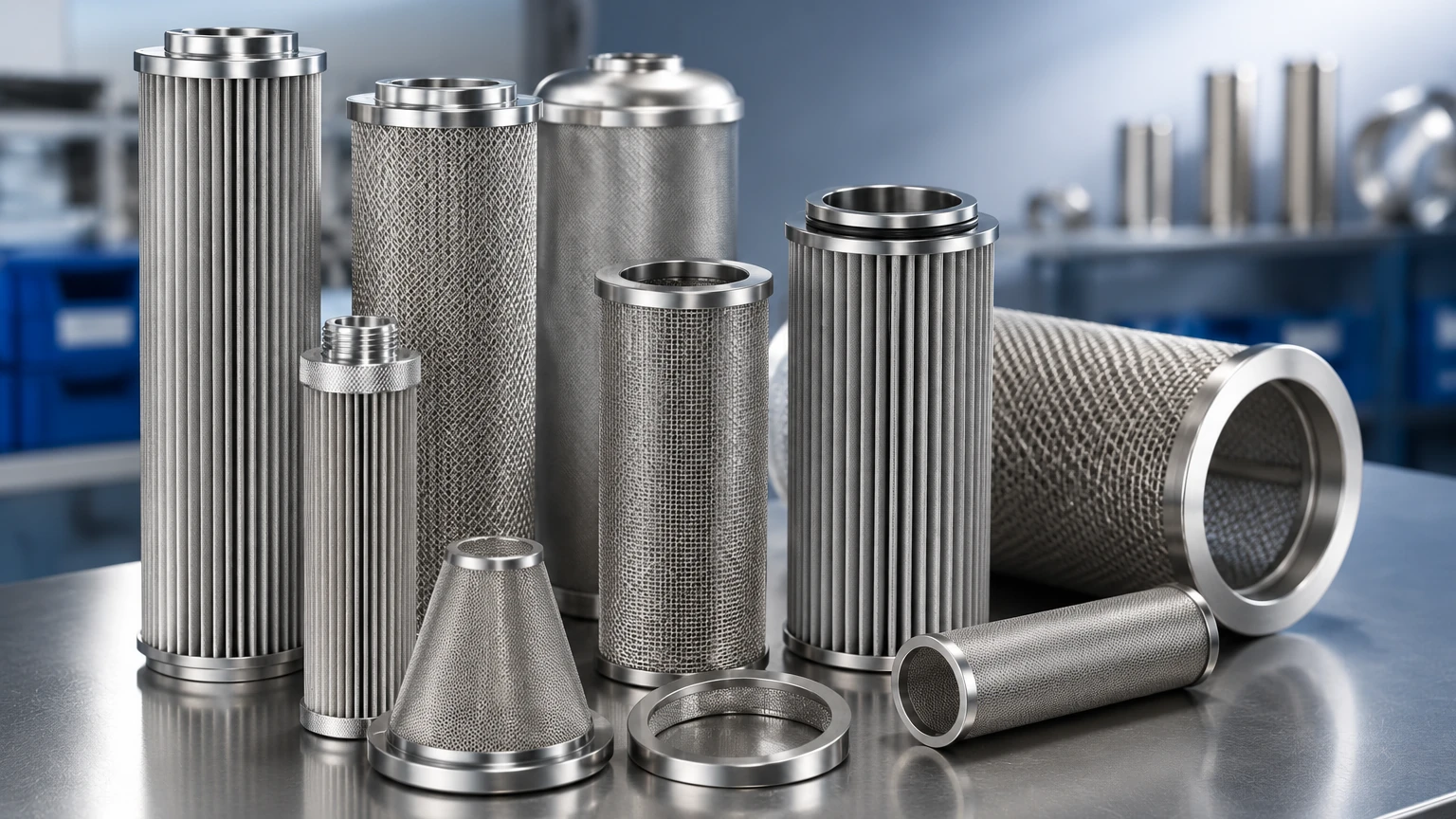
* Surface Area and Flux: The total filtration area determines the flow rate (flux) and the time between cleaning cycles. In custom manufacturing, filters can be designed with pleated mesh to maximize surface area within a compact footprint, allowing for higher throughput in existing piping systems.
* Surface Finish: For pharmaceutical applications, the surface finish of the filter housing and the media itself must be considered. Electropolishing to a specific Ra (roughness average) value is often required to minimize bacterial adhesion and ensure the effectiveness of Clean-in-Place (CIP) procedures.
Maintenance, Sterilization, and Operational Longevity
In the pharmaceutical industry, the ability to sterilize equipment is non-negotiable. api manufacturing processes often require the equipment to undergo Steam-in-Place (SIP) or Autoclaving. Stainless steel filters are ideally suited for these processes, as they can withstand repeated exposure to high-pressure steam (typically 121°C to 134°C) without losing their filtration properties.
Clean-in-Place (CIP) Protocols
Effective cleaning is essential to prevent cross-contamination between batches, especially in multi-product API facilities. Stainless steel filters can be cleaned using aggressive detergents, solvents, or ultrasonic baths. The robustness of the material allows for rigorous cleaning cycles that would destroy a polymeric membrane. When a filter is correctly specified and maintained, its operational life can extend to several years, providing a stable and predictable filtration performance.
Monitoring Differential Pressure
To optimize the replacement or cleaning cycle, engineers monitor the differential pressure (ΔP) across the filter. In api manufacturing, a sudden increase in ΔP may indicate a process upset or the successful capture of a large volume of particulates. By establishing clear baseline values, operators can schedule maintenance before the pressure reaches a critical level that could compromise the pump or the filter structure.
Custom OEM Solutions for Complex Synthesis
No two API processes are identical. Factors such as the crystal morphology of the product, the viscosity of the solvent, and the specific regulatory environment necessitate customized filtration solutions. Working with a manufacturer that offers OEM capabilities allows engineering teams to specify exact dimensions, flange types, and mesh configurations.
Customization options often include:
* Multi-layer Sintered Mesh: Combining different layers of mesh to provide both fine filtration and high mechanical strength.
* Specialized Fittings: Ensuring seamless integration into existing reactor vessels or centrifuge systems.
* Alloy Selection: Utilizing materials like 904L or Titanium for processes involving highly corrosive halogenated compounds.
By leveraging these customized designs, api manufacturing plants can achieve higher efficiency and reduce the risk of process downtime. For those looking to explore specific configurations, the Main Page of a dedicated filtration specialist provides a starting point for technical consultation and product selection.
Conclusion: Strategic Filtration in API Production
The role of filtration in api manufacturing extends far beyond simple separation. It is a fundamental component of quality control, process efficiency, and regulatory compliance. While the initial cost of high-quality stainless steel filtration components may be higher than disposable alternatives, the long-term benefits—including chemical resistance, thermal stability, reusability, and reduced waste—make them the superior choice for demanding industrial applications.
Engineers must approach filter selection with a focus on technical specifications and total cost of ownership. By understanding the unique challenges of API synthesis and selecting the appropriate materials and designs, manufacturing teams can ensure the consistent production of high-purity ingredients while optimizing their operational costs. As the pharmaceutical industry continues to evolve with more complex molecules and stricter purity requirements, the importance of robust, reliable, and precise filtration will only continue to grow.
