


Demistor
In industrial process engineering, the separation of liquid droplets from gas or vapor streams is a critical requirement for protecting downstream equipment, reducing product loss, and meeting environmental emission standards. A demistor, often referred to as a mist eliminator or entrainment separator, is a specialized technical component designed to perform this separation with high efficiency. For engineers and procurement teams sourcing filtration solutions, understanding the mechanical principles, material specifications, and design variables of a demistor is essential for optimizing system performance.
As a manufacturer specializing in custom stainless steel filtration solutions, Kaifil provides precision-engineered components that address the complexities of gas-liquid separation. This guide examines the technical aspects of demistor technology, providing the factual foundation necessary for informed selection and application in demanding industrial environments.
Fundamentals of Mist Elimination and Demistor Operation
The primary function of a demistor is to remove entrained liquid droplets from a gas stream. This is achieved through a process of coalescence, where small droplets are gathered into larger ones that can then be separated by gravity. The operation of a typical knitted wire mesh demistor relies on three distinct physical mechanisms:
1. Inertial Impaction: As the gas stream travels through the tortuous path created by the knitted wire mesh, the gas easily navigates around the wires. However, because liquid droplets have higher inertia than the gas, they cannot change direction as quickly. Consequently, they strike the surface of the wire and remain there due to surface tension.
2. Direct Interception: Smaller droplets that follow the gas streamlines may still come into contact with the wire if the distance between the streamline and the wire surface is less than the droplet's radius. These droplets are intercepted and adhere to the wire.
3. Brownian Diffusion: For extremely fine sub-micron droplets, random molecular motion (Brownian motion) causes the particles to deviate from the gas streamlines, eventually bringing them into contact with the wire surface.
Once the droplets are captured on the wire surface, they coalesce with other droplets to form larger films and beads. When the weight of these accumulated liquid masses exceeds the combined force of the gas velocity and surface tension, the liquid drains downward against the gas flow (in vertical vessels) or across the mesh (in horizontal vessels) and is collected in a sump or drainage area.
Materials and Engineering Specifications
The performance and longevity of a demistor are heavily dependent on the materials used in its construction. Because these components are frequently exposed to corrosive chemicals, high temperatures, and high-pressure differentials, material selection is a primary engineering consideration.
Kaifil specializes in stainless steel constructions, which are preferred in the chemical processing, pharmaceutical, and food and beverage industries due to their durability and resistance to oxidation. Common materials include:
* AISI 304/304L: Suitable for general industrial applications where moderate corrosion resistance is required.
* AISI 316/316L: The industry standard for applications involving chlorides or organic acids, offering superior pitting resistance.
* Specialty Alloys: For highly aggressive environments, demistors can be fabricated from 904L, Monel, Inconel, or Duplex stainless steels to ensure mechanical integrity over long service cycles.
Beyond the alloy type, the physical structure of the mesh—defined by the wire diameter, mesh density, and specific surface area—determines the filtration efficiency. A standard demistor might feature a wire diameter ranging from 0.20mm to 0.28mm. Increasing the surface area (m²/m³) generally improves the capture rate of smaller droplets but also increases the pressure drop across the unit. Engineers must balance these factors based on the specific droplet size distribution of the process gas.
Key Performance Indicators: Efficiency vs. Pressure Drop
When evaluating a demistor for a specific application, two performance metrics are paramount: separation efficiency and pressure drop.
Separation Efficiency
A well-designed demistor can typically remove 99% or more of liquid droplets larger than 5 to 10 microns. Efficiency is influenced by the "K-factor" (capacity factor), which is a function of the gas velocity. The relationship is often expressed using the Souders-Brown equation:
**V = K * √((ρL – ρG) / ρG)**
Where:
* V is the design gas velocity.
* K is the capacity factor (typically ranging from 0.07 to 0.11 m/s for mesh pads).
* ρL and ρG are the densities of the liquid and gas phases, respectively.
Operating above the design velocity can lead to "re-entrainment," where the force of the gas strips the liquid off the mesh and carries it downstream. Operating too far below the design velocity reduces the inertial impaction force, lowering the efficiency for smaller droplets.
Pressure Drop
In many industrial processes, maintaining a low pressure drop is critical for energy efficiency and compressor performance. A clean knitted wire mesh demistor typically operates with a pressure drop between 25 and 250 Pa (0.1 to 1.0 inches of water column). Factors that increase pressure drop include high liquid loading, high gas velocity, and fouling of the mesh. Regular monitoring of the pressure differential is the most effective way to determine when a demistor requires cleaning or replacement.
Selection Criteria for Industrial Applications
Choosing the correct demistor requires a detailed understanding of the process conditions. Engineers should confirm the following data points before finalizing a design:
* Gas Flow Rate (Minimum, Normal, Maximum): To ensure the velocity remains within the effective range of the K-factor.
* Operating Pressure and Temperature: To determine the required mechanical strength and material compatibility.
* Liquid Properties: Including density, viscosity, and surface tension, which affect how droplets coalesce and drain.
* Droplet Size Distribution: If the mist contains a high volume of sub-micron particles, a standard mesh pad may need to be supplemented with a fiber bed or a multi-stage separation system.
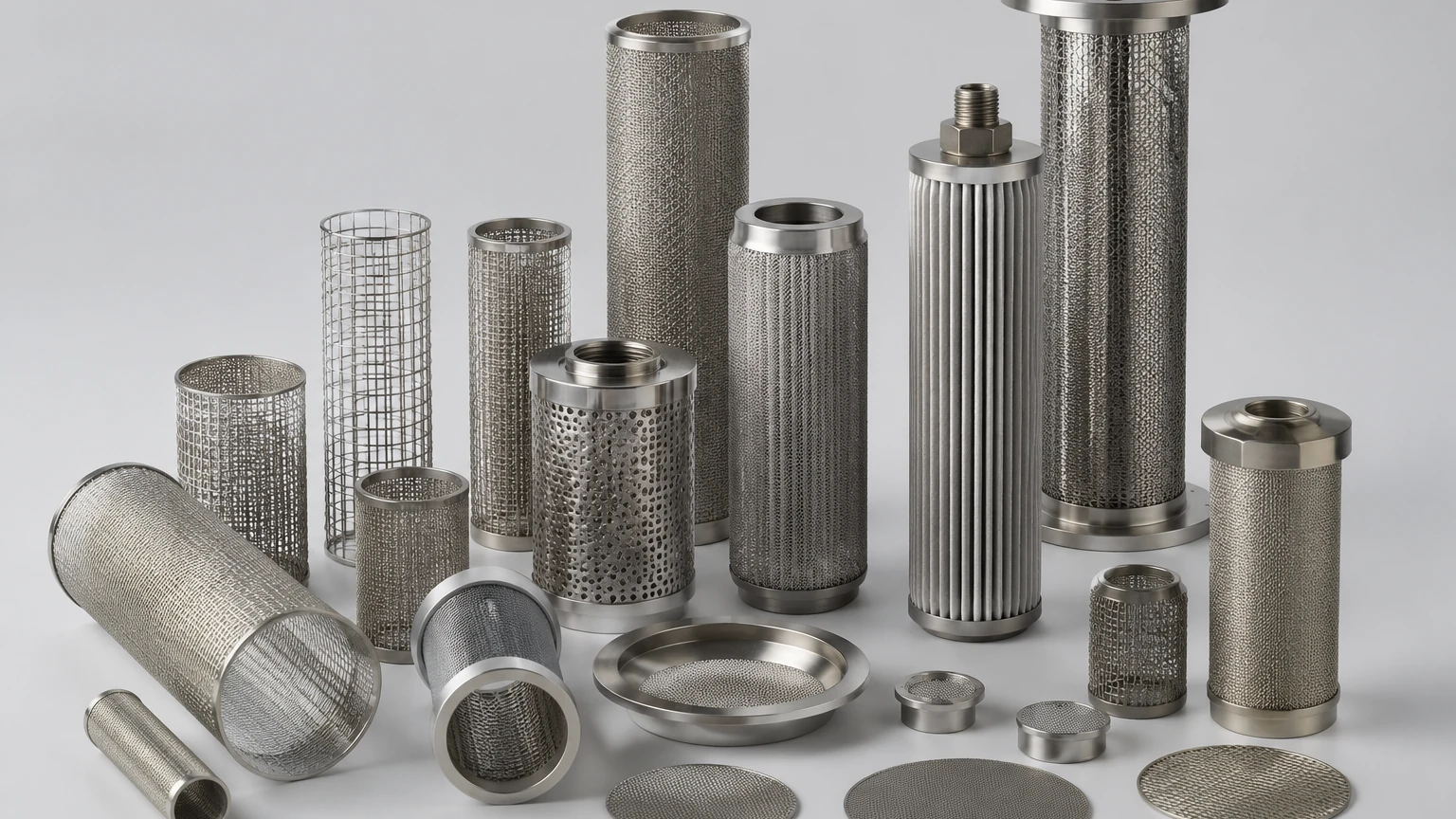
* Vessel Geometry: Demistors can be manufactured in circular, rectangular, or ring shapes to fit existing vessel manways or internal support rings.
For customized industrial filtration solutions, visiting the Main Page of a specialist manufacturer like Kaifil allows technical teams to review available configurations and align them with specific plant requirements.
Installation and Maintenance Best Practices
The effectiveness of a demistor is not only a matter of design but also of proper installation. Most mesh pads are provided in sections (slices) that can fit through standard manways. These sections must be installed tightly to prevent "gas bypassing," where the vapor stream flows through gaps between the mesh and the vessel wall rather than through the filter media.
Orientation and Support
In vertical flow applications, the demistor is usually installed horizontally. It must be supported by a rigid grid—often a combination of flat bars and round rods—to prevent the mesh from sagging or shifting under the weight of the liquid load or the force of the gas flow. In some high-velocity applications, a hold-down grid is also required on top of the mesh.
Maintenance and Cleaning
While stainless steel demistors are highly durable, they can become fouled by solids, waxes, or polymers present in the process stream. Fouling leads to an immediate increase in pressure drop and a decrease in separation efficiency. Maintenance teams should establish a cleaning schedule based on differential pressure readings. Cleaning methods typically include:
* Steam Cleaning: Effective for removing organic residues and waxes.
* Chemical Soaking: Using compatible solvents to dissolve scale or mineral deposits.
* Ultrasonic Cleaning: For precision mesh components where manual cleaning is impractical.
Total Cost of Ownership and Procurement Considerations
When procuring a demistor, the initial purchase price is only one component of the total cost of ownership (TCO). Engineers should also consider:
1. Energy Costs: A demistor with a high pressure drop increases the load on fans and compressors, leading to higher long-term energy consumption.
2. Product Recovery: In applications like evaporation or distillation, the demistor recovers valuable liquid products that would otherwise be lost, providing a direct return on investment.
3. Downstream Protection: By removing corrosive or abrasive droplets, the demistor extends the life of heat exchangers, turbine blades, and vacuum pumps, reducing unplanned downtime.
4. Customization vs. Off-the-Shelf: Standard sizes may be cheaper initially, but a customized demistor designed for specific flow conditions will offer better performance and longer intervals between maintenance.
By working with an OEM manufacturer like Kaifil, purchasing teams can ensure that the filtration components are built to the exact tolerances required for their specific industrial equipment. This collaboration ensures that material selection, mesh density, and structural support are optimized for the intended environment.
Conclusion
The demistor is a vital component in the toolkit of industrial filtration, providing a reliable and cost-effective method for gas-liquid separation. Whether used in a chemical scrubber to prevent acid rain, in a steam drum to ensure dry steam for a turbine, or in a pharmaceutical process to protect product purity, the technical integrity of the demistor is paramount. By focusing on engineering fundamentals—such as K-factors, material compatibility, and mesh geometry—technical professionals can select filtration solutions that enhance process efficiency and equipment longevity. For those seeking detailed product specifications or customized engineering support, exploring the resources on the Main Page provides a path toward optimized filtration performance.
