


Automatic Backwash Filters
In industrial fluid processing, the transition from batch filtration to continuous operation is often defined by the implementation of automatic backwash filters. These systems are engineered to remove suspended solids from liquid streams without necessitating process downtime for manual cleaning. For technical professionals and plant engineers, understanding the mechanical nuances, material constraints, and sizing variables of these systems is critical for maintaining system hydraulics and protecting downstream equipment.
Automatic backwash filters serve as a primary defense in cooling water circuits, chemical processing lines, and water treatment facilities. Unlike standard bag or cartridge filters that require human intervention once a terminal pressure drop is reached, these self-cleaning units utilize the system's own pressure or an external power source to clear the filter media. This capability is particularly vital in high-load environments where manual filter changes would result in prohibitive labor costs and frequent production halts.
The Mechanics of Self-Cleaning Filtration
The fundamental objective of an automatic backwash filter is to maintain a consistent flow rate while managing the accumulation of debris on the filter element. The process typically operates on a cycle dictated by either a timed interval or a pressure differential ($ΔP$) set point.
When the sensors detect that the pressure drop across the filter media has exceeded a pre-defined threshold—indicating that the accumulated "filter cake" is restricting flow—the cleaning cycle is initiated. There are several mechanical approaches to this:
1. Backflow Reversal: The flow of the fluid is momentarily reversed through a section of the filter media. This reversal dislodges particles from the surface of the mesh, which are then directed into a flush or drain line.
2. Suction Scanning: A rotating or reciprocating scanner moves across the internal surface of the filter element. This scanner creates a localized low-pressure zone that sucks debris off the mesh and carries it out of the system. This method is often preferred because it allows the main process flow to continue uninterrupted during the cleaning cycle.
3. Mechanical Scrapers: In applications involving highly viscous fluids or sticky contaminants, a mechanical blade or brush may be used to physically remove debris from the surface of a wedge wire or perforated metal element.
For engineers, the choice between these mechanisms depends largely on the nature of the contaminants (fibrous vs. granular) and the available system pressure. If the system pressure is too low to drive the backwash cycle, auxiliary pumps or external cleaning fluids may be required.
Material Engineering and Media Selection
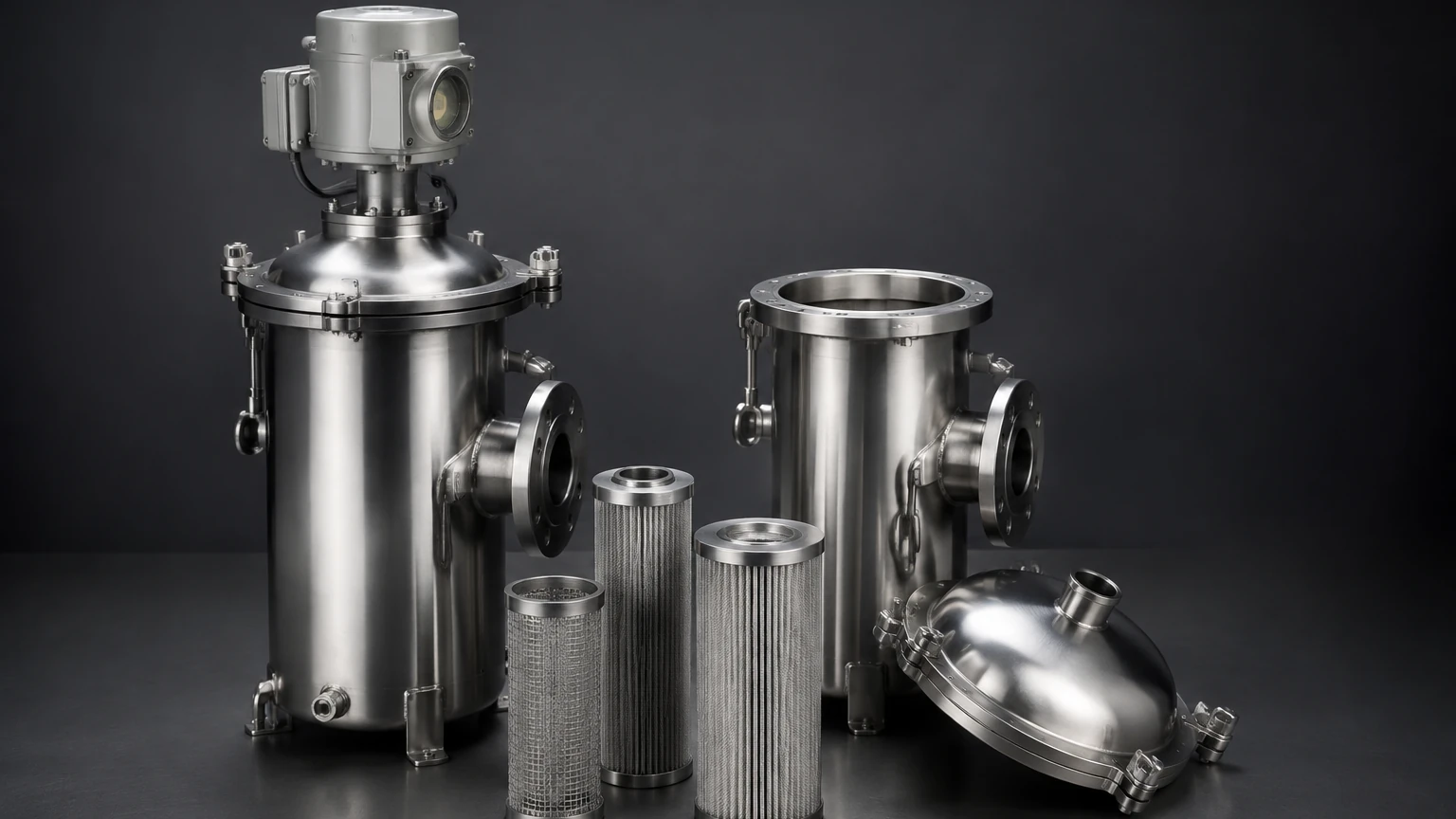
The heart of any automatic backwash filter is the filter element. Because these elements are subjected to repeated mechanical stress during the backwash cycle, material selection is paramount. Kaifil specializes in high-performance stainless steel filtration components that provide the structural integrity required for these demanding cycles.
Stainless Steel Wire Mesh
Multi-layered sintered wire mesh is a standard choice for automatic systems. By bonding multiple layers of woven wire mesh through heat and pressure, manufacturers create a media that combines high porosity with exceptional mechanical strength. This ensures that the mesh does not deform or migrate under the reverse-pressure pulses of a backwash cycle.
Wedge Wire Elements
Wedge wire (V-wire) is often utilized in automatic backwash filters for heavy-duty applications. The V-shaped profile of the wire creates a slot that widens inwardly, which significantly reduces the risk of "pegging" or particles becoming permanently wedged in the media. This geometry facilitates a more efficient release of debris during the cleaning phase.
Alloy Selection
* 304/304L Stainless Steel: Suitable for general industrial water and non-corrosive fluid applications.
* 316L Stainless Steel: The industry standard for chemical processing and food-grade applications due to its superior resistance to pitting and crevice corrosion.
* Duplex and Super Duplex: Reserved for highly aggressive environments, such as seawater filtration or high-chloride chemical streams, where standard austenitic steels would fail prematurely.
Critical Performance Parameters for System Sizing
Sizing an automatic backwash filter requires a detailed analysis of the fluid dynamics and the contaminant profile. Engineering teams should confirm the following data points before finalizing a specification:
Flux Rate and Effective Filtration Area
The flux rate—the volume of fluid passing through a given area of filter media over time—must be carefully managed. If the flux is too high, particles can be forced deep into the mesh pores (depth loading), making them difficult to remove during backwashing. A larger effective filtration area reduces the cleaning frequency and extends the total service life of the element.
Micron Rating: Absolute vs. Nominal
In many industrial contexts, a "10-micron" filter may only be 60% efficient at that size if it is rated nominally. For critical downstream protection (e.g., protecting high-pressure nozzles or membrane systems), an absolute micron rating is necessary. This ensures that 99.9% of particles above the specified size are retained.
Particle Load and Distribution
Automatic backwash filters are most effective when handling relatively low to moderate concentrations of suspended solids. If the particle load is too high, the filter may enter a state of "constant backwash," where the cleaning cycle cannot keep up with the accumulation of debris. In such cases, a primary separator or settling tank should be installed upstream.
Comparative Analysis: Automatic vs. Manual Systems
While the initial capital expenditure (CAPEX) for automatic backwash filters is higher than that of manual simplex or duplex strainers, the total cost of ownership (TCO) often favors automation in large-scale industrial settings.
| Feature | Manual Strainers | Automatic Backwash Filters |
| :— | :— | :— |
| Labor Requirement | High (Manual cleaning/replacement) | Low (Self-cleaning) |
| Process Continuity | Interrupted (unless using duplex) | Continuous |
| Waste Generation | High (Spent bags/cartridges) | Low (Concentrated backwash stream) |
| Safety Risk | Potential exposure to process fluids | Enclosed system; minimal exposure |
| Footprint | Variable | Compact relative to flow capacity |
For facilities looking to optimize their filtration infrastructure, reviewing the Main Page for technical specifications on stainless steel cartridges and custom mesh components can help in determining the feasibility of an automated upgrade.
Managing Operational Risks and System Longevity
Despite their automated nature, these filters are not "set and forget" devices. Several risks must be mitigated through proper engineering and maintenance protocols:
* Mesh Blinding: Over time, certain types of contaminants (like oils or biological growth) can form a film that the backwash cycle cannot remove. This is known as blinding. Periodic chemical cleaning or ultrasonic cleaning of the elements may be required to restore original permeability.
* Seal and Gasket Wear: The moving parts within the cleaning mechanism—such as the rotating scanner or the backwash valve—rely on high-quality seals. In abrasive applications, these seals can wear down, leading to internal bypass where unfiltered fluid leaks into the clean stream.
* Control System Errors: If the pressure differential sensors fail or are improperly calibrated, the system may fail to initiate a backwash cycle, leading to a collapsed filter element or a complete blockage of the process line.
To prevent these issues, it is recommended to implement a preventative maintenance schedule that includes inspecting the internal mechanical linkages and verifying sensor accuracy every six to twelve months.
Customization and Integration in Industrial OEM
Many industrial applications require filters that do not fit standard off-the-shelf configurations. This is where custom manufacturing becomes essential. When integrating an automatic backwash filter into a larger OEM system—such as a hydraulic power unit or a modular water treatment skid—engineers must consider the manifold design and the orientation of the inlet/outlet ports.
Kaifil provides customized filtration solutions, including specialized wire mesh configurations and precision-engineered filter cartridges, to meet specific spatial and performance requirements. Customization options often include:
* Reinforced Support Cores: For high-pressure applications where the element must withstand significant crushing forces.
* Tailored Micron Ratings: Developing specific mesh weaves to target unique particle shapes or sizes.
* Specialized End Fittings: Ensuring seamless integration with existing piping standards (NPT, Flanged, Sanitary Tri-clamp).
By working closely with a manufacturer that understands the metallurgy and mechanical behavior of stainless steel, purchasing teams can ensure that the filtration components are optimized for both the process fluid and the mechanical cleaning mechanism of the backwash system.
Conclusion: Selecting the Right Solution
Automatic backwash filters represent a sophisticated intersection of mechanical engineering and fluid dynamics. They are indispensable for modern industrial processes that demand 24/7 uptime and high-purity fluid streams. When evaluating these systems, engineers should look beyond the initial price tag and focus on the durability of the filter media, the efficiency of the cleaning mechanism, and the ease of future maintenance.
Successful implementation begins with accurate data regarding flow rates, pressure constraints, and contaminant characteristics. By prioritizing high-quality stainless steel components and robust mechanical designs, facilities can achieve reliable, long-term filtration performance with minimal operational intervention.
