


Automatic High-temperature Filters
In industrial processing, the ability to maintain continuous filtration under extreme thermal conditions is critical for both operational efficiency and product purity. Automatic high-temperature filters represent a specialized category of filtration technology designed to operate in environments where standard polymer-based or manual filtration systems fail. These systems are engineered to handle fluids, gases, and molten materials at temperatures often exceeding 200°C (392°F), and in specialized cases, reaching up to 800°C (1472°F).
For technical professionals and procurement teams, selecting the right filtration system involves balancing mechanical durability, filtration precision, and the total cost of ownership. By automating the cleaning process, these filters eliminate the need for system shutdowns, reduce labor costs, and protect downstream equipment from thermal and particulate damage. To explore the full range of custom engineering capabilities and product specifications, engineers can refer to the Kaifil Main Page for detailed technical documentation.
Understanding the Role of Automatic High-temperature Filters in Industrial Systems
High-temperature industrial processes, such as those found in petrochemical refining, polymer production, and steam generation, require filtration solutions that do not degrade under heat. Traditional filters often rely on manual replacement, which poses significant safety risks to operators when dealing with hot fluids. Automatic high-temperature filters solve this by integrating self-cleaning mechanisms that trigger based on pressure differentials or timed intervals.
The core advantage of these systems is their ability to maintain a constant flow rate. As contaminants accumulate on the filter medium, the differential pressure ($ΔP$) increases. Once a predetermined threshold is reached, the system initiates a cleaning cycle—typically back-flushing or mechanical scraping—while the system remains online. This continuity is vital in industries like chemical processing, where a temperature drop or a flow interruption can lead to product solidification or chemical instability.
Material Engineering for Extreme Thermal Environments
The primary challenge in designing automatic high-temperature filters is material fatigue and thermal expansion. When metals are subjected to extreme heat, they expand at different rates depending on their alloy composition. Engineering a filter that maintains its structural integrity and filtration accuracy requires precise material selection.
1. Stainless Steel Alloys: Grade 304 and 316L are standard for many applications due to their corrosion resistance. However, for temperatures exceeding 500°C, engineers often specify 310S or 321 stainless steel, which offer superior oxidation resistance.
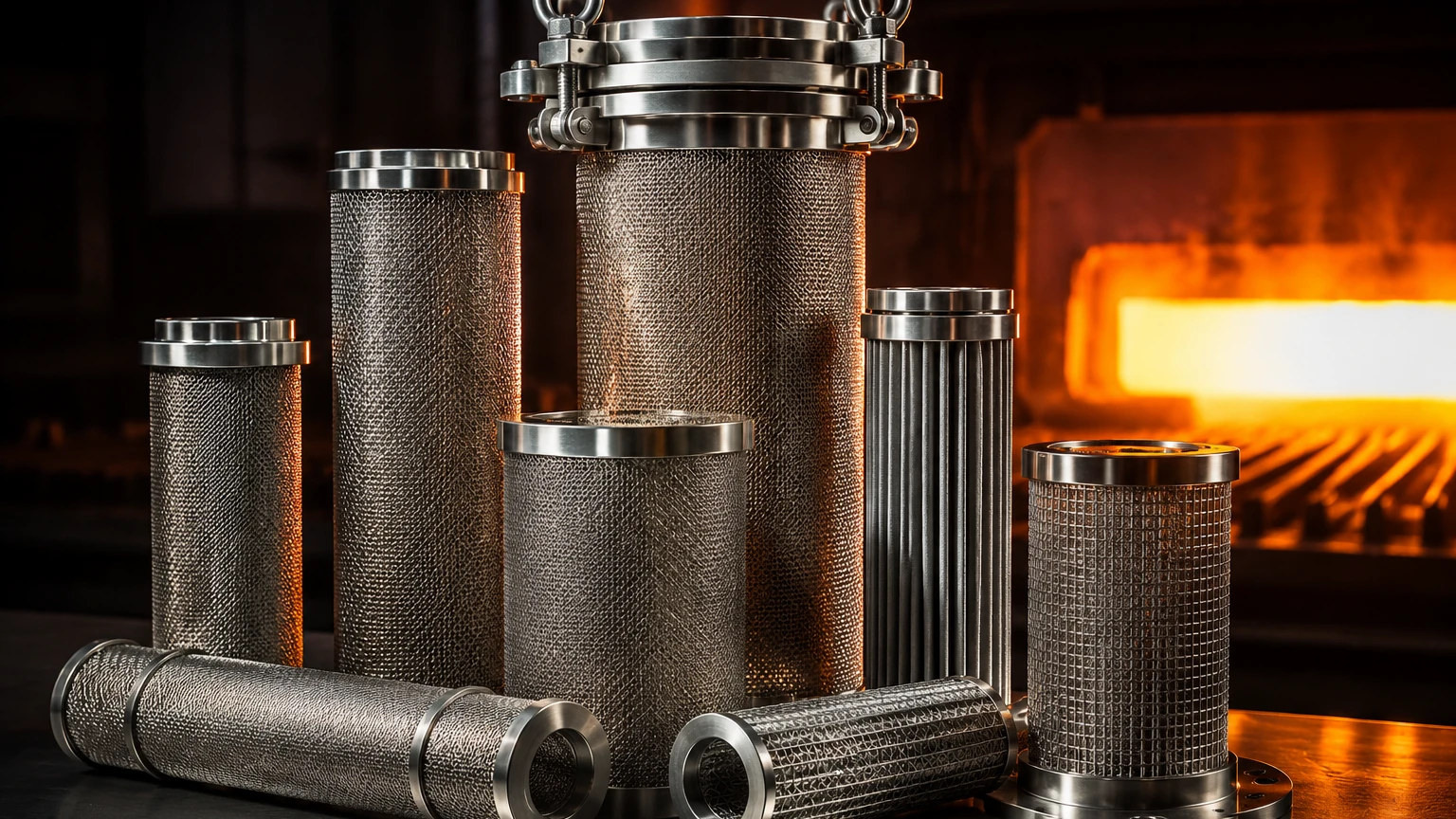
2. Sintered Metal Media: Sintered wire mesh and sintered metal fibers are preferred for high-temperature applications. The sintering process bonds the metal strands at their contact points, creating a rigid structure that does not migrate or deform under high pressure and heat.
3. Specialty Alloys: In highly corrosive or ultra-high-temperature environments, alloys such as Hastelloy, Inconel, and Monel are utilized. These materials maintain their mechanical strength and resist pitting and crevice corrosion even when exposed to aggressive chemicals at peak temperatures.
4. Sealing Technologies: Standard O-rings and gaskets fail at high temperatures. Automatic systems for these environments utilize metallic seals, graphite gaskets, or specialized PTFE compounds designed for extended thermal exposure.
Mechanisms of Automated Cleaning and Continuous Operation
The "automatic" component of these filters is what allows for 24/7 operation without manual intervention. There are two primary methods used in high-temperature settings:
Back-flushing Systems
In a back-flushing system, a portion of the filtered fluid (or an external clean fluid/gas) is forced backward through the filter media. This action dislodges the "filter cake" or accumulated debris from the surface of the mesh. In high-temperature gas filtration, pulsed jet cleaning using compressed air or nitrogen is common. The automation system must be carefully calibrated to ensure that the cleaning fluid does not cause thermal shock to the hot filter elements.
Mechanical Scraping
For high-viscosity fluids, such as molten polymers or heavy oils, mechanical scraping is often more effective. A rigid blade or brush rotates or moves linearly across the surface of the filter element, physically removing the contaminants. This method is highly effective for removing sticky or gelatinous particles that back-flushing might not dislodge. The scrapers themselves must be made from wear-resistant materials that can withstand constant friction at high temperatures.
Critical Selection Criteria: Beyond Micron Ratings
When engineers evaluate automatic high-temperature filters, the micron rating is only the starting point. Several other technical factors determine the success of the installation:
* Viscosity at Operating Temperature: Fluids behave differently as they heat up. A filter must be sized based on the fluid's viscosity at its actual operating temperature, not at ambient conditions. High viscosity increases the pressure drop across the media, which may require a larger filtration surface area.
* Thermal Expansion Coefficients: The housing and the internal filter elements must have compatible expansion rates. If the filter element expands more than the housing, it can buckle or break the seals, leading to bypass—where unfiltered fluid escapes around the media.
* Flow Velocity: High-velocity flow can cause erosion of the filter media, especially if the fluid contains abrasive particles. Proper housing design ensures that the flow is distributed evenly across the filter surface to prevent localized wear.
* Cleaning Frequency: The automation logic must be tuned to the contaminant load. If the cleaning cycle is too frequent, it can lead to premature wear of the moving parts; if it is too infrequent, the pressure drop may exceed the structural limits of the filter element.
Industry-Specific Applications and Performance Demands
Automatic high-temperature filters are essential across several heavy industries, each with unique requirements:
* Petrochemical and Refining: These filters are used to remove catalysts and carbon fines from hot oil streams. The ability to handle volatile hydrocarbons at high pressures and temperatures is a non-negotiable safety requirement.
* Food and Beverage: In large-scale frying operations or sugar refining, oils and syrups are processed at high temperatures to maintain flow. Automatic filtration ensures that carbonized particles are removed without cooling the product, which would increase energy costs for reheating.
* Pharmaceuticals: High-temperature steam filtration is used for sterilization. The filters must be capable of removing bacteria and pyrogens while withstanding repeated steam-in-place (SIP) cycles.
* Water Treatment: In power plants, high-temperature condensate return lines require filtration to remove iron oxides (crud) before the water is reused in boilers. This protects the boiler tubes from scaling and improves heat transfer efficiency.
Mitigating Operational Risks and Ensuring Longevity
Operating filtration equipment at the limits of its thermal capacity introduces specific risks that must be managed through engineering and maintenance protocols. One of the primary risks is thermal shock, which occurs when a cold cleaning fluid is introduced into a hot filter housing. This can cause micro-cracking in sintered metal media. Systems should be designed with pre-heating stages for cleaning fluids or gradual ramp-up cycles.
Another risk is corrosion acceleration. Chemical reactions typically speed up at higher temperatures. A material that is corrosion-resistant at 25°C may corrode rapidly at 250°C. Engineers must consult corrosion charts specific to the temperature and concentration of the process fluid. Regular borescope inspections during scheduled maintenance can help identify early signs of pitting or erosion within the automatic mechanism.
Furthermore, the reliability of sensors is paramount. Differential pressure transmitters used in these systems must be equipped with chemical seals and capillary tubes to isolate the sensitive electronics from the extreme heat of the process line.
Evaluating Total Cost of Ownership and System ROI
While the initial capital expenditure for automatic high-temperature filters is higher than that of manual or low-temperature systems, the Return on Investment (ROI) is often realized quickly through several channels:
1. Reduced Labor and Safety Costs: Eliminating the need for manual filter changes in hazardous, high-heat environments reduces the risk of workplace injuries and the labor hours required for maintenance.
2. Minimized Product Loss: Automatic systems typically have a smaller "hold-up volume" and lose less product during the cleaning cycle compared to manual housing blow-downs.
3. Energy Efficiency: By maintaining a clean filter surface, the system operates at a lower average pressure drop. This reduces the load on pumps and compressors, leading to significant energy savings over the life of the equipment.
4. Extended Media Life: Because the cleaning is controlled by precise automation, the filter media is less likely to be damaged by excessive pressure build-up or improper manual handling.
For organizations looking to optimize their industrial filtration processes, understanding the nuances of material science and automated control logic is essential. By choosing a partner with deep manufacturing expertise in stainless steel and alloy filtration, companies can ensure their systems are built to withstand the most demanding thermal environments. For further technical guidance and to view specific product configurations, visit the Kaifil Main Page.
In conclusion, automatic high-temperature filters are more than just a convenience; they are a critical component for modern industrial safety and efficiency. Through careful consideration of metallurgy, cleaning mechanisms, and operational parameters, engineers can implement filtration solutions that provide reliable performance even under the most grueling conditions.
