


Bag Filter for Water
Industrial water treatment and process water management require robust filtration systems capable of handling high flow rates while maintaining precise particle retention. A bag filter for water is one of the most versatile and cost-effective solutions for removing suspended solids, sediment, and contaminants from liquid streams. Unlike cartridge filters, which are often preferred for fine polishing, bag filters excel in applications where high dirt-holding capacity and ease of maintenance are paramount.
For engineers and procurement professionals, selecting the appropriate bag filtration system involves more than choosing a micron rating. It requires a comprehensive understanding of fluid dynamics, material compatibility, and the mechanical integrity of the filter housing and support structures. This guide examines the technical nuances of bag filtration in water-based applications, providing the factual data necessary to optimize industrial filtration performance.
Operating Principles of Bag Filtration Systems
The fundamental operation of a bag filter for water relies on a pressure-driven separation process. Liquid enters the filter housing, typically through the top or side inlet, and is directed into the interior of a filter bag. As the water passes through the filter media from the inside out, solid particles are trapped within the bag, while the clarified effluent exits through the outlet.
Pressure and Flow Dynamics
In industrial settings, the efficiency of a bag filter is measured by its ability to maintain a consistent flow rate with minimal pressure drop. The differential pressure ($ΔP$)—the difference between the inlet and outlet pressure—increases as the filter bag accumulates debris. Engineers must monitor this $ΔP$ to determine the optimal time for bag replacement. Typically, a clean bag filter for water will exhibit a pressure drop of less than 2 PSI. When the differential pressure reaches 15 to 25 PSI, the bag is considered "blinded" or full, and must be replaced to prevent housing damage or bypass.
Housing and Support Baskets
Because the filter bag is made of flexible media (felt or mesh), it requires a rigid internal support structure to withstand the hydraulic pressure of the water flow. This is where stainless steel components become critical. A precision-engineered stainless steel support basket holds the bag in place, ensuring that the media does not rupture or become displaced. High-quality housings, such as those provided by Kaifil, utilize heavy-duty perforated or mesh-lined baskets to maximize the effective filtration area and minimize flow resistance.
Material Selection for Water Filtration Media
The choice of filter media is the most critical factor in achieving the desired water quality. For a bag filter for water, materials are generally categorized into synthetic fibers and metal meshes.
Synthetic Felt and Monofilament Mesh
1. Polypropylene (PP): Widely used for its broad chemical compatibility and low cost. It is effective for general water filtration but has temperature limitations (typically up to 200°F/93°C).
2. Polyester (PE): Offers higher temperature resistance than polypropylene and is often used in industrial process water where thermal stability is required.
3. Nylon Monofilament: A woven mesh material that provides precise surface filtration. It is ideal for applications requiring exact particle size removal, as the uniform openings do not stretch or bypass easily.
Stainless Steel Wire Mesh
For demanding industrial environments, stainless steel wire mesh bags are the preferred choice. These are manufactured using 304 or 316L stainless steel and offer several technical advantages:
* Durability: Unlike synthetic bags, stainless steel mesh bags are resistant to high pressure and mechanical stress.
* Cleanability: These filters can often be backwashed or ultrasonically cleaned, making them a sustainable choice for long-term operations.
* Chemical Resistance: Essential for treated water containing aggressive chemicals or for high-temperature boiler feed water.
Kaifil specializes in these high-performance stainless steel filtration solutions, ensuring that the mesh geometry and weave patterns are optimized for specific industrial water requirements.
Engineering Considerations: Sizing and Micron Ratings
Correctly sizing a bag filter for water is essential to prevent premature clogging and system downtime. Sizing is influenced by the flow rate (GPM or m³/h), the nature of the solids (deformable vs. rigid), and the desired filtration accuracy.
Understanding Micron Ratings
Filter bags are rated by the size of particles they can trap, measured in microns (μ). However, engineers must distinguish between nominal and absolute ratings:
* Nominal Rating: Indicates that the filter will trap a high percentage (typically 60-80%) of particles of a certain size. This is common for felt bags used in general water pre-filtration.
* Absolute Rating: Indicates that the filter will trap 99% or more of particles at the specified micron level. This is achieved through high-precision woven wire mesh or multi-layered felt media.
Surface Area and Flow Velocity
To extend the service life of a bag filter for water, the flow velocity through the media should be kept low. Standard bag sizes (Size 1, Size 2, Size 3, and Size 4) provide different surface areas. For instance, a Size 2 bag (approximately 4.4 square feet of surface area) is typically rated for up to 220 GPM in clean water applications. However, if the water has a high solids loading, engineers often derate the flow to 50% of the maximum capacity to reduce the frequency of bag changes.
Sealing Mechanisms and Bypass Prevention
A common failure point in water filtration is "bypass," where contaminated water escapes around the top of the bag without passing through the media. Preventing bypass requires a high-integrity sealing mechanism between the bag and the housing.
Ring Types and Gaskets
* Snap-Band Rings: These use a flexible metal ring sewn into the bag top that "snaps" into a groove in the housing. While common, they may allow minor bypass if not seated perfectly.
* Plastic Flanges (SDS/Sentinal): These feature a molded plastic flange with a built-in handle. The flange creates a compression seal when the housing lid is closed, virtually eliminating bypass. These are standard in high-purity water applications.
* O-Ring Seals: For high-pressure or critical applications, the support basket and bag assembly may be sealed with EPDM, Viton, or Buna-N O-rings to ensure a leak-proof interface.
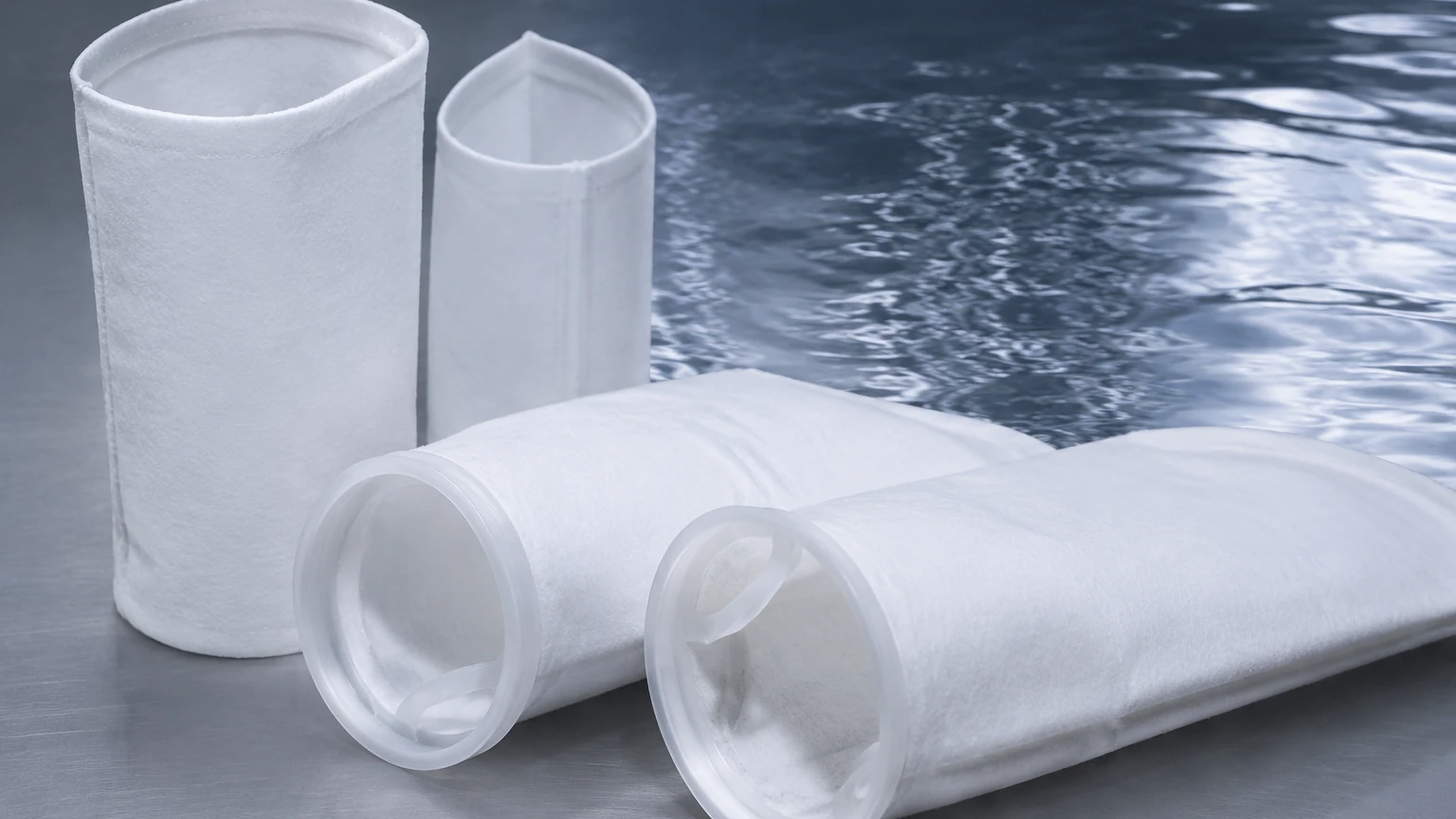
Industrial Applications for Bag Water Filters
The versatility of the bag filter for water makes it suitable for a wide range of sectors, each with unique technical requirements.
Cooling Towers and HVAC Systems
In cooling water loops, bag filters are used for side-stream filtration to remove scale, sand, and biological solids. By maintaining low turbidity, these filters prevent heat exchanger fouling and reduce the need for chemical treatments.
Food and Beverage Processing
Water used in food production must meet strict sanitary standards. Bag filters here often utilize 316L stainless steel housings and FDA-compliant media. They serve as pre-filters for reverse osmosis (RO) systems or as final polishers for wash water.
Chemical and Petrochemical Processing
In these environments, water often contains corrosive elements or is processed at extreme temperatures. Stainless steel wire mesh bags are frequently employed due to their ability to withstand aggressive pH levels and thermal cycling without losing structural integrity.
Wastewater Treatment
Bag filters are often the final stage in industrial wastewater treatment before discharge. They effectively remove residual flocculants or fine suspended solids to ensure compliance with environmental regulations.
Total Cost of Ownership and Maintenance
When evaluating a bag filter for water, purchasing teams should look beyond the initial capital expenditure (CAPEX) and consider the total cost of ownership (TCO). The TCO includes the cost of replacement bags, labor for change-outs, disposal costs, and the energy costs associated with pressure drop.
Maximizing Filter Life
To optimize TCO, several engineering strategies can be implemented:
1. Pre-filtration: Using a coarse strainer or a multi-stage bag system (coarse bag followed by a fine bag) can significantly extend the life of the more expensive fine filters.
2. Automated Monitoring: Installing differential pressure transmitters allows for real-time monitoring and prevents "over-running" filters, which can lead to bag rupture.
3. Customized Designs: For unique flow conditions, customized stainless steel filter components can improve flow distribution within the housing, ensuring the entire surface area of the bag is utilized.
Kaifil provides technical support to help engineers determine the most efficient configuration for their specific water treatment challenges. By focusing on precision manufacturing and durable materials, the goal is to achieve reliable performance with minimal operational interference.
Conclusion: Selecting the Right Solution
Choosing a bag filter for water requires a balance of mechanical durability, filtration accuracy, and operational efficiency. Whether the application involves municipal water treatment, industrial process cooling, or high-purity pharmaceutical water, the integrity of the filtration component is the determining factor in system success. For professionals seeking specialized guidance on stainless steel filtration components and custom OEM solutions, you can Review product options and application support on the Kaifil Main Page to find engineering-grade products tailored to demanding industrial environments.
By prioritizing high-quality materials and precise engineering, facilities can ensure consistent water quality, protect downstream equipment, and maintain a cost-effective filtration process.
