


Beer Brewing Filter
In the industrial production of beer, filtration is a critical process that determines the final product's clarity, flavor stability, and shelf life. A high-quality beer brewing filter does more than just remove visible particles; it manages the delicate balance between removing unwanted solids—such as hop residue, proteins, and yeast—and preserving the essential sensory characteristics of the brew. For engineers and production managers, selecting the right filtration media is a technical challenge that requires a deep understanding of fluid dynamics, material science, and sanitary design.
Industrial brewing environments demand filtration solutions that can withstand high temperatures, aggressive cleaning chemicals, and varying pressure levels. Stainless steel has emerged as the gold standard for these applications due to its durability and hygienic properties. This article explores the technical nuances of beer brewing filters, focusing on the engineering considerations that drive efficiency in modern breweries.
The Role of Filtration in the Brewing Process
Filtration occurs at several distinct stages of the brewing cycle, each requiring different technical specifications for the filter media. Understanding these stages is essential for selecting the appropriate beer brewing filter configuration.
Wort Separation (Lautering)
During the lautering process, the liquid wort is separated from the spent grains. While the grain bed itself acts as a primary filter, the equipment—typically a lauter tun—relies on a false bottom or screen. These screens are often constructed from heavy-duty stainless steel wedge wire or perforated plates. The engineering goal here is to maximize flow rate while preventing grain particles from passing through to the brew kettle.
Trub Removal (Whirlpool and Cooling)
After boiling, the wort contains "trub," which consists of hop debris and coagulated proteins. While whirlpooling is the primary method for gathering trub in the center of the vessel, a secondary beer brewing filter or kettle screen is often used to ensure that only clear wort moves to the heat exchanger. This stage is critical because any solids carried over can foul the heat exchanger plates and interfere with fermentation.
Cold-Side Filtration
Once fermentation is complete, the beer may undergo various levels of filtration depending on the desired style. This ranges from "rough" filtration to remove the bulk of the yeast, to "fine" or "sterile" filtration designed to remove spoilage organisms and achieve brilliance. At this stage, stainless steel filter cartridges and multi-layered mesh systems are frequently employed for their precision and ability to be cleaned in place (CIP).
Types of Stainless Steel Beer Brewing Filters
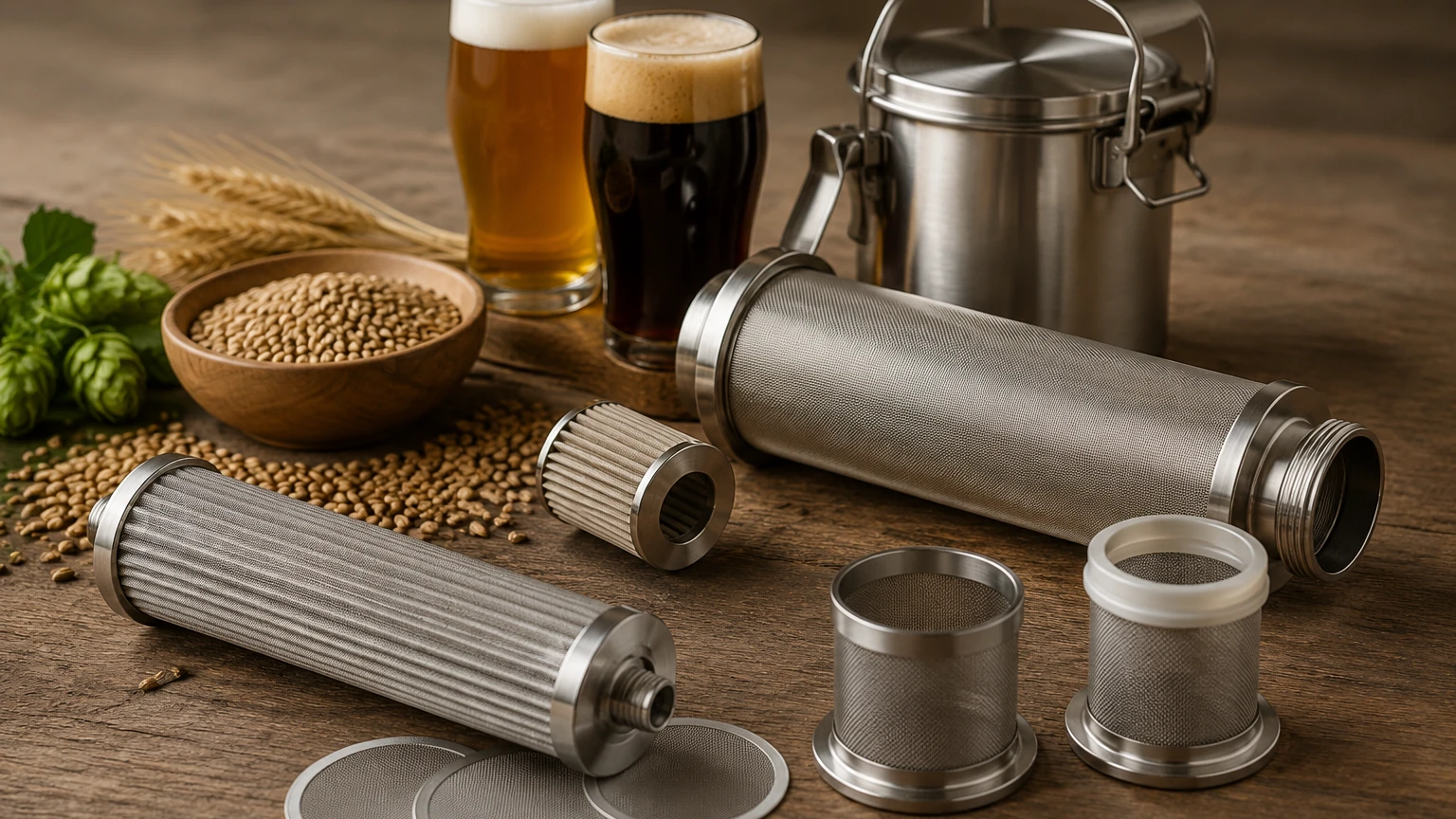
Stainless steel is the preferred material for industrial filtration components because it offers mechanical strength and chemical resistance that polymers cannot match. Within the category of beer brewing filters, several designs are commonly utilized.
Stainless Steel Wire Mesh Filters
Woven wire mesh is highly versatile and can be manufactured to precise micron ratings. In brewing, these are often used in hop spiders, line strainers, and intake filters. The high open-area ratio of wire mesh allows for excellent flow rates with minimal pressure drop. For more information on the technical specifications of these components, engineers can visit the Kaifil Main Page to review product options and application support.
Sintered Metal Filters
Sintered stainless steel filters are created by fusing layers of wire mesh or metallic powders under heat and pressure. This creates a porous structure that is incredibly robust. Sintered filters are often used for gas sparging (carbonation) or for high-pressure steam filtration within the brewery. Their ability to withstand backpulsing makes them ideal for long-term use in automated systems.
Wedge Wire Screens
Wedge wire is characterized by its V-shaped profile wires, which provide a non-clogging surface. In the context of a beer brewing filter, wedge wire is the industry standard for lauter tun false bottoms. The design allows for a high load-bearing capacity, which is necessary when supporting several tons of wet grain, while maintaining precise slot widths for efficient drainage.
Material Selection and Engineering Considerations
When specifying a beer brewing filter, engineers must look beyond the basic dimensions. The chemical and physical environment of the brewery dictates the material requirements.
304 vs. 316L Stainless Steel
While Grade 304 stainless steel is common in many industrial applications, Grade 316L is often preferred for brewing filters that come into contact with beer or cleaning solutions. 316L contains molybdenum, which provides superior resistance to chloride-induced pitting—a common issue when using certain sanitizers or when dealing with varying water chemistry. Furthermore, the "L" (low carbon) designation ensures better corrosion resistance after welding, which is vital for custom-fabricated filter housings.
Micron Ratings and Filtration Efficiency
The choice of micron rating depends on the target particle size. For example:
* Coarse Filtration (50-200 microns): Used for removing hops and large trub particles.
* Clarification (5-20 microns): Used for removing the majority of yeast cells.
* Polishing (0.5-2 microns): Used to achieve high clarity and microbial stability.
Engineers must balance the micron rating with the allowable pressure drop. A filter that is too fine will clog rapidly (blinding), leading to frequent downtime for cleaning and increased stress on pumps.
Technical Benefits of Stainless Steel Filtration Solutions
Transitioning to high-performance stainless steel filtration components offers several operational advantages over disposable or lower-grade alternatives.
1. Durability and Longevity: Unlike plastic or fabric filters, a stainless steel beer brewing filter can withstand the mechanical stresses of high-pressure flow and the thermal shock of transitioning from boiling wort to cold rinse water. This longevity reduces the total cost of ownership by extending the time between component replacements.
2. Cleanability and Hygiene: Sanitary design is paramount in brewing to prevent infection. Stainless steel components can be polished to a high Ra (Roughness Average) value, ensuring there are no microscopic pits where bacteria can hide. They are fully compatible with Clean-in-Place (CIP) cycles involving caustic and acid washes.
3. Sustainability: By using permanent, cleanable stainless steel filters, breweries can significantly reduce their solid waste compared to using disposable filter pads or cartridges. This aligns with modern industry trends toward more sustainable production practices.
Maintenance and Replacement Cycles
Even the most robust beer brewing filter requires a structured maintenance program to ensure peak performance. Over time, organic materials like proteins and polyphenols can form a "beer stone" (calcium oxalate) buildup on the filter surface, which standard CIP cycles might not fully remove.
Monitoring Pressure Differential
The most effective way to monitor filter health is by tracking the pressure differential (delta P) across the filter housing. An escalating delta P indicates that the filter is becoming loaded with solids. Establishing a baseline for a clean filter allows operators to set precise thresholds for when a cleaning cycle or a deep chemical soak is required.
Inspection and Integrity Testing
Regular physical inspections should be conducted to check for mesh blinding, mechanical deformation, or seal degradation. In critical applications, such as final filtration before packaging, integrity testing (like the bubble point test) may be performed to ensure that the filter still meets its specified micron rating and has not developed any bypass paths.
Customization Options for Industrial Brewing
Every brewery layout is unique, and off-the-shelf filtration products often require modification to fit existing piping and vessel configurations. Customization is a core aspect of industrial filtration procurement.
OEM and Bespoke Designs
Manufacturers like Kaifil specialize in developing custom filtration components that meet specific engineering drawings. This includes custom flange types (such as Tri-Clamp or DIN), specialized lengths for filter cartridges, and reinforced structures for high-viscosity liquids. When designing a custom beer brewing filter, engineers should consider the ease of disassembly; a filter that is difficult to remove for manual inspection is less likely to be maintained properly.
Scaling Production
As breweries scale from pilot systems to full-scale production, the filtration requirements change. A system designed for a 5-barrel batch will not scale linearly to a 50-barrel system due to the changes in fluid velocity and solids loading. Working with a manufacturer that understands these scaling challenges ensures that the filtration system remains an asset rather than a bottleneck.
Conclusion
Selecting the right beer brewing filter is a fundamental decision that impacts the quality, consistency, and profitability of a brewing operation. By focusing on high-grade materials like 316L stainless steel, understanding the specific needs of each production stage, and prioritizing sanitary design, engineers can implement filtration systems that deliver reliable performance over thousands of cycles. Whether the goal is removing heavy trub or achieving a crystal-clear finish, the technical integrity of the filtration media remains the foundation of a successful brew. For those looking to explore specific filtration configurations or custom OEM solutions, the Kaifil Main Page serves as a comprehensive resource for technical data and engineering support.
