


Bag Filters for Water Treatment
In the landscape of industrial liquid processing, bag filtration remains one of the most versatile and cost-effective methods for removing suspended solids from water streams. Engineers and procurement teams often specify bag filters for water treatment due to their high flow capacity, ease of maintenance, and the relatively low capital investment required compared to complex membrane systems or high-pressure cartridge housings. However, achieving optimal filtration performance requires a deep understanding of the technical variables involved, from material compatibility to the physics of pressure differentials.
As a manufacturer specializing in high-performance filtration components, Kaifil provides the engineering support and custom manufacturing capabilities necessary to integrate these systems into demanding industrial environments. This guide explores the technical considerations essential for selecting and maintaining bag filters in water treatment applications.
The Mechanics of Bag Filtration in Water Systems
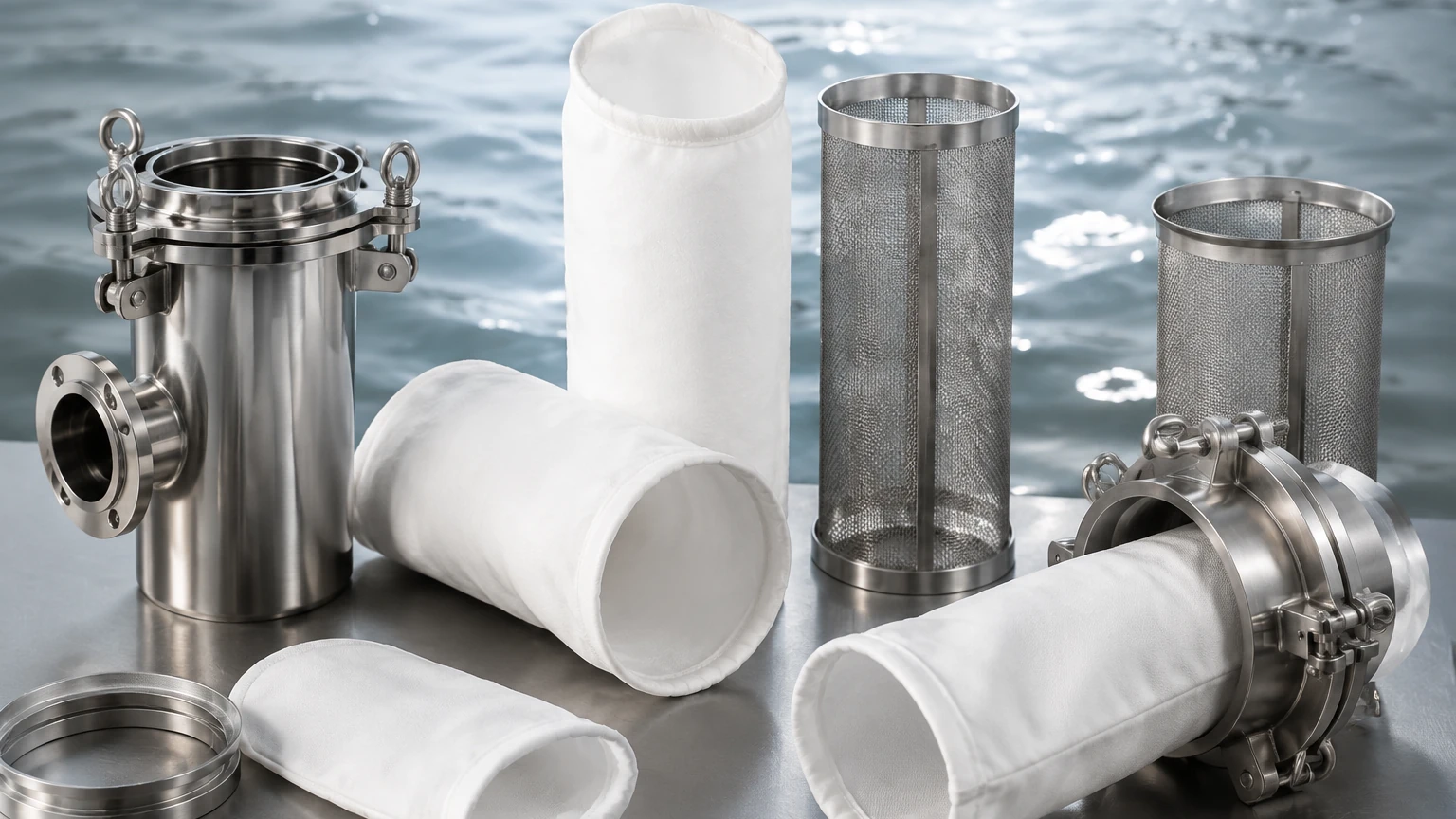
Bag filtration operates on a pressure-driven principle. The untreated water enters the filter housing, typically from the top or side, and is forced through a reinforced filter bag supported by a perforated metal basket. The flow direction is strictly "inside-to-out," meaning the contaminants are trapped within the bag while the clean filtrate passes through the mesh or felt media into the housing’s discharge port.
This design offers a distinct advantage in industrial water treatment: when the filter bag reaches its dirt-holding capacity, the accumulated solids are contained entirely within the bag. This prevents downstream contamination during the change-out process and simplifies the cleaning of the internal housing. For high-volume applications, multi-bag housings allow for significantly higher flow rates, often exceeding several hundred cubic meters per hour, without a proportional increase in the system's physical footprint.
Material Engineering and Chemical Compatibility
Selecting the correct media is the most critical decision in the engineering of bag filters for water treatment. The chemical composition of the water, including pH levels, temperature, and the presence of hydrocarbons or oxidizing agents, dictates the material requirements.
Polypropylene and Polyester
Polypropylene is the industry standard for general water treatment due to its excellent chemical resistance and low cost. It is highly effective for acidic and alkaline solutions. Polyester is preferred when higher operating temperatures are expected or when the water contains specific solvents that might degrade polypropylene. Both materials are typically available in needle-felt structures, which provide depth filtration capabilities.
Stainless Steel Wire Mesh
For high-temperature applications or processes requiring a reusable filter medium, stainless steel wire mesh is the superior choice. Kaifil specializes in custom stainless steel filtration solutions that offer exceptional durability. Unlike disposable synthetic bags, stainless steel mesh bags can be cleaned and reused, making them ideal for removing large, abrasive particles or for use in high-pressure systems where synthetic fibers might migrate or fail. These are often utilized in cooling water loops and primary intake filtration.
Nylon Monofilament
Nylon is frequently used for surface filtration. Monofilament meshes provide precise, uniform pore sizes, which are essential when a specific "absolute" cut-off point is required for particle size. This is common in the food and beverage industry and in pre-filtration for fine chemical processing.
Key Engineering Selection Criteria
When specifying bag filters for water treatment, engineers must evaluate several performance metrics to ensure the system meets the required effluent quality while maintaining operational efficiency.
1. Micron Rating (Nominal vs. Absolute): Most bag filters are rated nominally, meaning they will trap a high percentage (typically 60-80%) of particles at the specified micron size. For critical water treatment steps, such as protecting sensitive RO membranes, engineers may require high-efficiency bags that approach absolute ratings (95-99% efficiency).
2. Flow Rate and Velocity: The velocity of the water through the filter media affects both filtration efficiency and bag life. High velocities can force deformable particles through the pores or cause premature "blinding" of the media surface. It is generally recommended to size the housing so that the initial pressure drop remains below 2 PSI (0.14 bar).
3. Viscosity and Temperature: While water has a low viscosity, temperature fluctuations can impact the structural integrity of synthetic bags. As temperature increases, the maximum allowable pressure drop for a synthetic bag decreases. Stainless steel components are often specified for systems where temperature stability cannot be guaranteed.
4. Dirt Holding Capacity: This refers to the total mass of contaminants a bag can retain before the pressure drop reaches the terminal limit. Depth-loading felt bags generally offer higher dirt-holding capacity than surface-loading meshes for fine, gelatinous particles.
Comparing Bag Filters and Cartridge Filters
In the procurement phase, the choice between bag filters and cartridge filters often arises. While both serve similar functions, their application profiles differ significantly.
* Volume and Surface Area: Bag filters generally handle higher volumes of solids. A single #2 size filter bag has a much larger surface area than a standard 10-inch cartridge, allowing it to process higher flow rates with fewer housing units.
* Waste and Cost: Bag filters are typically more cost-effective for primary or secondary filtration. The cost per gallon of treated water is usually lower with bags due to the lower unit price of the media and the reduced labor required for change-outs.
* Precision: Cartridge filters are often preferred for final-stage polishing where sub-micron filtration (below 1 micron) is required. Bag filters are most effective in the 1 to 1,000-micron range.
For many industrial water treatment plants, a tiered approach is used: bag filters serve as the pre-filtration stage to remove the bulk of suspended solids, thereby extending the life of more expensive downstream cartridge filters or membrane elements.
Operational Maintenance and Replacement Cycles
To maintain the integrity of a water treatment system, a rigorous maintenance schedule based on differential pressure ($ΔP$) is essential. Most industrial bag filter housings are equipped with pressure gauges at the inlet and outlet.
* Initial $ΔP$: Typically 1–3 PSI for a clean bag.
* Terminal $ΔP$: The bag should be replaced when the differential pressure reaches 12–15 PSI. Exceeding this limit risks "blow-by," where the pressure forces the bag to seat improperly, or even structural failure of the media, allowing contaminants to bypass the filter.
Regular inspection of the O-rings and seal surfaces is also required. Even the highest quality bag will fail if the seal between the bag collar and the housing basket is compromised. At Kaifil, we emphasize the importance of precision-engineered seating surfaces in our custom housings to prevent bypass in high-pressure water applications.
Customization and OEM Solutions for Water Treatment
Standard off-the-shelf filtration products do not always meet the rigorous demands of specialized chemical processing or pharmaceutical water systems. Customization is often necessary to address specific spatial constraints, unusual flow requirements, or extreme chemical environments.
Kaifil works closely with global engineering teams to develop tailored filtration components. This includes:
* Custom Mesh Configurations: Adjusting weave patterns and wire diameters to balance flow rate and mechanical strength.
* Specialized Housing Materials: Utilizing 316L stainless steel or exotic alloys for corrosive wastewater treatment.
* Integrated Systems: Designing filter housings that incorporate magnetic separators or multi-stage internal baskets for complex fluid streams.
By focusing on the technical nuances of metal and synthetic media, Kaifil ensures that the filtration solution provided is not just a commodity, but a precision engineered component of the larger industrial process. For more information on our full range of custom stainless steel filtration products and engineering support, please visit our Main Page.
Total Cost of Ownership (TCO) Considerations
When evaluating bag filters for water treatment, the purchase price is only one component of the Total Cost of Ownership. Engineers must also account for:
* Disposal Costs: Synthetic bags are generally single-use. In some regions, the cost of disposing of contaminated bags can exceed the initial purchase price.
* Energy Consumption: Operating a system with a high average pressure drop increases the load on pumps, leading to higher electricity costs. Sizing the system correctly to minimize $ΔP$ is an investment in long-term energy efficiency.
* Downtime: The speed of bag replacement directly impacts plant uptime. Tool-less housing designs and quick-opening covers are critical features for high-frequency change-out applications.
Conclusion
Bag filters for water treatment offer a robust, scalable, and efficient solution for managing suspended solids across a variety of industries. By carefully considering material compatibility, micron ratings, and the mechanical design of the housing, engineers can significantly improve water quality while controlling operational costs. Whether the application involves cooling tower side-stream filtration or pre-treating process water for a manufacturing line, the success of the system depends on the quality of the filtration media and the precision of the housing components. Partnering with a manufacturer like Kaifil provides access to the technical expertise needed to navigate these complex variables and implement a reliable filtration strategy.
