


Basket Strainer for Pump
In industrial fluid handling, the pump is often the most critical and expensive component of a system. Whether it is a centrifugal, positive displacement, or diaphragm pump, its internal clearances are engineered to precise tolerances. The introduction of foreign debris—such as pipe scale, weld slag, or process solids—can lead to catastrophic mechanical failure, seal damage, and unplanned downtime. A basket strainer for pump protection serves as the primary line of defense, capturing large-volume solids while maintaining the hydraulic conditions necessary for efficient pump operation.
Selecting the correct filtration component requires a deep understanding of fluid dynamics, material compatibility, and the specific requirements of the pump’s suction side. As a specialized manufacturer of stainless steel filtration solutions, Kaifil provides the engineering expertise needed to integrate high-performance strainers into demanding industrial environments. For more information on our full range of filtration capabilities, visit our Main Page.
The Critical Role of Basket Strainers in Pump Protection
Centrifugal pumps are particularly susceptible to damage from entrained solids. When debris enters the pump casing, it can strike the high-speed impeller, causing erosion, imbalance, and pitting. Furthermore, even small particles can migrate into mechanical seal faces or sleeve bearings, leading to premature wear and leakage.
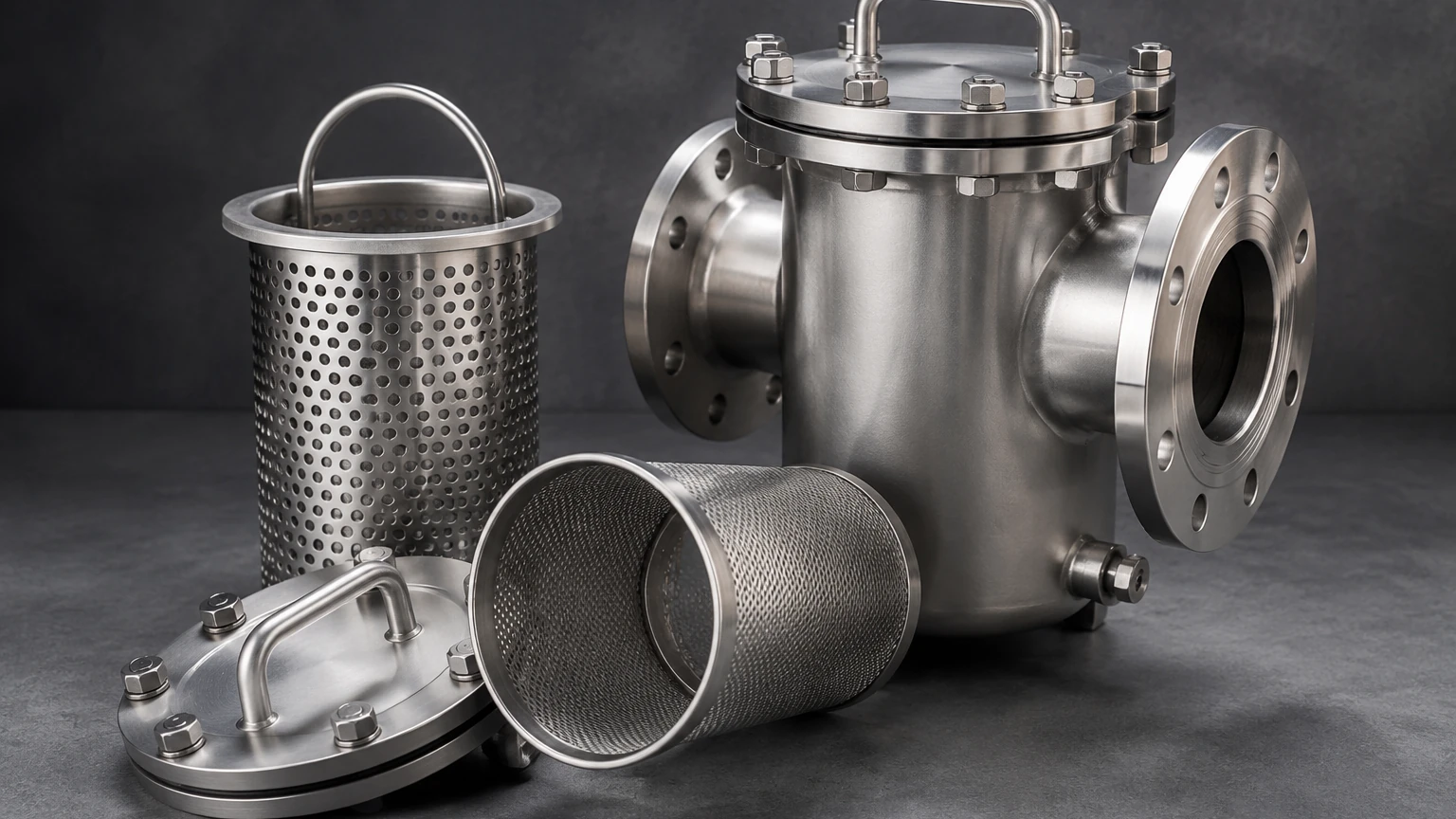
A basket strainer for pump applications is designed with a larger internal volume than standard Y-strainers. This increased surface area allows for a higher dirt-holding capacity and a lower pressure drop, which is vital for maintaining the pump's performance. By effectively removing contaminants before they reach the intake, these strainers extend the mean time between failures (MTBF) for rotating equipment and reduce the total cost of ownership for the facility.
Engineering Considerations for Suction-Side Filtration
The placement of a basket strainer on the suction side of a pump introduces specific engineering challenges, most notably the impact on Net Positive Suction Head (NPSH). If a strainer is improperly sized or becomes excessively clogged, it creates a significant pressure drop (ΔP). If the pressure at the pump inlet falls below the vapor pressure of the liquid, cavitation occurs.
NPSH and Pressure Drop Management
Cavitation causes the formation and subsequent collapse of vapor bubbles, which can erode metal surfaces and lead to severe vibration. To prevent this, engineers must calculate the allowable pressure drop across the strainer in both clean and dirty conditions. A well-designed basket strainer for pump protection should offer an open area ratio (OAR) of at least 6:1 or 8:1 relative to the pipe's cross-sectional area. This ensures that even as the basket collects debris, the fluid velocity remains low enough to prevent excessive friction loss.
Flow Profile and Turbulence
Turbulence at the pump inlet can lead to uneven loading on the impeller and increased noise. Basket strainers help to some extent by acting as a plenum, but they must be installed with sufficient straight pipe runs—typically five to ten pipe diameters—between the strainer outlet and the pump inlet to ensure a laminar flow profile. Kaifil’s custom-engineered baskets are designed to minimize internal turbulence, ensuring that the fluid enters the pump in a stable state.
Material Selection and Durability in Industrial Environments
Industrial filtration components must withstand not only the physical stress of high-pressure flow but also the chemical environment of the process fluid. Stainless steel is the industry standard for high-performance basket strainers due to its superior mechanical strength and corrosion resistance.
Austenitic Stainless Steels (304 and 316)
At Kaifil, we specialize in the fabrication of 304 and 316/316L stainless steel filter components.
* Grade 304: Suitable for general-purpose applications, including water treatment and food and beverage processes where moderate corrosion resistance is required.
* Grade 316/316L: Contains molybdenum, which provides enhanced resistance to chlorides and pitting. This is the preferred choice for chemical processing, pharmaceutical manufacturing, and marine environments.
Using high-grade stainless steel ensures that the basket itself does not become a source of contamination through oxidation or material degradation. Furthermore, the durability of these materials allows for repeated cleaning cycles, making them a more sustainable and cost-effective choice than disposable filter elements.
Evaluating Filtration Accuracy: Mesh vs. Perforation
The effectiveness of a basket strainer for pump protection depends on the selection of the media. This is generally a balance between the size of the particles that must be removed and the allowable pressure drop.
1. Perforated Plate: This is the most robust form of strainer media. It consists of a stainless steel sheet with punched holes, typically ranging from 1/32" to 1/2". Perforated baskets are ideal for removing large debris like stones, bolts, or large scale.
2. Wire Mesh Lining: For finer filtration, a stainless steel wire mesh is layered over a perforated metal support basket. This allows for filtration down to 20 microns or finer. In pump applications, mesh-lined baskets are used when the pump has very tight internal clearances or when the process requires a higher level of purity.
When specifying a basket strainer, engineers must define the "maximum allowable particle size" for the pump. It is a common mistake to specify a mesh that is too fine, which leads to rapid clogging and frequent maintenance. The goal is to protect the pump, not to perform high-precision process filtration unless required by the application.
Operational Efficiency: Simplex vs. Duplex Systems
The choice between a simplex and a duplex basket strainer depends on the criticality of the process and the frequency of cleaning required.
* Simplex Strainers: These are used in systems where the pump can be shut down periodically for maintenance. The process must be stopped, the strainer housing depressurized, and the basket removed for cleaning. These are common in batch processing or systems with redundant pump skids.
* Duplex Strainers: Also known as twin-basket strainers, these consist of two separate strainer chambers connected by a diversion valve. When one basket becomes full, the flow is diverted to the clean chamber without interrupting the pump's operation. This is essential for continuous processes in chemical plants, refineries, and power generation facilities.
Maintenance Protocols and Total Cost of Ownership
A basket strainer for pump protection is only effective if it is properly maintained. A neglected strainer can become a liability, either by allowing bypass if the basket ruptures under high pressure or by causing pump cavitation due to blockage.
Differential Pressure Monitoring
The most reliable way to monitor a strainer’s condition is through differential pressure (DP) gauges. By measuring the pressure before and after the strainer, operators can determine exactly when the basket needs cleaning. Typically, a basket should be cleaned when the DP reaches 5-10 psi over the clean pressure drop, depending on the system design.
Cleaning and Inspection
Stainless steel baskets are designed for longevity. During maintenance, the basket should be inspected for signs of "blinded" mesh (where particles are permanently wedged in the openings) or structural deformation. Kaifil’s precision-welded baskets are engineered to withstand the mechanical stresses of high-pressure differentials, ensuring they maintain their shape and filtration integrity over many years of service.
Customization and OEM Solutions for Specialized Pump Systems
Standard off-the-shelf strainers do not always meet the spatial or technical requirements of complex industrial skids. Customization is often necessary to optimize the performance of a basket strainer for pump systems in unique environments.
Kaifil provides comprehensive OEM and customized manufacturing services, including:
* Custom Dimensions: Tailoring the basket height and diameter to fit existing housings or restricted spaces.
* Reinforced Structures: Adding support rings or heavy-duty perforated backups for high-viscosity fluids or high-pressure applications.
* Specialized Coatings: While stainless steel is inherently resistant, certain applications may require additional surface treatments for extreme chemical compatibility.
* Variable Micron Ratings: Engineering multi-layered mesh structures to achieve specific filtration gradients.
By working closely with engineers during the design phase, Kaifil ensures that the filtration component is perfectly matched to the pump’s flow characteristics and the fluid’s properties.
Conclusion: Selecting the Right Partner for Pump Protection
The integration of a high-quality basket strainer for pump protection is a fundamental requirement for any industrial fluid system. By understanding the relationship between filtration surface area, pressure drop, and material science, engineers can protect their equipment from damage and optimize process efficiency.
Kaifil’s commitment to quality and technical precision makes us a trusted partner for global industries. Whether you are designing a new hydraulic system, upgrading a chemical processing line, or maintaining a water treatment facility, our stainless steel filtration solutions provide the reliability your pumps require. For detailed technical specifications and to explore our full product range, please visit our Main Page.
