


Beer Brewing Stainless Filter
In the industrial brewing sector, the transition from raw ingredients to a refined, shelf-stable product relies heavily on mechanical separation processes. A beer brewing stainless filter is not merely a strainer but a critical engineering component designed to manage solids, ensure clarity, and protect downstream equipment. For brewery engineers and procurement teams, selecting the correct filtration media involves balancing flow rates, pressure tolerances, and hygienic standards. Stainless steel has emerged as the definitive material for these applications due to its durability, chemical resistance, and ability to withstand the rigorous thermal cycles of a professional brewhouse.
The Engineering Necessity of Stainless Steel in Filtration
Industrial brewing environments are demanding. Equipment is subjected to high temperatures during wort boiling, acidic environments during fermentation, and caustic chemicals during Clean-in-Place (CIP) cycles. A beer brewing stainless filter must maintain its structural integrity and filtration accuracy under these varying conditions. Unlike polymer-based filters or disposable media, stainless steel components offer a long service life and a high degree of recyclability, which aligns with the operational efficiency goals of modern industrial facilities.
Material selection typically centers on AISI 304 or 316L stainless steel. While 304 is sufficient for many general-purpose brewing applications, 316L is often preferred for components that come into frequent contact with high-concentration sanitizers or acidic fruit additions due to its superior resistance to pitting and crevice corrosion. The choice of material directly impacts the total cost of ownership; while the initial investment in a high-grade stainless filter is higher than alternative materials, the reduction in replacement frequency and the elimination of disposable waste provide significant long-term value.
Technical Classifications of Brewing Filters
To optimize the brewing process, engineers must select the specific type of filter structure that matches the solids loading and particle size of each stage. For more information on specialized filtration components, professionals can visit the Main Page to review technical specifications.
Wire Mesh Filters
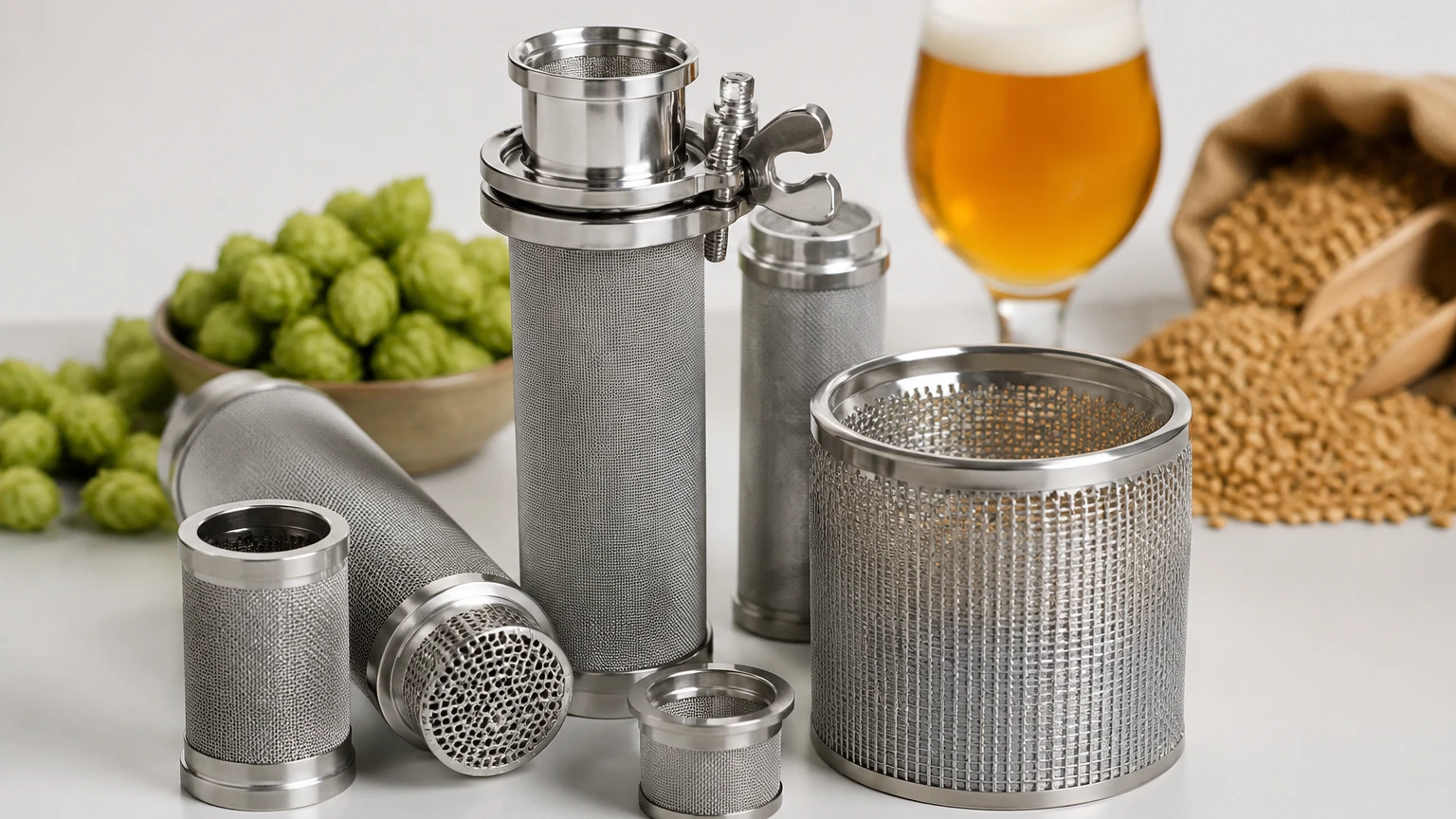
Wire mesh filters are constructed from woven stainless steel wire. They are highly versatile and can be manufactured to precise micron ratings. In brewing, these are often used for hop strainers (hop spiders) or as secondary screens to protect heat exchangers from stray particles. The open area of the mesh determines the flow capacity, and the weave type (such as plain or Dutch weave) dictates the filtration efficiency and mechanical strength.
Wedge Wire Screens
Wedge wire is a specialized filter type used primarily in lauter tuns. It consists of V-shaped profile wires resistance-welded onto support rods. This design creates a non-clogging surface because the gap widens inwardly, allowing particles that pass the initial opening to move freely through the screen. This is essential for efficient wort collection and grain bed support, where preventing a "stuck mash" is a primary concern for the brewer.
Sintered Metal Filters
Sintered filters are created by fusing stainless steel powder or multi-layer wire mesh under high heat and pressure without melting the material. This creates a porous structure with high mechanical strength and precise filtration down to sub-micron levels. Sintered components are frequently used in carbonation stones for CO2 injection or in fine filtration stages where yeast removal or cold-side clarification is required.
Filtration Stages in the Brewing Process
Every stage of the brewing process presents a different challenge for a beer brewing stainless filter. Understanding these stages allows for the correct specification of micron ratings and filter housing designs.
1. Mash and Lautering: In the initial stage, the goal is to separate the liquid wort from the spent grain. The filter media must support the weight of the grain bed while allowing the liquid to pass through at a controlled rate. Wedge wire is the industry standard here due to its high load-bearing capacity and ease of cleaning.
2. Wort Boiling and Whirlpooling: During the boil, proteins and hop resins coagulate (hot break). A filter at this stage—often a mesh screen or a perforated plate—prevents these solids from entering the heat exchanger, where they could cause fouling and reduce cooling efficiency.
3. Fermentation and Maturation: On the "cold side," filtration becomes more delicate. Filters are used to remove yeast cells and protein haze. This often involves multi-stage filtration, starting with a coarser mesh and moving toward finer sintered or pleated stainless steel cartridges.
4. Bright Beer and Packaging: The final filtration stage ensures the beer is visually clear and biologically stable. Precision-engineered stainless steel cartridges are used here to achieve the final polish before the beer is sent to the bright tank or kegging line.
Selection Criteria: Micron Rating and Flow Dynamics
When specifying a beer brewing stainless filter, engineers must prioritize two main factors: filtration accuracy (micron rating) and flow dynamics. The micron rating defines the size of the particles the filter will capture. For example, a 100-micron filter is suitable for removing large hop particles, while a 1-micron filter may be required for yeast removal.
However, a finer micron rating results in a higher pressure drop (Delta P) across the filter. If the pressure drop is too high, it can lead to pump cavitation, reduced flow rates, and potential damage to the filter media itself. To mitigate this, engineers must calculate the total surface area required to maintain the desired flow rate at the specified micron level. Custom-designed filter cartridges often utilize pleated designs to maximize surface area within a compact footprint, allowing for high-efficiency filtration without sacrificing throughput.
Customization and OEM Integration
Industrial brewing systems are rarely "one size fits all." Manufacturers like Kaifil specialize in providing customized filtration solutions that integrate seamlessly into existing brewery infrastructure. Customization options include:
* Fitting Types: Ensuring compatibility with standard Tri-clamp, NPT, or flanged connections commonly used in the food and beverage industry.
* Reinforced Structures: For high-pressure applications, such as filtration in pressurized fermentation vessels, filters can be reinforced with internal cores or external shrouds to prevent collapse.
* Specific Geometries: Custom-shaped filters can be designed to fit into unique vessel shapes or to accommodate specific agitation equipment within the tank.
By working with an OEM manufacturer, brewery engineers can ensure that the filtration components are optimized for their specific recipes and production volumes, rather than relying on generic off-the-shelf parts that may underperform.
Maintenance and CIP Compatibility
One of the primary advantages of a beer brewing stainless filter is its compatibility with Clean-in-Place (CIP) systems. Hygiene is paramount in brewing to prevent microbial contamination that can spoil entire batches. Stainless steel filters are designed to withstand high-velocity cleaning fluids and high temperatures (up to 80°C or higher for caustic cycles).
To maintain the performance of the filter, regular backwashing or ultrasonic cleaning may be required, especially for sintered or fine-mesh components where particles can become deeply embedded. Engineers should also implement a regular inspection schedule to check for signs of mechanical wear, such as wire displacement or weld fatigue. Passivation, a chemical process that restores the protective oxide layer on the surface of the stainless steel, should be performed periodically to ensure the material remains resistant to corrosion.
Evaluating Total Cost and Performance
When procuring filtration equipment, it is essential to look beyond the initial purchase price. The total cost of ownership for a stainless steel filter includes the cost of cleaning chemicals, the labor required for maintenance, and the potential cost of production downtime if a filter fails. Because stainless steel filters are cleanable and reusable, they eliminate the recurring costs associated with disposable cartridges and bags.
Furthermore, the precision of a high-quality stainless filter improves product consistency. By reliably removing unwanted solids and haze-forming proteins, breweries can ensure that every batch meets their quality standards, reducing the risk of product recalls or customer dissatisfaction. For technical professionals seeking to optimize their filtration systems, consulting with a specialized manufacturer can provide insights into the latest material advancements and design configurations.
In conclusion, the beer brewing stainless filter is a cornerstone of professional brewing technology. Whether it is a wedge wire screen in a lauter tun or a precision sintered cartridge in the final stages of packaging, these components ensure the purity and quality of the final product. By understanding the technical requirements of material selection, micron ratings, and maintenance, brewery engineers can implement filtration solutions that enhance operational efficiency and product excellence. For further details on custom manufacturing and industrial filtration options, please refer to the Main Page.
