


Can You Filter Ocean Water
When addressing the question, "can you filter ocean water," the answer depends entirely on the intended end-use and the specific stage of the filtration process. In industrial contexts, ocean water filtration is a multi-step engineering challenge that involves removing suspended solids, biological matter, and dissolved salts. While simple mechanical filtration cannot turn salt water into fresh water, it is a critical prerequisite for desalination and a vital process for industrial cooling, ballast water treatment, and offshore oil and gas operations.
For engineers and procurement specialists, understanding the technical boundaries of seawater filtration is essential for selecting the right equipment. This guide examines the mechanical and chemical requirements for processing ocean water, focusing on the role of high-performance stainless steel filtration components in these demanding environments.
Understanding the Composition of Ocean Water for Industrial Filtration
Before determining how to filter ocean water, one must analyze its constituents. Seawater is a complex solution containing approximately 3.5% dissolved salts (mostly sodium chloride), along with a variety of suspended solids, organic matter, and microorganisms.
Total Dissolved Solids (TDS) vs. Total Suspended Solids (TSS)
Mechanical filtration, such as that provided by wire mesh or sintered metal cartridges, is designed to address Total Suspended Solids (TSS). This includes sand, silt, algae, and micro-plastics. However, mechanical filters cannot remove Total Dissolved Solids (TDS), which are the salts and minerals responsible for the water's salinity. Removing TDS requires membrane-based technologies like Reverse Osmosis (RO) or thermal distillation.
Biological Load and Biofouling
Ocean water is biologically active. It contains bacteria, plankton, and larvae that can quickly colonize the surfaces of filtration equipment. This leads to biofouling, which increases pressure drops and reduces the flow rate across the filter medium. Industrial systems must account for this biological load through specific material choices and maintenance protocols.
The Multi-Stage Process: Can You Filter Ocean Water Effectively?
Filtering ocean water for industrial use is rarely a single-step operation. Instead, it involves a sequence of filtration stages, each designed to protect the subsequent, more sensitive equipment.
Stage 1: Coarse Pre-filtration
The first line of defense is usually a coarse screen or intake filter. These are often large-scale stainless steel wire mesh structures designed to keep out large debris, seaweed, and marine life. The goal here is to protect pumps and downstream piping from catastrophic blockage.
Stage 2: Fine Mechanical Filtration
In this stage, the focus shifts to protecting downstream membranes or precision machinery. This is where stainless steel filter cartridges and precision wire mesh filters are most commonly employed. These filters typically range from 10 to 100 microns. By removing the bulk of the suspended solids, these components extend the life of expensive RO membranes or high-pressure nozzles.
Stage 3: Ultrafiltration and Desalination
To answer the literal interpretation of "can you filter ocean water" for drinking or high-purity industrial use, one must move beyond mechanical filtration. Ultrafiltration (UF) membranes remove viruses and fine colloids, while Reverse Osmosis (RO) membranes remove the dissolved salt ions. These membranes are highly sensitive to fouling, making the efficiency of the mechanical pre-filtration stage (Stage 2) the most critical factor in the system's total cost of ownership.
Material Engineering: Combatting Chloride-Induced Corrosion
The primary challenge in ocean water filtration is the highly corrosive nature of the medium. The high concentration of chloride ions in seawater causes rapid pitting and crevice corrosion in standard carbon steels and even lower-grade stainless steels like 304.
The Role of 316L Stainless Steel
For most seawater applications, 316L stainless steel is the baseline requirement. The addition of molybdenum in 316L provides significantly better resistance to chloride-induced pitting compared to 304. At the Main Page, technical specifications for filtration components often highlight the use of 316L to ensure durability in marine environments.
Advanced Alloys: Duplex and Super Duplex
In environments with high temperatures or stagnant water (where crevice corrosion is more likely), even 316L may reach its limits. In these cases, engineers specify Duplex (e.g., 2205) or Super Duplex stainless steels. These materials offer superior mechanical strength and localized corrosion resistance, which is vital for the structural integrity of fine wire mesh and sintered metal filters used in offshore platforms.
Mechanical Design Factors in Seawater Filter Cartridges
When selecting a filter for ocean water, the mechanical construction is just as important as the material. The filter must withstand the differential pressure caused by salt crystallization and biological buildup.
Pleated vs. Cylindrical Designs
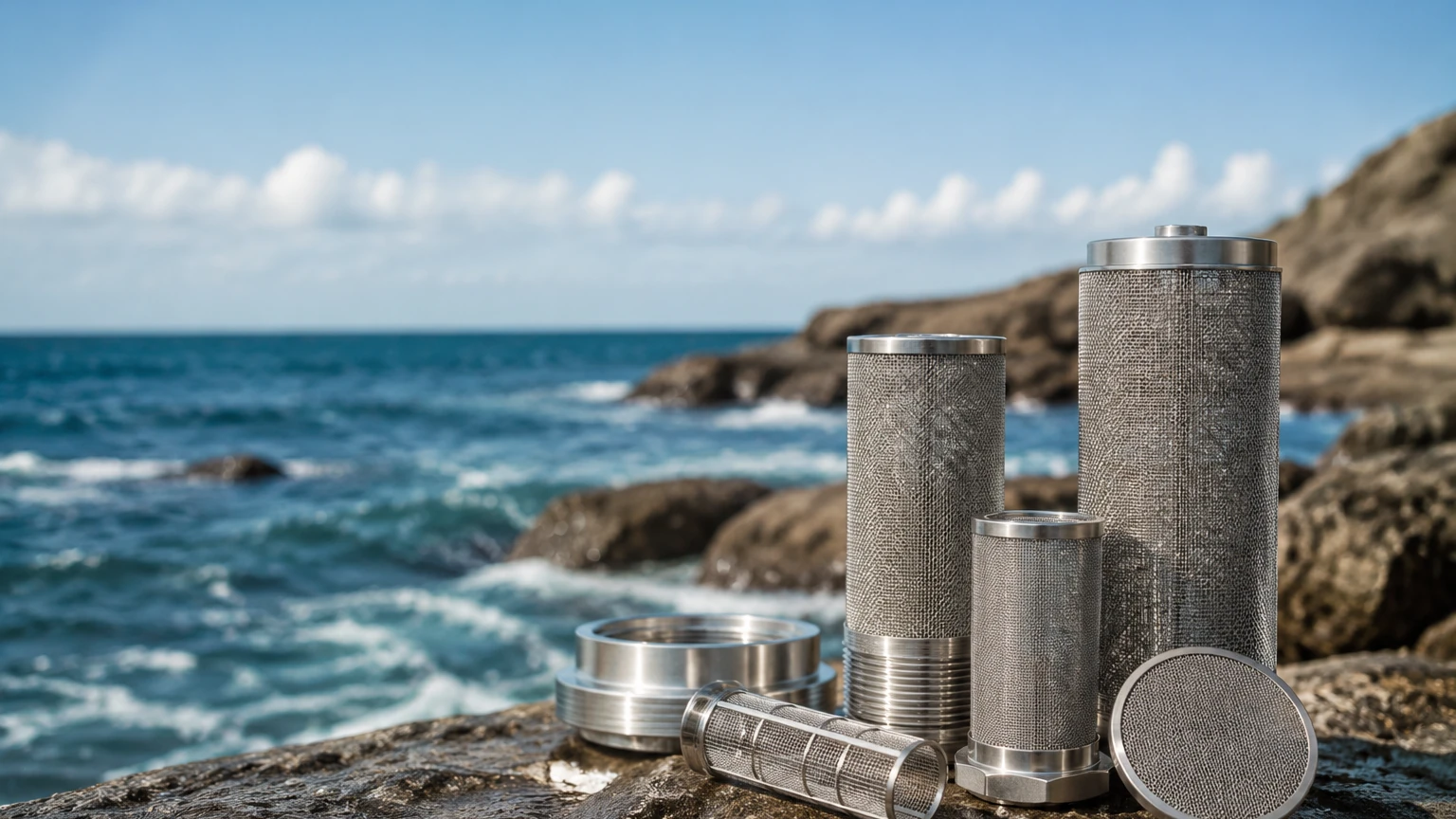
Pleated stainless steel filter cartridges offer a significantly higher surface area than standard cylindrical designs. In seawater applications, a higher surface area means a lower face velocity, which reduces the rate at which particles are forced into the depth of the mesh. This makes the filter easier to clean and extends the time between maintenance cycles.
Sintered Metal Mesh
For high-pressure seawater applications, such as hydraulic systems on ships or offshore rigs, sintered metal mesh provides the necessary structural rigidity. Sintering bonds multiple layers of wire mesh together, creating a robust filter medium that does not migrate or deform under high pressure. This ensures that the filtration accuracy remains consistent even when the filter is heavily loaded with marine debris.
Operational Challenges: Biofouling and Maintenance Cycles
Even the best-designed filter will eventually clog when processing ocean water. The key to industrial efficiency is managing the cleaning cycle.
Backwashing and Cleaning-in-Place (CIP)
Industrial seawater filters are often designed for backwashing, where the flow is reversed to flush out accumulated solids. However, biological slime can be difficult to remove through mechanical backwashing alone. Systems often require Cleaning-in-Place (CIP) protocols using mild acids or biocides to break down organic buildup. The filter material must be chemically compatible with these cleaning agents; this is a primary reason why stainless steel is preferred over plastic or disposable fiber elements in these settings.
Monitoring Differential Pressure
Engineers must monitor the differential pressure (ΔP) across the filter. A sudden spike in ΔP in a seawater system often indicates a biological bloom or a change in current that has stirred up seafloor sediment. Automated systems use these readings to trigger cleaning cycles before the filter reaches its structural limit.
Selection Criteria for Industrial Seawater Pre-filtration Systems
When evaluating "can you filter ocean water" for a specific project, engineers should confirm several variables before finalizing a purchase. These factors directly impact the efficiency and longevity of the filtration system.
1. Micron Rating vs. Flow Rate: There is always a trade-off between how fine a filter is and how much water can pass through it. In seawater intake, over-specifying a fine micron rating can lead to excessive maintenance without providing additional protection for the downstream process.
2. Housing Compatibility: The filter element is only as good as the housing it sits in. Ensure that the seals and gaskets (often Viton or EPDM) are compatible with both seawater and any chemicals used for biofouling control.
3. Total Cost of Ownership (TCO): While stainless steel filters have a higher initial cost than disposable polypropylene filters, their ability to be cleaned and reused multiple times makes them far more cost-effective in long-term seawater applications.
4. Customization Requirements: Standard off-the-shelf filters may not fit the unique piping configurations of marine vessels or offshore platforms. Custom-designed filter cartridges allow for optimized flow paths and easier integration into existing systems.
Conclusion
So, can you filter ocean water? Yes, provided you have a clear understanding of the multi-stage requirements and the harsh chemical environment involved. Mechanical filtration using high-grade stainless steel components is the foundation of any successful seawater processing system. By selecting the correct alloys, such as 316L or Duplex, and utilizing robust designs like sintered or pleated mesh, industrial operators can reliably manage the challenges of salinity and biofouling.
For technical professionals seeking durable, precision-engineered solutions, the choice of filtration partner is critical. High-performance stainless steel filters ensure that whether the goal is desalination, cooling, or equipment protection, the process remains efficient and the equipment stays protected. For more information on custom filtration solutions and material specifications, visit the Main Page to explore professional engineering support for your next water treatment project.
