


Cartridge Filter Housings
In industrial filtration, the cartridge filter housing serves as the critical interface between the raw process fluid and the high-precision filter media. As a pressure vessel designed to contain and direct fluid through filter cartridges, the housing's design, material composition, and structural integrity directly impact the efficiency, safety, and longevity of the entire filtration system. For engineers and procurement specialists in sectors such as chemical processing, pharmaceuticals, and food and beverage, selecting the appropriate cartridge filter housings is a decision that balances hydraulic performance with long-term operational costs.
Kaifil, a specialist in custom stainless steel filtration solutions, emphasizes that a housing is more than just a container; it is an engineered component that must withstand fluctuating pressures, corrosive environments, and stringent hygiene requirements. Understanding the technical nuances of these vessels is essential for optimizing industrial processes.
Understanding the Role of Cartridge Filter Housings in Industrial Systems
Cartridge filter housings are designed to hold one or more filter cartridges, ensuring that all fluid entering the inlet must pass through the filter media before exiting the outlet. This "positive seal" is the most fundamental requirement of any housing. Without a secure seal, fluid can bypass the filter media, leading to downstream contamination and potential equipment failure.
In industrial applications, these housings are integrated into piping systems to remove suspended solids, chemicals, or biological contaminants. The housing must manage the flow dynamics to minimize turbulence and pressure drop ($\\Delta P$). A well-designed housing ensures even distribution of the fluid across the surface of the filter cartridges, preventing localized blinding of the media and extending the service life of the filter elements.
Furthermore, the housing provides the necessary structural support to prevent the filter cartridges from collapsing or shifting under high differential pressures. This is particularly critical in hydraulic systems or high-viscosity chemical processing where pressure spikes are common.
Material Engineering: The Case for Stainless Steel Construction
The choice of material for cartridge filter housings is dictated by the chemical compatibility of the process fluid and the environmental conditions of the facility. While plastic housings may suffice for low-pressure water applications, industrial-grade filtration almost exclusively demands metal construction, specifically stainless steel.
304 Stainless Steel
304 stainless steel is the standard choice for general industrial applications. It offers excellent durability and resistance to oxidation. It is commonly used in water treatment, cooling towers, and pre-filtration for reverse osmosis systems where the fluid is relatively non-corrosive.
316L Stainless Steel
For more demanding environments, 316L stainless steel is the industry benchmark. The addition of molybdenum provides superior resistance to chlorides and acids, making it essential for chemical processing, marine environments, and pharmaceutical manufacturing. The "L" denotes low carbon content, which improves weldability and reduces the risk of intergranular corrosion in the heat-affected zones of the vessel.
Kaifil specializes in utilizing high-grade stainless steel to manufacture housings that meet the rigorous demands of global industrial standards. By focusing on material purity and precision welding, these housings provide a reliable barrier against leakage and structural failure. For more information on material selection and custom filtration components, you can visit the Main Page.
Design Configurations: Single-Round vs. Multi-Round Systems
Cartridge filter housings are generally categorized by the number of cartridges they accommodate, which determines the flow capacity of the system.
Single-Round Housings
Single-round housings contain a single filter cartridge. These are typically used in low-flow applications, pilot plants, or as point-of-use filters. Because of their compact size, they are easy to install in tight spaces and are often used for high-value fluids where minimizing hold-up volume is a priority. They are available in various lengths (typically 10", 20", or 30") to match standard cartridge sizes.
Multi-Round Housings
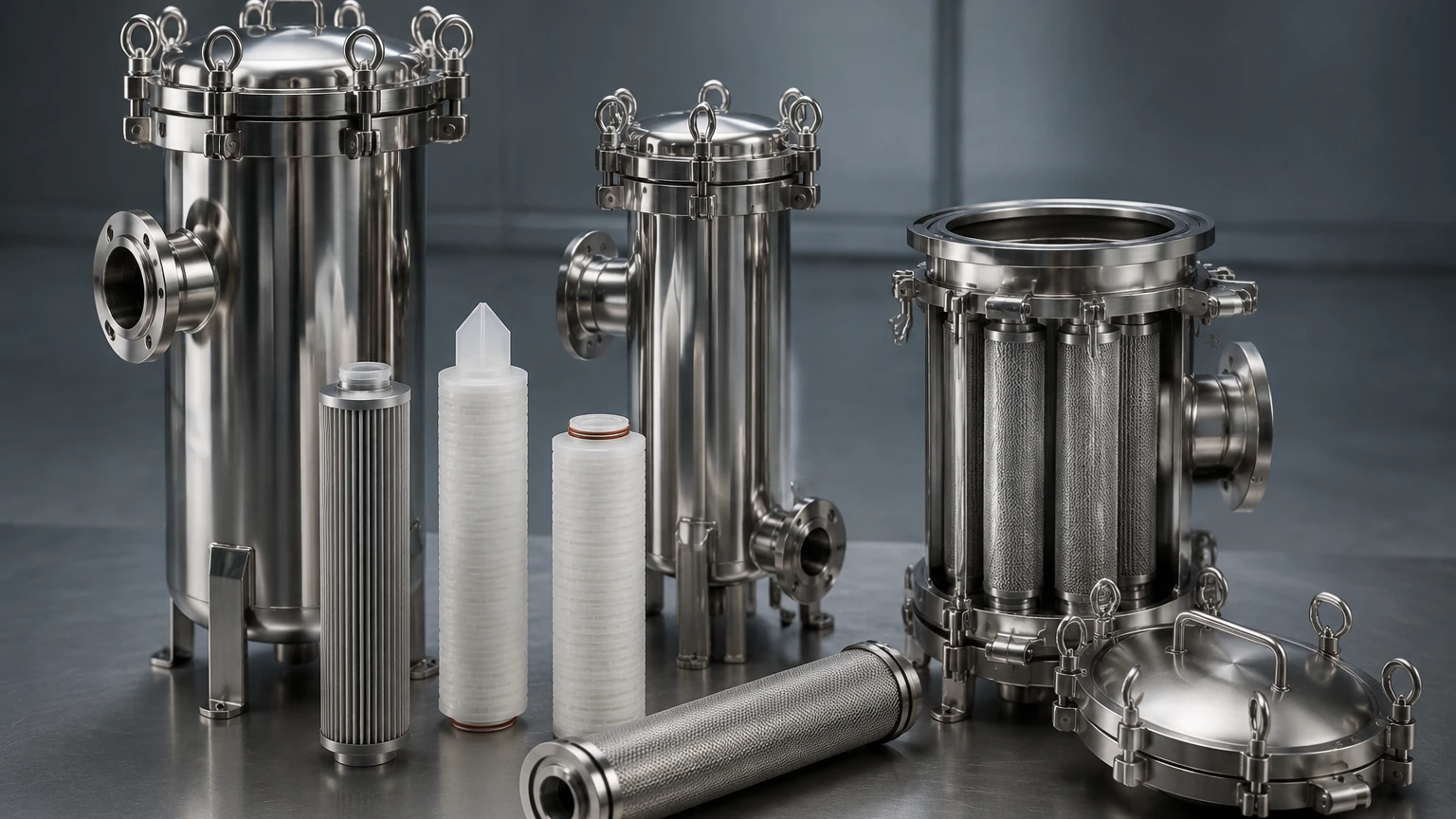
Multi-round housings are designed for high-volume industrial processes. These vessels can hold anywhere from three to over a hundred cartridges. The cartridges are arranged in a circular pattern around a central plenum or distribution plate. Multi-round housings are engineered to handle high flow rates while maintaining a low footprint. Design considerations for these large vessels include heavy-duty swing-bolt closures for frequent cartridge changes and davit arms to assist in lifting heavy lids.
Technical Specifications and Performance Metrics
When evaluating cartridge filter housings, engineers must look beyond physical dimensions and focus on technical performance metrics that ensure system compatibility.
1. Pressure and Temperature Ratings: Every housing must be rated for a maximum allowable working pressure (MAWP) and temperature. It is standard practice to select a housing with a rating at least 20% higher than the maximum expected operating pressure to account for surges.
2. Flow Rate and Pressure Drop: The housing itself contributes to the total pressure drop of the system. Large inlet and outlet ports reduce fluid velocity and turbulence, thereby lowering the initial pressure drop. Engineers should calculate the clean pressure drop of the housing plus the cartridges to ensure the pump capacity is sufficient.
3. Sealing Mechanisms: The interface between the cartridge and the housing is a common point of failure. Housings support different cartridge end-cap configurations, such as Double Open End (DOE) or Single Open End (SOE) with 222 or 226 O-rings. The 226 locking tab design is often preferred for critical applications as it provides a mechanical lock that prevents the cartridge from unseating during back-pressure events.
4. Closure Types: For frequent filter changes, quick-opening closures like V-band clamps or swing bolts are preferred. For high-pressure or hazardous fluid applications, bolted flange closures provide the highest level of security.
Sanitary vs. Industrial Applications: Compliance and Surface Finish
The internal surface finish of a cartridge filter housing is a critical specification, especially in the food, beverage, and pharmaceutical industries.
Industrial Grade
In general industrial settings, a standard pickled or passivated finish is often sufficient. The focus is on structural integrity and corrosion resistance rather than microscopic cleanliness.
Sanitary Grade
Sanitary cartridge filter housings require high-precision polishing, often measured in Ra (Roughness Average). A typical sanitary housing might require an internal polish of <0.8 μm Ra or even electro-polishing to <0.4 μm Ra. This smooth surface prevents bacterial growth and allows for effective Clean-in-Place (CIP) or Steam-in-Place (SIP) sterilization. Sanitary housings also feature tri-clamp connections and are designed without "dead legs" where fluid could stagnate and contaminate the batch.
Maintenance, Safety, and Operational Longevity
To maintain the efficiency of cartridge filter housings, a proactive maintenance schedule is required. The primary indicator for maintenance is the differential pressure ($\\Delta P$).
* Monitoring: Housings should be equipped with upstream and downstream pressure gauges. A significant increase in $\\Delta P$ indicates that the cartridges are loaded with contaminants and need replacement. Conversely, a sudden drop in $\\Delta P$ could indicate a ruptured cartridge or a failed seal within the housing.
* Gasket and O-ring Replacement: Every time a housing is opened for a cartridge change, the cover gasket and cartridge O-rings should be inspected. Common materials include EPDM, Viton, and PTFE-encapsulated silicone. Selecting the right elastomer is vital for preventing leaks and ensuring chemical compatibility.
* Venting and Draining: Proper housing design includes vent valves at the highest point to remove trapped air and drain valves at the lowest point to allow for complete fluid removal before servicing. This is a critical safety step when handling hot or corrosive fluids.
Custom OEM Solutions for Complex Filtration Challenges
Standard off-the-shelf housings do not always meet the specific needs of complex industrial systems. This is where custom manufacturing becomes essential. Factors such as non-standard piping sizes, specific alloy requirements (like Duplex stainless steel or Hastelloy), or unique mounting configurations require a tailored approach.
Kaifil provides comprehensive OEM and customized filtration solutions, working closely with engineering teams to develop housings that fit specific spatial and performance constraints. From material selection to the final filtration accuracy of the internal components, a customized housing ensures that the filtration system is an asset rather than a bottleneck.
By integrating advanced manufacturing capabilities with deep industrial expertise, Kaifil supports the development of precision metal filter components that enhance the reliability of cartridge filter housings in demanding environments. Whether it is a specialized hydraulic application or a large-scale chemical processing plant, the right housing configuration is fundamental to operational success.
Conclusion: Selecting the Right Housing for Your Application
Selecting cartridge filter housings is a multi-faceted engineering task that requires a deep understanding of fluid dynamics, material science, and operational requirements. By prioritizing high-grade stainless steel construction, appropriate pressure ratings, and the correct sealing mechanisms, engineers can ensure that their filtration systems provide consistent performance and protect downstream assets.
When evaluating a housing, always confirm the chemical compatibility of both the vessel and the seals, verify the flow capacity against the expected pressure drop, and consider the ease of maintenance for the operators. With the right selection, a cartridge filter housing becomes a durable, high-performance component of the industrial infrastructure, contributing to product quality and process efficiency for years to come. For those seeking reliable, custom-engineered filtration components, reviewing product options and application support on the Main Page is the first step toward an optimized filtration solution.
