


Cyclonic Filtration System
In the landscape of industrial fluid management, the cyclonic filtration system stands as a fundamental technology for the primary separation of solids from liquids or gases. For engineers and procurement professionals tasked with optimizing process efficiency, understanding the mechanics, limitations, and integration of cyclonic separators is essential. While these systems are highly effective at removing bulk contaminants, their performance is often maximized when paired with secondary precision components, such as the stainless steel wire mesh filters and cartridges manufactured by Kaifil.
This guide examines the engineering principles of cyclonic filtration, provides technical criteria for system selection, and explores how these systems interface with high-performance metal filtration media to ensure long-term operational stability in demanding B2B environments.
The Engineering Principles of Cyclonic Separation
A cyclonic filtration system, often referred to as a hydrocyclone (for liquids) or a cyclone separator (for gases), operates on the principle of centrifugal sedimentation. Unlike barrier filtration, which uses a physical medium to intercept particles, a cyclone utilizes fluid dynamics to achieve separation based on density and particle size.
The Vortex Mechanism
The process begins when the contaminated fluid enters the cylindrical chamber tangentially at high velocity. This tangential entry forces the fluid into a rapid rotational motion, creating a primary vortex that spirals downward toward the conical section of the unit. As the fluid rotates, centrifugal force acts upon the suspended particles. Particles with a higher density than the carrier fluid are flung outward toward the inner wall of the cyclone.
Particle Precipitation and Discharge
Once the particles strike the wall, they lose kinetic energy and slide down the conical section into a collection chamber or underflow discharge point. Meanwhile, the fluid, now stripped of heavier solids, reaches the bottom of the cone and reverses direction. It forms a secondary, narrower vortex that travels upward through the center of the chamber, exiting through a "vortex finder" at the top. This clean fluid is then directed to the next stage of the process or recirculated.
Key Performance Metrics for Engineers
When evaluating a cyclonic filtration system for an industrial application, several technical parameters must be analyzed to ensure the equipment meets the required filtration efficiency without compromising system hydraulics.
1. The Cut Point (d50)
The cut point is perhaps the most critical metric in cyclonic separation. It represents the particle size at which 50% of the particles are separated and 50% remain in the overflow. A lower d50 indicates a higher separation efficiency for finer particles. This value is influenced by the cyclone's diameter, the fluid's viscosity, and the pressure drop across the system.
2. Pressure Drop (ΔP)
Cyclonic systems are passive in terms of moving parts but require significant fluid energy to maintain the vortex. The pressure drop—the difference between the inlet and outlet pressure—is a direct indicator of the energy consumed. Engineers must balance the desire for high-efficiency separation (which usually requires higher velocities and thus higher ΔP) against the operational costs and pump capacities.
3. Flow Rate Stability
Cyclones are sensitive to fluctuations in flow. If the flow rate drops below the design threshold, the centrifugal force diminishes, leading to a rapid decrease in separation efficiency. Conversely, exceeding the design flow rate can cause excessive turbulence and premature wear of the internal surfaces.
Material Selection and Structural Integrity
Industrial filtration environments are frequently characterized by abrasive solids, corrosive chemicals, and high temperatures. Therefore, the material of construction for both the cyclonic body and the downstream filtration components is a primary concern.
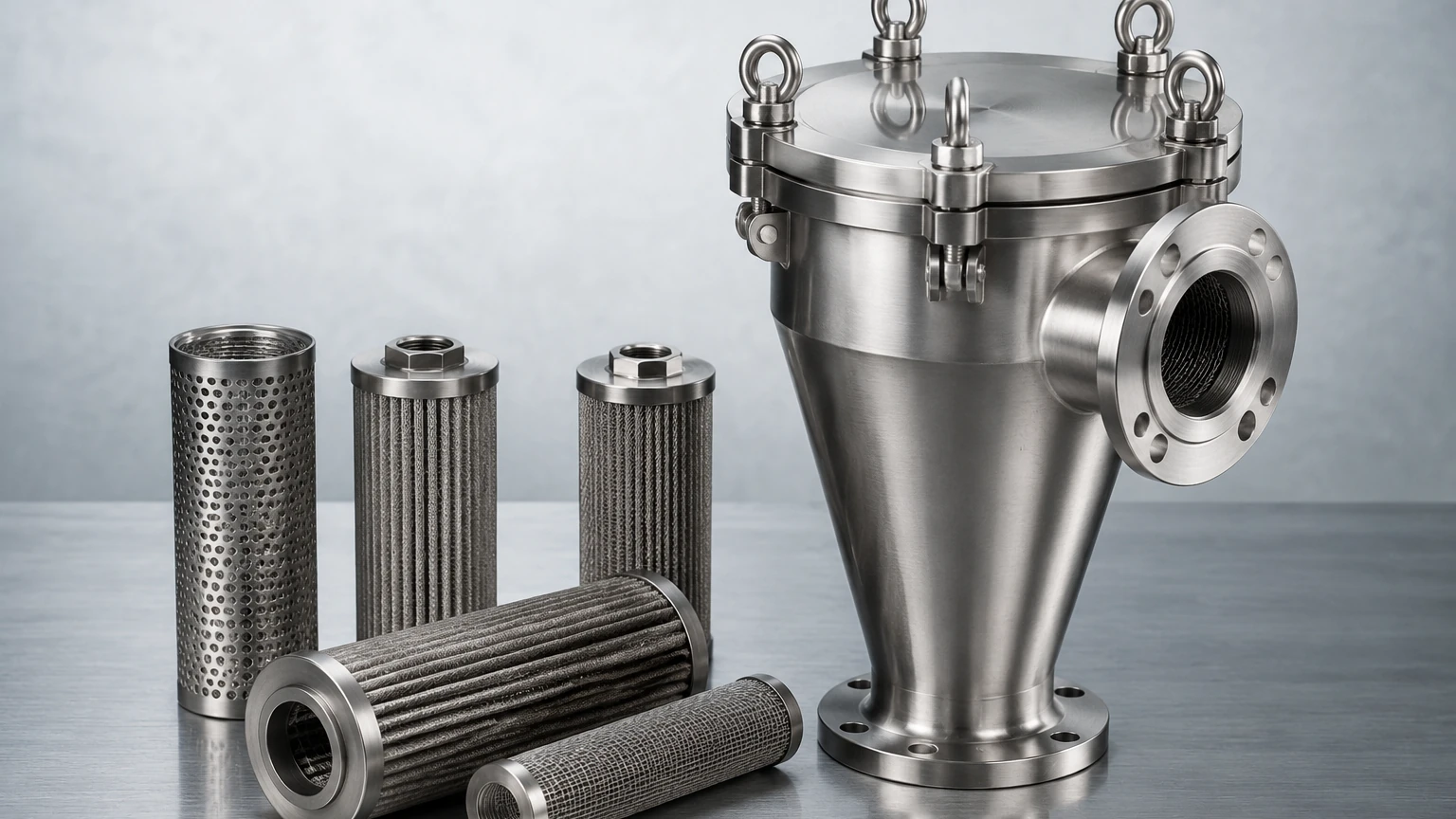
Kaifil specializes in custom stainless steel filtration solutions that complement these systems. In many cyclonic applications, the internal surfaces are subjected to constant impingement by abrasive particles. Utilizing high-grade stainless steel, such as 304 or 316L, provides the necessary oxidation resistance and structural strength. For more aggressive chemical environments, specialized alloys or surface treatments may be required to prevent pitting and stress corrosion cracking.
When selecting materials, engineers should confirm:
- Chemical Compatibility: Does the fluid pH or chemical composition react with the metal?
- Temperature Ratings: Will the system maintain its seal and structural integrity at peak operating temperatures?
- Abrasive Resistance: Are the solids particularly hard (e.g., sand, metal shavings), requiring hardened stainless steel or sacrificial liners?
Integrating Cyclones with Precision Stainless Steel Filters
A cyclonic filtration system is rarely used in isolation for high-purity applications. While excellent at removing 90% or more of heavy solids, cyclones struggle with neutrally buoyant particles or those smaller than 5-10 microns. This is where the synergy between cyclonic pre-filtration and precision metal filtration becomes vital.
Protecting Downstream Media
By removing the bulk of the solid load, a cyclonic separator significantly reduces the "cake" formation on downstream stainless steel filter cartridges. This extension of the secondary filter's life cycle reduces maintenance frequency and lowers the total cost of ownership. For instance, in a hydraulic system, a cyclone might remove large metallic debris, while a Kaifil precision wire mesh filter captures the fine silt that could otherwise damage sensitive valves.
Redundancy and Safety
In critical processes, such as pharmaceutical or food and beverage production, the cyclonic system acts as a buffer. If a process upset occurs and a large volume of solids is suddenly introduced, the cyclone prevents the precision filters from blinding instantly, allowing for a controlled shutdown or bypass.
To explore how precision components can be integrated into your existing infrastructure, you can Review product options and application support on the Kaifil Main Page.
Common Risks and Mitigation Strategies
Despite their reliability, cyclonic filtration systems face specific operational risks that must be managed through proper design and maintenance.
1. Air Ingress and Cavitation
If air is drawn into the system through the underflow or inlet, it can disrupt the vortex stability. This leads to "short-circuiting," where contaminated fluid bypasses the separation zone and exits through the overflow. Ensuring airtight seals and proper venting is essential.
2. Erosion and Wear
The high-velocity nature of the vortex means that the bottom of the conical section and the vortex finder are prone to erosion. Regular ultrasonic thickness testing of the housing is recommended for systems handling abrasive slurries. Using high-quality stainless steel components ensures that the wear is predictable and manageable.
3. Particle Re-entrainment
If the collection chamber (underflow) becomes too full, the primary vortex can stir up the collected solids and carry them back into the clean fluid stream. Automated discharge valves or continuous flow underflows are often used to mitigate this risk.
Selection Guide: Questions for Purchasing Teams
Before finalizing a purchase for a cyclonic filtration system or the associated stainless steel filter elements, procurement teams should confirm the following data points with their technical partners:
1. What is the specific gravity of the solids versus the fluid? (The greater the difference, the more efficient the cyclone).
2. What is the required filtration accuracy (micron rating) for the final effluent? (This determines if a cyclone is sufficient or if a secondary stainless steel cartridge is mandatory).
3. What are the space constraints? (Cyclones are typically vertical and require significant head height).
4. Is customization required for inlet/outlet configurations? (Standard units may not fit existing piping, requiring OEM solutions).
Applications Across Key Industries
Chemical Processing
In chemical manufacturing, cyclonic systems are used for catalyst recovery and the removal of precipitates from corrosive liquors. The use of 316L stainless steel mesh in subsequent stages ensures that even the finest catalyst fines are recovered, protecting both the product purity and the environment.
Food and Beverage
Cyclones are employed to remove sand and grit from wash water in vegetable processing or to separate pulp in juice production. Because these applications require strict adherence to hygiene standards, the smooth, non-porous surfaces of stainless steel filtration components are non-negotiable to prevent bacterial growth.
Hydraulic and Cooling Systems
In large-scale industrial cooling towers or hydraulic power units, cyclonic filtration removes scale and metal particles. This protects heat exchangers from fouling and prevents premature wear on pumps and actuators. The durability of metal filter elements ensures they can withstand the high pressures common in these systems.
Conclusion
The cyclonic filtration system is a workhorse of industrial separation, offering a robust, low-maintenance solution for high-volume solids removal. However, the true efficiency of a filtration circuit lies in the intelligent combination of technologies. By utilizing a cyclone as a primary separator and high-precision stainless steel wire mesh filters as a secondary stage, engineers can achieve superior fluid clarity while protecting their equipment from wear and clogging.
As a professional manufacturer, Kaifil provides the technical expertise and customized stainless steel components necessary to optimize these systems. Whether you are designing a new process or retrofitting an existing line, focusing on material quality, filtration accuracy, and system synergy will ensure reliable performance in the most demanding industrial environments.
