


Filter Bag Supplier
In industrial liquid and gas filtration, the selection of a filter bag supplier is a decision that impacts not only the clarity of the final product but also the operational efficiency and maintenance costs of the entire facility. Bag filtration is one of the most versatile and cost-effective methods for removing particulates from process streams. However, the performance of these systems is heavily dependent on the technical specifications of the media, the precision of the bag construction, and the supplier's ability to match the filter to specific chemical and thermal environments.
For engineers and procurement teams, identifying a reliable supplier requires a deep understanding of filtration mechanics, material science, and the engineering tolerances required for high-pressure or high-temperature applications. This guide examines the technical criteria for evaluating suppliers and the engineering considerations necessary for optimizing filtration performance.
The Role of a Filter Bag Supplier in Industrial Processes
A professional filter bag supplier does more than provide a consumable product; they act as a technical partner in process optimization. In sectors such as chemical processing, food and beverage, and water treatment, the filter bag is often the primary defense against contamination or the final step in product polishing.
When evaluating a supplier, it is essential to look beyond the unit price. A supplier must demonstrate expertise in how different media—such as needle felt, monofilament mesh, and multifilament mesh—interact with various fluids. For instance, in the pharmaceutical industry, the supplier must ensure that the media is free of silicone and other lubricants that could leach into the process stream. In hydraulic applications, the focus shifts to the mechanical strength of the bag to withstand sudden pressure surges without rupturing or bypassing.
Technical Media Selection: Balancing Material and Micron Rating
The core of any filter bag is the media. A competent filter bag supplier should offer a range of materials tailored to specific chemical compatibilities and temperature ranges. The most common materials include:
* Polypropylene (PP): Excellent for aqueous solutions and most acids and alkalis. It has a relatively low temperature limit (typically around 90°C/194°F) but offers high chemical resistance and is generally the most cost-effective option.
* Polyester (PE): Preferred for higher temperature applications (up to 150°C/302°F) and provides good resistance to most oxidizing agents and solvents, though it is susceptible to hydrolysis in the presence of steam or strong acids.
* Nylon Monofilament: Ideal for precise straining applications where a consistent pore size is required. It is often used in the food and beverage industry due to its high strength and lack of fiber migration.
* PTFE and Nomex: Reserved for extreme thermal environments or highly aggressive chemical processes where standard polymers would fail.
Beyond material, the supplier must define the micron rating as either nominal or absolute. Nominal ratings indicate the ability to trap a percentage of particles of a certain size, whereas absolute ratings (often achieved through high-performance felt or multi-layered designs) ensure that no particles above a specific size pass through. Understanding this distinction is critical for engineers who must meet strict downstream purity standards.
Engineering Specifications for Bag Filter Housing Compatibility
A common point of failure in industrial filtration is not the media itself, but the seal between the bag and the housing. A filter bag supplier must provide components that adhere to strict dimensional tolerances to prevent "bypass," where unfiltered fluid escapes around the edges of the bag.
Ring and Flange Designs
Suppliers typically offer several top-ring configurations:
1. Snap-Band Rings: Usually made of carbon steel or stainless steel, these rely on mechanical tension to seal against the housing's internal rim.
2. Plastic Flanges (Sentinel or Polyloc style): These use a pressure-activated bypass-free seal. As the differential pressure increases, the seal becomes tighter, which is critical for high-purity applications.
3. Drawstring Tops: Generally used in low-pressure, gravity-fed systems where a perfect seal is less critical.
Dimensional Accuracy
Standard industrial sizes (Size #1, #2, #3, and #4) are the industry norm, but custom housings often require bespoke dimensions. A supplier with in-house manufacturing capabilities can provide custom lengths and diameters to ensure a snug fit in older or proprietary housing units. This precision prevents the bag from stretching or sagging, which can lead to premature failure or uneven cake buildup.
Evaluating Quality and Compliance in Filtration Manufacturing
Quality assurance is the differentiator between a commodity vendor and a strategic filter bag supplier. For B2B buyers, verifying the supplier’s manufacturing standards is a non-negotiable step in the procurement process.
Key quality indicators include:
* Material Traceability: Can the supplier provide batch-specific data for the raw fibers and resins used? This is essential for industries governed by FDA or EU food contact regulations.
* Construction Methods: For felt bags, welded seams are generally superior to sewn seams. Sewn seams create needle holes that can allow particulate bypass, whereas ultrasonic or thermal welding creates a continuous, leak-proof bond.
* Fiber Migration Control: High-quality suppliers use singed or glazed surface treatments on felt bags to prevent loose fibers from entering the filtrate, a common issue in lower-grade products.
Furthermore, the supplier should offer technical documentation, including chemical compatibility charts and flow rate vs. pressure drop (ΔP) graphs. This data allows engineers to calculate the required number of filter housings and the expected frequency of bag changes.
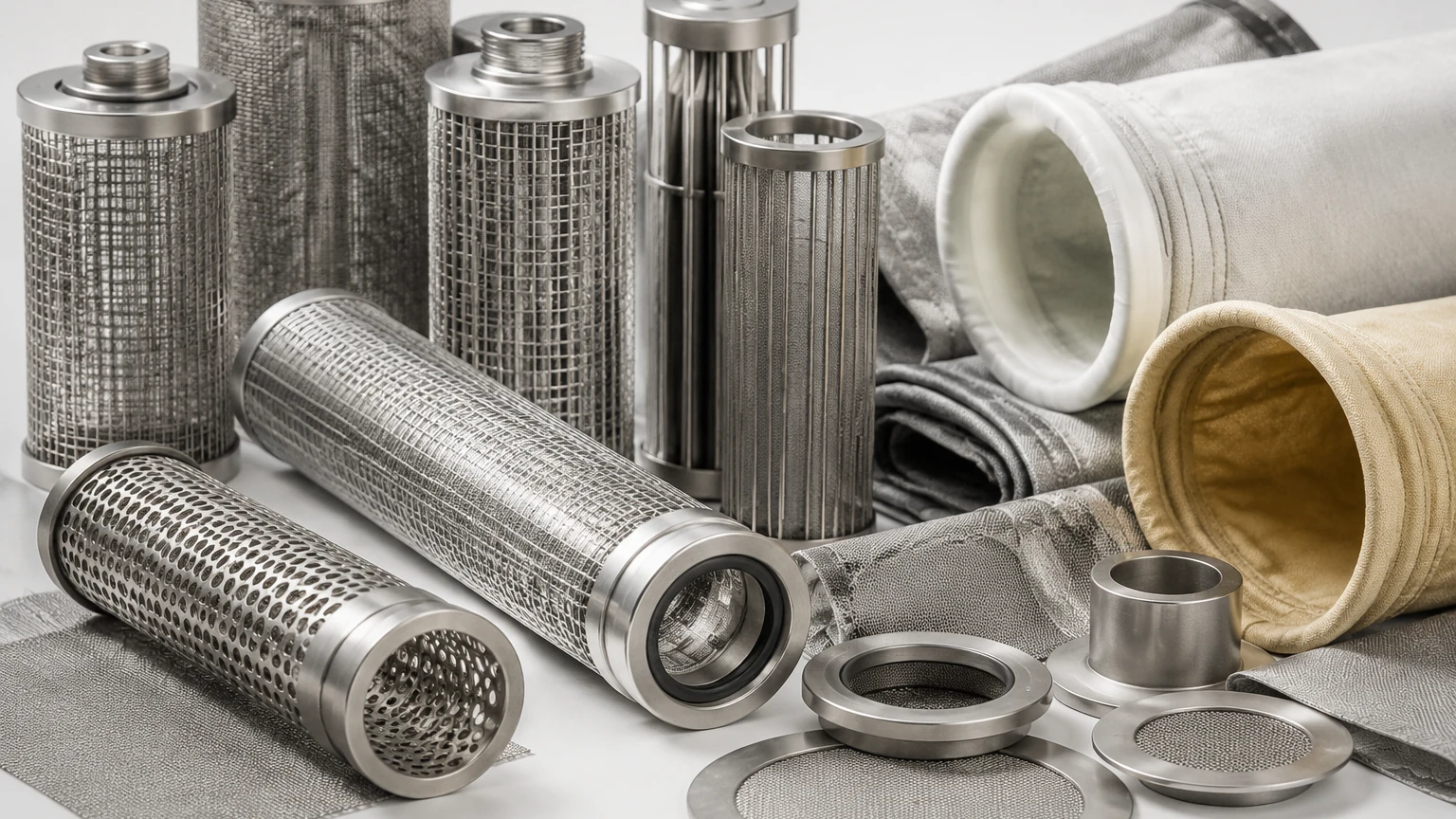
Transitioning from Disposable Bags to Permanent Stainless Steel Solutions
While traditional fabric filter bags are effective, many industrial applications are moving toward more durable solutions. As a professional manufacturer specializing in custom stainless steel filtration, Kaifil provides alternatives that bridge the gap between disposable bags and high-performance metal elements.
In environments characterized by high temperatures, high pressures, or aggressive solvents, fabric bags often require frequent replacement, leading to significant downtime and waste. Stainless steel wire mesh filters and precision metal components offer a reusable, cleanable alternative that fits into existing bag filter housings. These metal elements provide absolute filtration ratings and can be ultrasonically cleaned, significantly reducing the total cost of ownership over the life of the equipment.
Engineers looking to optimize their systems often consult the Main Page to explore how stainless steel mesh can replace or supplement traditional bag media in demanding environments. The transition to metal filtration is particularly beneficial in the chemical and hydraulic sectors, where the structural integrity of the filter medium is paramount.
Total Cost of Ownership: Beyond the Initial Purchase Price
A common mistake in procurement is selecting a filter bag supplier based solely on the lowest price per unit. A comprehensive analysis of the Total Cost of Ownership (TCO) often reveals that higher-quality filters are more economical.
Factors that influence TCO include:
1. Change-out Frequency: A bag that lasts twice as long due to better depth-loading characteristics reduces labor costs and process downtime.
2. Disposal Costs: In many regions, the cost of disposing of contaminated filter bags (especially those used with hazardous chemicals) can exceed the purchase price of the bag itself.
3. Product Loss: Bags that are prone to bursting or bypassing can result in contaminated batches, leading to expensive rework or product loss.
4. Energy Consumption: High-quality media with a lower initial pressure drop reduces the load on pumps, leading to measurable energy savings over time.
By working with a supplier that provides technical support and performance guarantees, companies can move from a reactive maintenance model to a proactive one, where filter changes are scheduled based on predictable pressure drop curves rather than unexpected failures.
Critical Questions for Potential Suppliers
Before finalizing a contract with a filter bag supplier, technical teams should confirm the following:
* What is the maximum differential pressure the bag can withstand before the risk of fiber migration or structural failure?
* Are the micron ratings tested according to industry standards (such as the multi-pass test)?
* Can the supplier provide custom configurations for non-standard housings or unique chemical environments?
* What technical support is available for troubleshooting filtration issues, such as premature blinding or high turbidity in the filtrate?
A supplier’s ability to answer these questions with technical data rather than marketing claims is a strong indicator of their engineering competence.
Conclusion
Selecting a filter bag supplier is a critical engineering decision that affects the reliability and cost-effectiveness of industrial processes. By focusing on material science, seal integrity, and manufacturing quality, procurement teams can ensure they receive products that meet the rigorous demands of modern industry. While disposable bags remain a staple of liquid filtration, the integration of advanced metal filtration components—such as those developed by Kaifil—represents the next step in achieving high-performance, sustainable filtration. Whether utilizing fabric or stainless steel, the goal remains the same: precise, reliable, and efficient separation that protects downstream equipment and ensures product quality.
