


Cartridge Filter Pvdf
In the landscape of industrial liquid and gas processing, the selection of filtration media is a critical engineering decision that impacts product purity, equipment longevity, and operational safety. Among the various high-performance polymers used in filtration, Polyvinylidene Fluoride (PVDF) stands out for its unique combination of chemical resistance, thermal stability, and mechanical toughness. A cartridge filter PVDF is often the primary choice for demanding applications in the pharmaceutical, semiconductor, and chemical processing industries where standard polymers like polypropylene or polyester may fail due to chemical degradation or thermal stress.
For engineers and procurement professionals, understanding the technical nuances of PVDF media—ranging from its surface energy characteristics to its compatibility with aggressive solvents—is essential. While Kaifil specializes in custom stainless steel filtration solutions, providing a comprehensive technical overview of polymer-based options like PVDF allows for a better understanding of the broader filtration ecosystem and helps in determining when a metallic solution or a specialized polymer solution is most appropriate for a given process.
Technical Properties of PVDF in Filtration Media
PVDF is a highly non-reactive thermoplastic fluoropolymer. Its molecular structure, characterized by alternating units of CH2 and CF2, provides a balance of high electronegativity and strong carbon-fluorine bonds. This chemical architecture yields several properties that are vital for industrial filtration.
Chemical Resistance and Inertness
One of the primary reasons for selecting a cartridge filter PVDF is its broad chemical compatibility. It is resistant to most mineral and organic acids, aliphatic and aromatic hydrocarbons, and oxidizing agents like ozone and chlorine. Unlike many other polymers, PVDF maintains its structural integrity when exposed to aggressive solvents such as alcohols and halogenated hydrocarbons. This makes it a staple in chemical transfer lines and fine chemical manufacturing.
Thermal and Mechanical Stability
PVDF retains its mechanical properties at elevated temperatures, typically up to 140°C (284°F) in continuous use, depending on the pressure and the specific grade of the resin. This thermal ceiling is significantly higher than that of polypropylene. Furthermore, PVDF exhibits excellent fatigue resistance and high tensile strength, which is critical for cartridge filters that must withstand repeated pressure pulses and differential pressure fluctuations during the filtration cycle.
Surface Energy: Hydrophobic vs. Hydrophilic
In its natural state, PVDF is highly hydrophobic. This makes it an excellent choice for gas filtration, tank venting, and the filtration of non-aqueous solvents. However, for aqueous applications, PVDF membranes are often surface-modified to become permanently hydrophilic. This modification allows the membrane to be wetted by water spontaneously, facilitating high flow rates at low differential pressures without the need for pre-wetting with alcohols.
Structural Design of PVDF Cartridge Filters
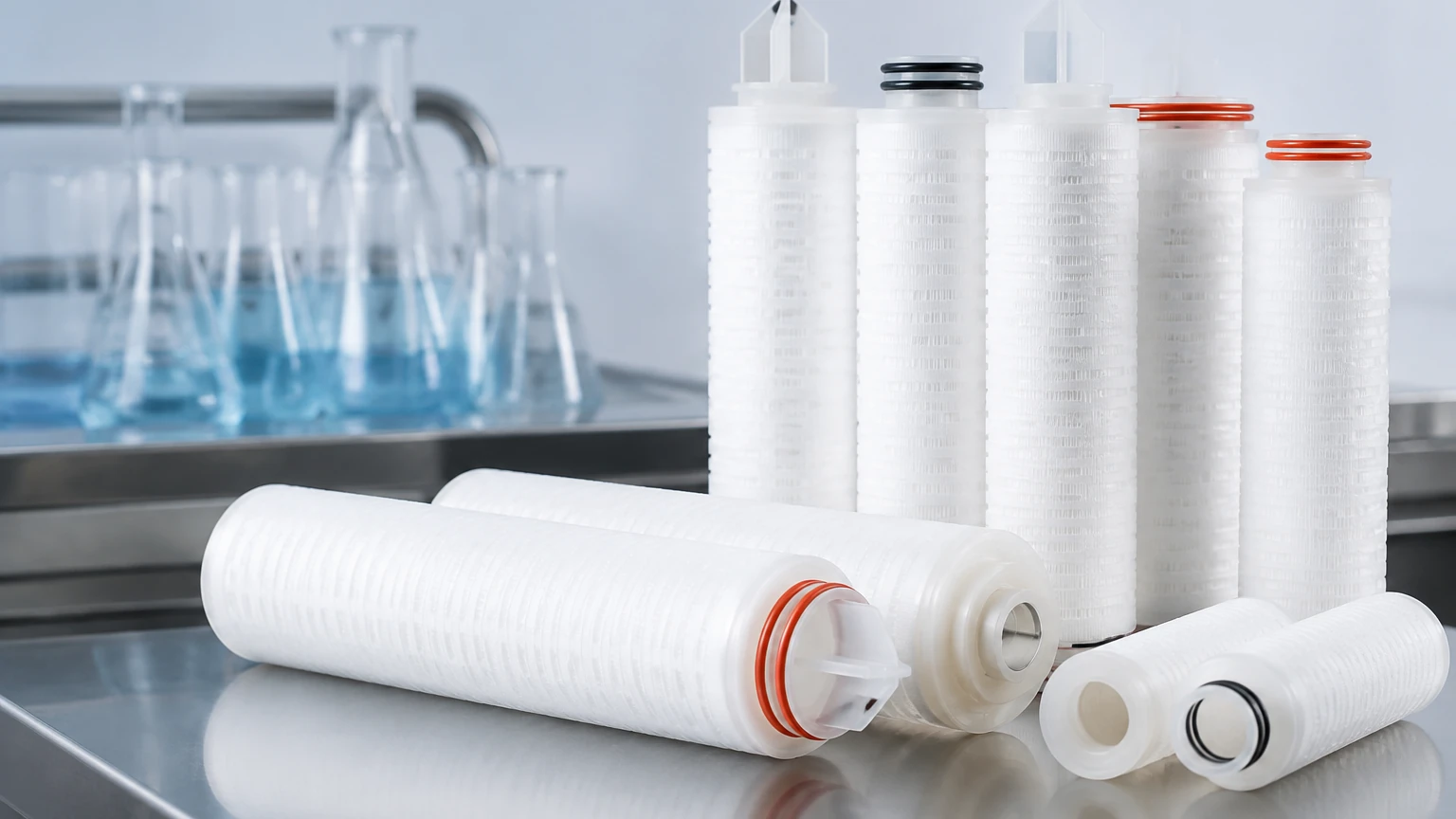
The performance of a cartridge filter PVDF is not solely dependent on the material but also on its physical construction. Most industrial PVDF filters utilize a pleated membrane design to maximize the effective filtration area (EFA) within a standard cartridge footprint.
Membrane Morphology
PVDF membranes are typically produced through a phase-inversion process, which allows for precise control over the pore size distribution. These membranes often feature an asymmetric structure, where the pore size gradually decreases from the upstream side to the downstream side. This design acts as a built-in pre-filter, capturing larger particles on the surface while the finer internal matrix provides the final rated retention. This morphology significantly extends the service life of the cartridge compared to symmetric membranes.
Support and Hardware Components
While the membrane is the functional core, the cartridge includes several other components:
* Core and Cage: Usually made of reinforced polypropylene or, in high-temperature versions, PVDF or stainless steel. These provide the structural cage to prevent the pleat pack from collapsing under pressure.
* Support Layers: Non-woven layers (often polyester or polypropylene) are placed on both sides of the PVDF membrane to protect it from mechanical abrasion and to ensure uniform flow distribution across the pleats.
* End Caps and Adapters: These are thermally bonded to the pleat pack to ensure a bypass-free seal. Common configurations include Code 7 (226 O-ring/fin) and Code 3 (222 O-ring/flat), ensuring compatibility with standard industrial filter housings.
Engineering Selection Criteria
When specifying a cartridge filter PVDF, engineers must evaluate several performance metrics to ensure the component meets the specific requirements of the process.
Micron Rating and Retention Efficiency
PVDF filters are typically available in ratings from 0.1 μm to 1.0 μm. It is important to distinguish between "nominal" and "absolute" ratings. An absolute-rated PVDF membrane provides a defined retention efficiency (often 99.9% or higher) for a specific particle size, which is critical for sterile filtration or high-purity chemical processing. For pharmaceutical applications, these filters are often validated for bacterial retention using organisms like *Brevundimonas diminuta*.
Flow Rate and Differential Pressure
The relationship between flow rate and differential pressure (ΔP) is a key design consideration. A high EFA (Effective Filtration Area) reduces the flux (flow per unit area), which in turn lowers the initial ΔP and extends the time until the terminal ΔP is reached. Engineers should consult flow-versus-pressure drop curves provided by the manufacturer to size the housing and pump systems correctly.
Extractables and Purity
In the semiconductor and pharmaceutical sectors, the level of extractables—substances that can leach from the filter into the process fluid—is a major concern. PVDF is favored because it is inherently low in extractables, including metal ions and organic compounds. Many PVDF cartridges are manufactured in cleanroom environments and flushed with high-purity water to ensure they meet stringent TOC (Total Organic Carbon) and conductivity requirements upon installation.
Comparing PVDF with Stainless Steel Filtration
As a manufacturer of stainless steel filtration solutions, Kaifil recognizes that material selection is often a trade-off between chemical specificity and mechanical durability. While a cartridge filter PVDF offers excellent resistance to certain acids, stainless steel filters provide distinct advantages in other industrial scenarios.
| Feature | PVDF Cartridge Filter | Stainless Steel Filter (Kaifil) |
| :— | :— | :— |
| Temperature Limit | Up to 140°C | Up to 600°C+ (depending on alloy) |
| Pressure Resistance | Moderate (limited by polymer housing) | Very High (suitable for high-pressure hydraulics) |
| Cleanability | Limited (usually disposable) | Excellent (backwashable, ultrasonic cleaning) |
| Chemical Resistance | High (Acids, Solvents) | High (Corrosion-resistant alloys like 316L) |
| Initial Cost | Lower | Higher |
| Lifecycle Cost | Higher (due to frequent replacement) | Lower (due to reusability) |
For applications involving extreme temperatures, high viscosity fluids, or where the ability to clean and reuse the filter is paramount, stainless steel is often the superior choice. However, for single-use pharmaceutical batches or highly specific solvent filtrations where metal ion contamination must be zero, PVDF remains a critical tool. For more information on durable metal filtration options, you can visit the Main Page of our technical resource site.
Applications in High-Purity and Corrosive Environments
The unique properties of PVDF make it indispensable in several specialized sectors:
Pharmaceutical and Biotechnology
In the production of Active Pharmaceutical Ingredients (APIs), PVDF membranes are used for the filtration of aggressive solvents and for sterile air venting of fermentation tanks. Their ability to withstand repeated autoclaving or In-Situ Steam (SIP) sterilization cycles without losing integrity is a significant advantage.
Semiconductor Manufacturing
The electronics industry requires ultra-pure chemicals and deionized water. PVDF filters are used to remove sub-micron particles from photoresists, etchants, and cleaning solvents. The low extractable profile ensures that the delicate circuitry of microchips is not contaminated by leached ions.
Food and Beverage
While less common than polypropylene in general food applications, PVDF is used in the filtration of highly acidic fruit juices or in processes that involve aggressive CIP (Clean-In-Place) chemicals like ozone or concentrated peracetic acid, which might degrade lesser polymers.
Maintenance, Integrity Testing, and Replacement
To ensure the continued performance of a cartridge filter PVDF, rigorous maintenance and monitoring protocols must be established.
Integrity Testing
For critical applications, especially sterile filtration, the integrity of the PVDF membrane must be verified before and after use. The most common methods include:
* Bubble Point Test: Measures the minimum pressure required to force air through a liquid-wetted membrane. A drop in the bubble point indicates a breach in the membrane or a seal failure.
* Diffusion Flow Test: Measures the rate of gas diffusion through a wetted membrane at a pressure below the bubble point. Excessive flow suggests damaged pores or thinning of the membrane.
Monitoring Differential Pressure
The most practical way to determine the end of a filter's life is by monitoring the differential pressure across the housing. As the membrane pores become loaded with contaminants, ΔP increases. Manufacturers typically specify a "terminal differential pressure" (often around 2.0 to 2.5 bar at ambient temperature), beyond which the filter should be replaced to prevent structural failure or particle unloading.
Storage and Handling
PVDF filters should be stored in their original packaging in a cool, dry environment away from direct sunlight (UV exposure). When installing, it is vital to ensure that O-rings are properly lubricated with a process-compatible fluid to prevent galling or bypass leaks. Handling should be done with gloves to prevent skin oils from contaminating the high-purity media.
Conclusion
The cartridge filter PVDF is a sophisticated component designed for environments where standard filtration materials reach their chemical and thermal limits. By leveraging the inherent properties of Polyvinylidene Fluoride, these filters provide a reliable barrier against contaminants in some of the world's most sensitive industrial processes.
When selecting a filtration solution, engineers must weigh the benefits of polymer membranes against the long-term durability and reusability of metallic options. Whether the application calls for the high-purity capabilities of PVDF or the rugged, high-temperature performance of stainless steel, a deep understanding of material science and mechanical design is the foundation of an efficient process. For organizations seeking to optimize their industrial filtration systems with custom-engineered metal components, exploring the options available at Main Page can provide the technical clarity needed to make an informed investment.
