


Stainless Steel Sintered Filters
In the landscape of industrial filtration, the demand for components that can withstand extreme temperatures, corrosive environments, and high-pressure differentials is constant. Stainless steel sintered filters represent a pinnacle of engineering in this field, offering a robust alternative to disposable polymer-based filters and less durable mesh screens. These components are not merely filters; they are precision-engineered porous structures designed to provide consistent performance over long operational lifecycles. For engineers and procurement teams, understanding the technical nuances of these filters is essential for optimizing system efficiency and reducing the total cost of ownership.
As a professional manufacturer, Kaifil specializes in custom stainless steel filtration solutions, providing the technical expertise required to navigate the complexities of material selection and design. For more information on specific capabilities, you can visit the Main Page to review product options and application support.
Understanding the Sintering Process and Material Science
The performance of stainless steel sintered filters is rooted in the sintering process itself. Sintering is a thermal treatment that fuses metallic particles or wire mesh layers together at temperatures below their melting point. This process relies on solid-state diffusion, where atoms migrate across the boundaries of the particles, creating "necks" that bond the material into a rigid, porous structure.
Material Selection: 304 vs. 316L
While various alloys can be sintered, the industrial standard typically focuses on 304 and 316L stainless steel.
- 304 Stainless Steel: Suitable for general industrial applications where basic corrosion resistance and high strength are required.
- 316L Stainless Steel: The "L" denotes low carbon content, which is critical for preventing carbide precipitation during the sintering process or subsequent welding. 316L offers superior resistance to pitting and crevice corrosion in chloride-rich environments, making it the preferred choice for chemical processing and marine applications.
Types of Sintered Media
There are three primary forms of sintered media used in industrial filtration:
1. Sintered Metal Powder: Produced by compacting and sintering spherical or irregular metal powders. This results in a deep, tortuous path for the fluid, providing excellent filtration accuracy and the ability to capture fine particulates within the depth of the media.
2. Sintered Wire Mesh: Multiple layers of woven wire mesh are laminated and sintered. This structure provides high permeability and mechanical strength, making it ideal for high-flow applications and surface filtration where easy cleaning is a priority.
3. Sintered Metal Fiber (Felt): Non-woven stainless steel fibers are sintered into a porous web. This media offers exceptionally high porosity (up to 80%), which translates to low pressure drop and high dirt-holding capacity.
Performance Characteristics of Stainless Steel Sintered Filters
Stainless steel sintered filters are selected for applications where traditional media fail. Their performance is defined by several key physical and mechanical properties.
Thermal and Mechanical Stability
Unlike polymer filters that soften or degrade at elevated temperatures, sintered stainless steel maintains its structural integrity. These filters can typically operate in environments ranging from cryogenic levels up to 450°C (842°F) in oxidizing atmospheres, and even higher in reducing environments. Mechanically, the sintered bond ensures that the pore geometry remains stable even under high differential pressures, preventing "media migration"—a common failure mode where filter fragments enter the downstream flow.
Filtration Accuracy and Pore Distribution
The sintering process allows for precise control over pore size and distribution. Filtration ratings can range from sub-micron levels (0.5 μm) up to 200 μm or more. Because the structure is rigid, the "absolute" rating of a sintered filter is more reliable than that of a flexible fabric or paper filter, which may bypass larger particles if the pressure increases.
Chemical Compatibility
Stainless steel is naturally resistant to a wide range of industrial chemicals, including organic solvents, hydraulic oils, and various acids. This compatibility ensures that the filter does not leach contaminants into the process stream or suffer from premature structural failure due to chemical erosion.
Critical Engineering Considerations for Filter Selection
Selecting the right stainless steel sintered filters requires a deep dive into the specific parameters of the application. Engineers must balance filtration efficiency with system throughput.
Pressure Drop and Flow Rate
Every filter introduces a resistance to flow, known as pressure drop (ΔP). According to Darcy’s Law, the pressure drop is proportional to the fluid viscosity and the flow velocity. When designing a system, it is vital to calculate the initial clean pressure drop to ensure the pump or system pressure is sufficient. A filter with a higher dirt-holding capacity will maintain a lower pressure drop for a longer period, extending the interval between cleaning cycles.
Absolute vs. Nominal Ratings
In B2B procurement, it is critical to distinguish between nominal and absolute filtration ratings:
- Nominal Rating: An arbitrary value indicating the filter's ability to retain a percentage of particles of a certain size (e.g., 90% of 10-micron particles).
- Absolute Rating: The diameter of the largest hard spherical particle that will pass through the filter under specified test conditions. For critical pharmaceutical or chemical processes, absolute ratings are usually required to ensure process safety.
Housing Integration and Seal Integrity
The filter element is only as effective as its seal. Sintered filters are often integrated into housings using threaded connections, NPT fittings, or specialized gaskets (such as PTFE or Viton). Ensuring a leak-proof interface is essential to prevent bypass, where unfiltered fluid escapes around the edges of the filter element.
Industrial Applications: From Chemical Processing to Pharmaceuticals
The versatility of stainless steel sintered filters makes them indispensable across various high-stakes industries.
Chemical and Petrochemical Industry
In these sectors, filters are exposed to aggressive solvents and high-temperature catalysts. Sintered metal powder cartridges are frequently used for catalyst recovery, where the filter must capture expensive catalyst particles from a high-temperature slurry and then be cleaned for reuse.
Food and Beverage Production
Stainless steel is the material of choice for food-grade applications due to its non-toxic nature and ease of sterilization. Sintered filters are used for steam filtration (culinary steam), gas sparging (carbonation), and the removal of particulates from edible oils. The ability to withstand Clean-in-Place (CIP) procedures is a major advantage here.
Pharmaceutical and Biotechnology
Precision is paramount in pharmaceutical manufacturing. Sintered metal fiber felt is often used for sterile air filtration and vent filtering on fermentation tanks. The high efficiency and ability to be autoclaved or steam-sterilized in situ make these filters ideal for maintaining aseptic conditions.
Hydraulic and Aerospace Systems
High-pressure hydraulic systems require filters that can withstand sudden pressure surges without collapsing. Sintered wire mesh filters protect sensitive valves and actuators from wear-inducing contaminants, ensuring the reliability of flight control systems and heavy industrial machinery.
Customization and OEM Integration Strategies
Standard off-the-shelf filters rarely meet the specific needs of complex industrial equipment. This is where the value of a specialized manufacturer like Kaifil becomes apparent. Customization allows engineers to tailor every aspect of the filter to the application.
Geometry and Form Factor
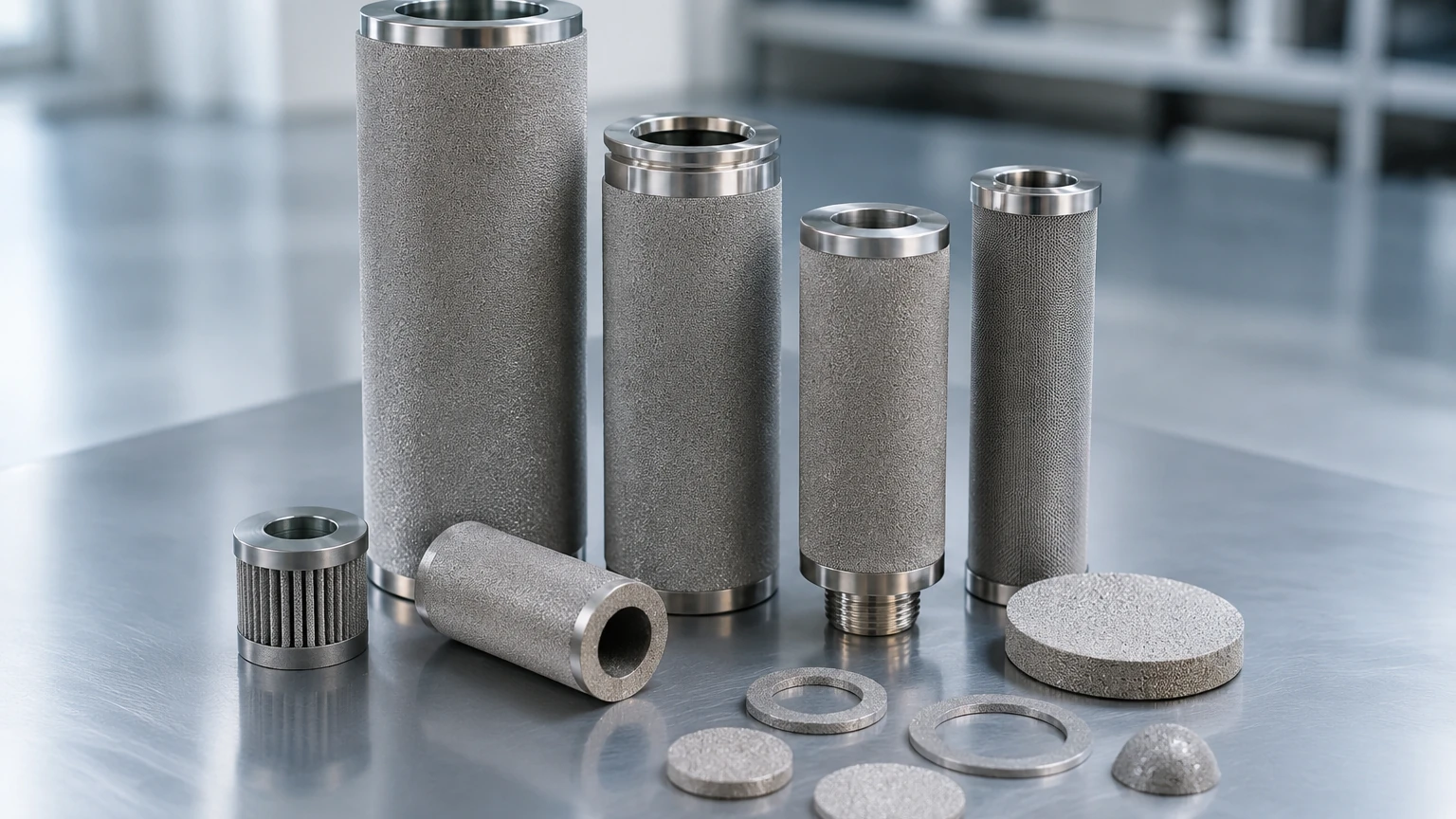
Sintered filters can be manufactured in various shapes, including cylinders, discs, cones, and flat plates. For OEM applications, the filter can be designed to fit within existing spatial constraints, often eliminating the need for bulky external housings. Custom end caps, flanges, and support cores can be welded directly to the sintered media to create a unified, high-strength component.
Multilayer Laminates
For applications requiring both fine filtration and high mechanical strength, engineers can specify multilayer sintered mesh. For example, a 5-layer structure might include a fine filtration layer protected by coarser mesh layers on both sides, with a heavy-duty support layer at the base. This configuration provides the necessary rigidity for high-pressure backwashing.
Prototyping and Technical Support
When developing new equipment, working with a partner that offers technical guidance on pore size selection and material compatibility is vital. For those looking to explore custom designs, the Main Page provides a starting point for collaborating on specific engineering requirements.
Maintenance and Cleaning Protocols for Extended Service Life
One of the primary economic justifications for investing in stainless steel sintered filters is their cleanability. Unlike disposable filters, which represent a recurring cost and a waste stream, sintered filters can be restored to near-original performance levels through various cleaning methods.
Backwashing and Backpulsing
In liquid and gas systems, backwashing involves reversing the flow through the filter to dislodge accumulated solids from the surface. This is particularly effective for sintered wire mesh filters used in continuous flow processes. Backpulsing uses a sudden burst of high-pressure gas to achieve a similar result in gas filtration systems.
Ultrasonic Cleaning
For filters with deep-seated contaminants, such as sintered powder filters, ultrasonic cleaning is highly effective. The filter is submerged in a cleaning solvent, and high-frequency sound waves create cavitation bubbles that implode, stripping away particles from the internal pores of the media.
Chemical and Thermal Cleaning
In cases where the contaminants are organic or polymeric, chemical cleaning (using caustic or acidic solutions) or thermal cleaning (burn-off) may be employed. Because the stainless steel is resistant to these harsh treatments, the filter can be cleaned multiple times without losing its filtration efficiency. It is important to monitor the "bubble point" of the filter after multiple cleaning cycles to ensure that the pore structure has not been damaged.
Conclusion: Making Informed Purchasing Decisions
Stainless steel sintered filters are a critical investment for any industrial operation where reliability and precision are non-negotiable. By understanding the differences between powder and mesh media, the importance of absolute vs. nominal ratings, and the benefits of custom OEM designs, engineers can ensure they select a solution that optimizes performance while minimizing long-term costs.
When evaluating a supplier, technical professionals should confirm the manufacturer's ability to provide material certifications, pressure test data, and customization support. Kaifil’s commitment to quality and durability ensures that every filtration component is built to meet the demanding requirements of modern industry. For a comprehensive look at available filtration solutions and to discuss your specific project needs, please visit the Main Page and review our product options and application support.
